The Machine That Does What No Other Machine Can: Turns Stones Into Soil
An agricultural stone crusher is a tractor-mounted implement that pulverizes stones, rocks, and boulders embedded in the soil into fine fragments — typically under 50 mm — in a single pass. Unlike rock rakes that move stones to windrows, rock pickers that collect stones into bins, or rotavators that bury stones beneath the surface, a stone crusher permanently destroys the stone. The material that was once a 300 mm boulder becomes gravel-sized particles that are mixed into the soil profile, improving drainage and adding mineral content without ever reappearing on the surface.
Stone crushers are used in agriculture (preparing stony land for high-value crops like potatoes), construction (clearing sites, recycling rubble), forestry (clearing stumps and rocky ground for replanting), and land reclamation (converting abandoned quarries or rock fields into productive land). In every application, the core value is the same: the stones are gone — permanently — and the land is transformed from rocky and unworkable into smooth, tillable, and productive.
This guide explains how a stone crusher works at the mechanical level, what components determine its performance, what types exist, and how to select the right one for your application.
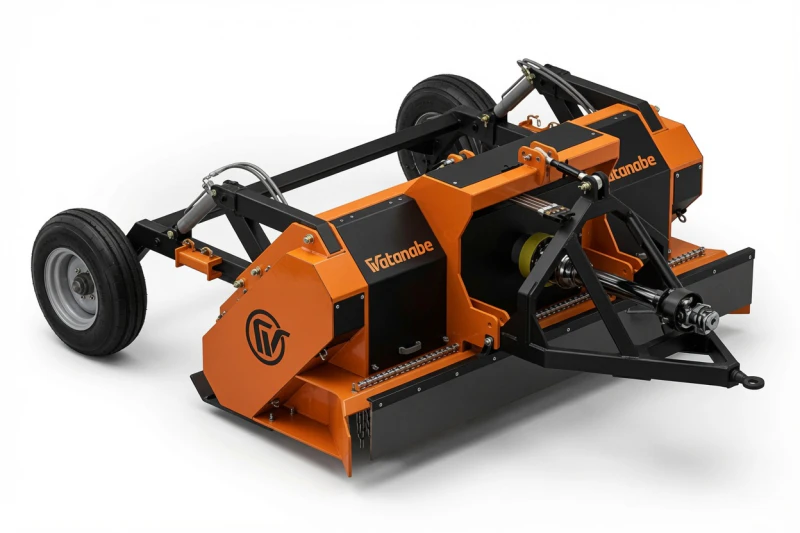
How a Stone Crusher Works: The Core Mechanism
At its heart, an agricultural stone crusher is a high-speed rotating drum fitted with replaceable hardened steel or tungsten carbide tools (teeth, hammers, or picks) that strike stones with enough kinetic energy to shatter them. The drum is housed inside a heavy steel casing that contains the fragments and directs the crushed material back into the soil. The entire assembly is mounted on a tractor’s three-point hitch or drawbar and powered by the tractor’s PTO (power take-off) shaft.
The process unfolds in a continuous sequence as the tractor advances:
|
Stage 1: Penetration The front of the crusher housing, fitted with a depth-control skid or roller, presses into the soil surface. The rotating drum, positioned behind the penetration point, engages the soil at the set working depth — typically 15 to 40 cm depending on the model and application. The drum sinks into the ground, contacting both soil and embedded stones. |
|
Stage 2: Impact and Fracture As the drum rotates at high speed (typically 800 to 1,200 RPM depending on the model and stone type), the tools mounted on its surface strike embedded stones with enormous kinetic energy. The impact shatters the stone along its natural fracture lines. Larger stones may require multiple tool strikes as successive teeth hit different points on the same stone during a single drum revolution. The drum’s rotational energy is the crushing force — there is no hydraulic press or jaw mechanism as in quarry crushers. |
|
Stage 3: Secondary Crushing and Sizing Fragments from the initial fracture are thrown upward by the drum rotation and hit the interior walls and counter-bars of the crusher housing. This secondary impact further reduces the fragment size. The gap between the drum and the rear housing wall acts as a sizing control — fragments must be small enough to pass through this gap to exit the machine. Adjusting this gap changes the maximum output fragment size. |
|
Stage 4: Reintegration Crushed fragments and the processed soil are deposited behind the machine as it advances. The result is a smooth, stone-free surface where the fragments are mixed into the soil profile — adding mineral content and improving drainage without creating surface debris. A rear roller or leveling bar (depending on model) compacts and smooths the output for an even finish. |
Key Components: What Determines Crusher Performance
| Rotating drum | The core component. A heavy steel cylinder, precision-balanced, mounted on high-capacity bearings. Drum diameter determines the maximum stone size that can be engaged. Drum width determines the working width per pass. The drum must withstand extreme impact forces from striking hard rock thousands of times per minute. |
| Crushing tools (teeth/picks) | Replaceable tools bolted to the drum surface in a spiral or staggered pattern. The tool material determines wear life: hardened steel tools are economical but wear faster on hard rock; tungsten carbide tools last 3 to 5 times longer and maintain their cutting edge, making them the professional choice for heavy-duty and abrasive stone types. Tool replacement is the primary ongoing maintenance cost. |
| Housing / casing | The heavy steel enclosure surrounding the drum. Contains fragments, directs material flow, and houses the counter-bars for secondary crushing. Must be made from wear-resistant steel (Hardox or equivalent) to withstand constant abrasion from flying rock fragments. |
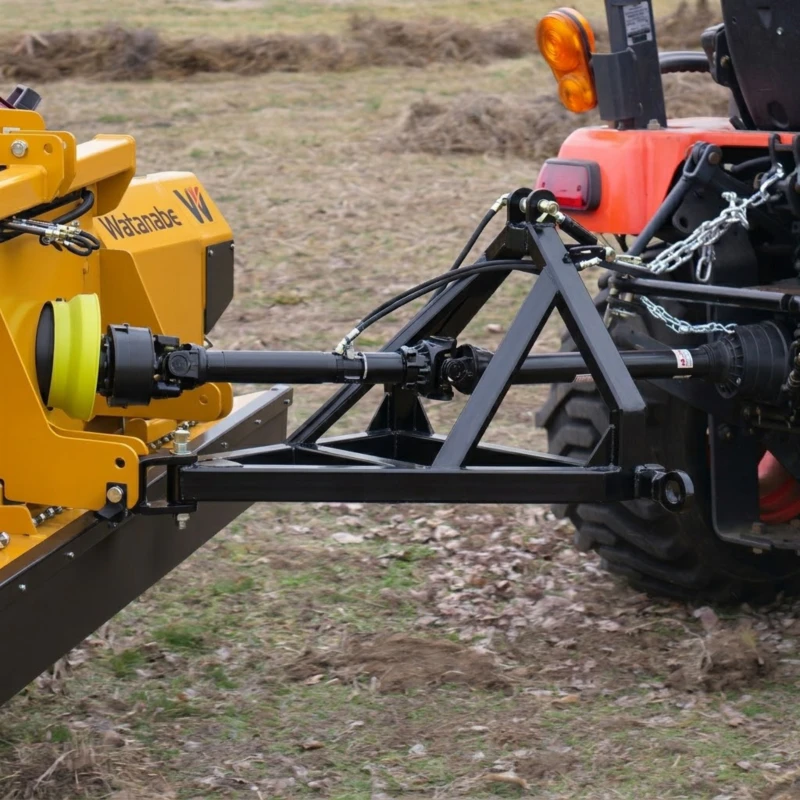
| Drive system | PTO-driven through a heavy-duty gearbox and belt or chain system. The drive must transmit the tractor’s full PTO power to the drum while absorbing the shock loads from stone impacts. Belt-drive systems provide a degree of shock absorption that protects the tractor’s PTO shaft from peak impact forces. |
| Depth control | Skids, rollers, or adjustable support legs that set and maintain the working depth. Consistent depth control ensures the drum engages stones at the correct level across uneven terrain — too shallow misses deep stones; too deep wastes power on non-productive soil volume. |
| Three-point hitch / drawbar | The mounting system that attaches the crusher to the tractor. Three-point hitch mounting (Cat II or III) is standard for most models. A drawbar kit option allows conversion to trailed configuration for use with larger tractors or on-road transport between sites. |
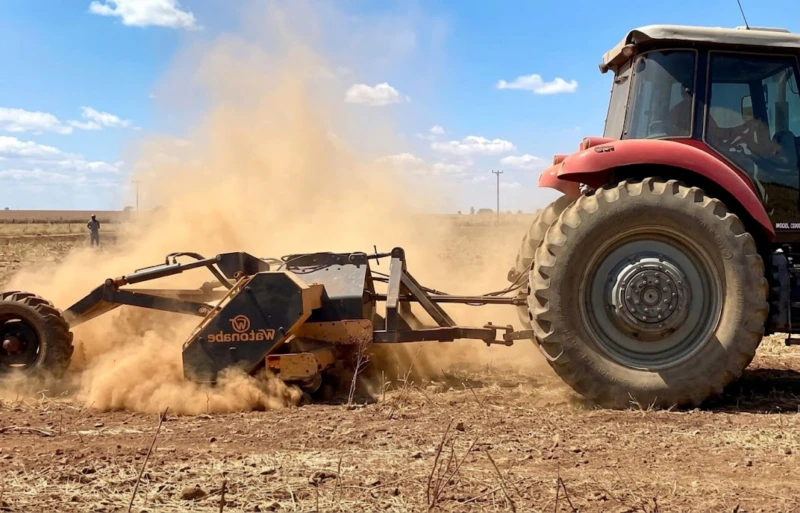
The Stone Management Spectrum: Where Crushers Fit
Stone crushers are one of four machine types used to manage stones on agricultural land. Each addresses the problem differently:
| Machine Type | Action | Stones Gone? | Permanent? | HP |
|---|---|---|---|---|
| Rock Rake (EW-4000) | Windrows surface stones for collection | No — relocated, not destroyed | No — new stones surface with tillage | 75 |
| Rock Picker (CT-2100) | Collects stones into onboard bin | Yes — removed from field | Partially — deep stones remain | 95 |
| Rotavator (PSW-3200) | Buries stones below tillage depth | No — hidden, not removed | No — deep ploughing resurfaces them | 160 |
| Stone Crusher (THOR) | Pulverizes stones into fragments | Yes — permanently destroyed | Yes — fragments never reform | 180-300 |
Each machine has its role. Rock rakes and pickers are lower-cost, lower-power options for surface stone clearance. Rotavators bury stones for short-term improvement. But only a stone crusher provides a permanent, one-time solution — the stone is destroyed at the molecular level and cannot return. For high-value crop production (potatoes, vegetables, seed crops) and permanent land improvement, crushing is the definitive treatment. For a detailed comparison, see: Rock Rake vs. Rock Picker vs. Stone Crusher: Which One Do You Need?
Specifications That Matter When Choosing a Stone Crusher
|
Working Width Determines the area covered per pass. Wider machines (2.4 to 3.0 m) cover more ground per hour, reducing total treatment time. The working width must match the tractor’s power — wider drums require more energy to drive. Choose width based on the available tractor power and the total area to be treated. |
|
Working Depth How deep the drum penetrates the soil to reach embedded stones. Typical range: 15 to 40 cm. Deeper working depth reaches more stones but requires more power. For potato production, a treatment depth of 25 to 35 cm is usually sufficient because the ridge zone rarely exceeds this depth. For land reclamation with deeply embedded boulders, maximum depth may be required. |
|
Maximum Stone Size The largest stone diameter the crusher can process in a single pass. This depends on drum diameter and tool arrangement. Most agricultural crushers handle stones up to 400 to 500 mm diameter. Larger boulders may require a second pass or pre-treatment (breaking with a breaker attachment before crushing). |
|
Output Fragment Size The maximum size of crushed fragments leaving the machine. Typically 20 to 50 mm for agricultural applications. Smaller output requires more energy (slower forward speed or multiple passes). For potato production, under 50 mm is sufficient — fragments of this size pass through harvest sieve webs without damaging tubers. Adjustable via the rear housing gap on most models. |
|
Tractor Power Requirement Stone crushing is the most power-intensive agricultural operation per meter of working width. Typical requirements: 180 to 300+ hp depending on working width, depth, stone density, and stone hardness. A well-matched tractor-crusher combination ensures the drum maintains sufficient rotational speed for effective fracture — underpowered tractors cause the drum to stall or produce oversized fragments. |
|
Tool Material Tungsten carbide tools are the professional standard — they maintain cutting edges 3 to 5 times longer than hardened steel, crush harder rock types effectively, and reduce the frequency of tool replacement stops. For detailed comparison, see: Tungsten Carbide vs. Hardened Steel: Which Tool Material Lasts Longer? (coming soon). |
.webp "Before and After: How a Stone Crusher Transforms Rocky Ground")
The THOR Stone Crusher Range
| Spec | THOR 2.4 | THOR 3.0 |
|---|---|---|
| Working Width | 2.4 m | 3.0 m |
| Working Depth | Up to 40 cm | |
| Max. Stone Diameter | Up to 500 mm | |
| Min. Tractor Power | 180 hp | 250 hp |
| Tool Material | Tungsten carbide (standard) | |
| PTO Speed | 1,000 RPM | |
| Drawbar Kit | Optional (converts to trailed configuration) | |
| Best For | Standard farms, 180-250 hp tractors | Large-scale, contractors, 250+ hp |
Common Applications
|
Potato and root crop land preparation Eliminating stones from the ridge zone prevents tuber bruising at harvest, reduces harvester damage, and enables precision planting. The highest-value application of stone crushing in agriculture. See: Preparing Stony Land for Potato Planting. |
|
New land development Converting rocky pasture, scrubland, or cleared forest into arable land. A single crushing pass transforms unworkable ground into tillable soil. See: The Complete Guide to Land Clearing Equipment. |
|
Construction site preparation Crushing rock and rubble on building sites, road corridors, and pipeline routes to create a workable subgrade without excavation and disposal. |
|
Forestry replanting Clearing stumps and rocky ground after timber harvest to prepare sites for replanting. The crusher processes both wood and rock, returning organic and mineral material to the soil. |
Frequently Asked Questions
|
Q1: How fast does a stone crusher work? Forward speed depends on stone density and hardness: 0.5 to 3 km/h is typical. On lightly stony ground, faster speeds are possible. On heavily stony or boulder-dense ground, slower speeds ensure complete crushing. Daily output ranges from 2 to 8 hectares depending on conditions and working width. |
|
Q2: What types of rock can a crusher handle? Agricultural stone crushers handle most common rock types: limestone, sandstone, shale, granite, basalt, flint, and mixed glacial deposits. Extremely hard rocks (dense granite, quartzite) require more power and cause faster tool wear but are still processable. The THOR’s tungsten carbide tools are designed for the hardest agricultural stone types. |
|
Q3: How often do the tools need replacing? Tool life depends on rock hardness and volume. Tungsten carbide tools on the THOR typically last 50 to 200+ hectares before replacement — varying widely with stone conditions. Tool replacement is a field operation (bolted fittings, standard tools) that takes 1 to 2 hours. Carry a spare set during extended crushing campaigns. |
|
Q4: Is crushing a one-time treatment or do I need to repeat it? One-time for the treatment depth. Stones that have been crushed are permanently destroyed and will not reform or reappear. However, if deeper ploughing subsequently brings untreated stones from below the crushed depth to the surface, a second treatment of the newly exposed stones may eventually be needed. For most operations, one treatment is sufficient for 10 to 20+ years. |
|
Q5: Can I hire a crusher instead of buying one? Yes. Many contractors offer stone crushing as a per-hectare service — practical for one-time land preparation. For farms with ongoing crushing needs (new fields, maintenance passes) or contractors building a service business, purchasing provides scheduling independence and lower per-hectare cost over time. |
|
Q6: Does crushing damage the soil structure? The crushing pass disturbs the soil in the treatment zone — similar to deep tillage. After crushing, a single pass with a cultivator or rotavator restores tilth. The crushed rock fragments actually improve soil structure by adding coarse particles that enhance drainage and reduce compaction in clay-heavy soils. |
|
Q7: How do I get a THOR quote or crushing service recommendation? Contact our team with your total area, stone density (light/moderate/heavy), rock type (if known), and tractor power. We will recommend the right THOR model, provide factory-direct pricing, and connect you with contractor services in your region if hiring is preferred. |
Stones Are a Problem. Crushing Is the Permanent Answer.
A stone crusher does what no other machine can: permanently destroys stones in the soil, transforming rocky, unproductive land into smooth, tillable, high-value farmland in a single pass. The THOR range delivers this capability with tungsten carbide tools, proven rotor design, and the lowest per-hectare treatment cost available. Factory-direct pricing, worldwide delivery.
|
THOR Quote 2.4 or 3.0 model pricing |
Site Assessment Stone density and model match |
Contractor Services Hire crushing in your region |