Too Little Power and the Machine Stalls. Too Much Power and You Waste Money. Here Is How to Get It Right.
Every implement in our range — from a 75 hp rock rake to a 250+ hp stone crusher — specifies a minimum tractor horsepower. This number is not arbitrary. It is the threshold below which the implement cannot operate at its designed speed, depth, and throughput. Run an implement on a tractor below the minimum HP and the result is stalling under load, overheating, excessive fuel consumption, premature driveline wear, and output quality that falls far short of the machine’s capability.
But the HP number on your tractor’s badge is not necessarily the HP available at the PTO or drawbar — where the implement actually consumes power. Drivetrain losses, altitude derating, accessory loads, and the difference between engine HP and PTO HP can reduce the usable power by 15 to 30 percent. A tractor rated at 200 engine HP may deliver only 150 to 170 PTO HP — and if the implement needs 180 PTO HP, the tractor is underpowered despite what the badge says.
This guide explains the calculation, the common traps, and provides a complete HP matching table for every product in our range.
The Critical Distinction: Engine HP vs. PTO HP
When a tractor manufacturer advertises “200 HP,” they typically mean engine horsepower — the power produced at the flywheel before any drivetrain losses. The power that actually reaches your implement through the PTO shaft is always lower, because energy is consumed by the transmission, hydraulic system, cooling fan, alternator, air conditioning, and other parasitic loads between the engine and the PTO output.
| HP Measurement Point | What It Means | Typical Loss From Engine HP |
|---|---|---|
| Engine HP (rated) | Power at the flywheel, clean test conditions | Baseline (0%) |
| PTO HP | Power delivered at PTO shaft | -10 to 20% (transmission + parasitic losses) |
| Drawbar HP | Power available to pull (draft) implements | -20 to 35% (transmission + tire slip + rolling resistance) |
Rule of thumb: PTO HP is approximately 80 to 90 percent of engine HP on most modern tractors. A tractor rated at 200 engine HP delivers approximately 160 to 180 PTO HP. When an implement specifies “minimum 180 HP,” it means 180 PTO HP — so you need a tractor rated at approximately 200 to 225 engine HP to deliver this at the PTO.
How to know your actual PTO HP: Many tractor manufacturers publish official PTO HP test results (e.g., Nebraska Tractor Test Laboratory data). These tests measure the actual power delivered at the PTO stub shaft under standardized conditions — the most reliable number for implement matching. If your tractor has been tested, use the published PTO HP, not the engine HP, for all implement matching calculations.
The Matching Formula: Minimum + Safety Margin
The correct tractor HP for any implement is not the minimum specification — it is the minimum plus a safety margin that provides reserve power for peak loads, difficult conditions, and altitude derating:
|
Step 1: Identify the implement’s minimum PTO HP requirement This is stated in the implement’s specification sheet. If the spec says “minimum 180 HP,” this means 180 HP at the PTO shaft — not engine HP. If the spec does not clarify, assume it means PTO HP (the standard in European agricultural equipment). |
|
Step 2: Add 15-20% safety margin The minimum HP keeps the implement running under ideal conditions (flat ground, average stone density, optimal soil moisture). Real-world conditions include hills, dense stone patches, wet clay, and worn engine conditions. A 15 to 20 percent margin above the minimum provides the reserve power to maintain performance without stalling. Formula: Required PTO HP = Implement Minimum × 1.15 to 1.20. |
|
Step 3: Convert PTO HP to engine HP Divide the required PTO HP by 0.85 (assuming 15% drivetrain loss) to find the minimum engine HP rating. Formula: Minimum Engine HP = Required PTO HP ÷ 0.85. This gives you the tractor badge rating to look for. |
|
Step 4: Adjust for altitude (if applicable) Naturally aspirated diesel engines lose approximately 3 to 4 percent power per 300 m (1,000 ft) of altitude above sea level. Turbocharged engines lose approximately 1.5 to 2 percent per 300 m. At 1,500 m altitude, a naturally aspirated engine loses 15 to 20 percent of its sea-level rating. Add this loss to your engine HP requirement if your farm is at significant altitude. |
Worked Example: Matching a Tractor to the THOR 2.4 Stone Crusher
| THOR 2.4 minimum PTO HP | 180 hp |
| + 15% safety margin | 180 × 1.15 = 207 PTO HP required |
| ÷ 0.85 (PTO-to-engine conversion) | 207 ÷ 0.85 = 244 engine HP minimum |
| Altitude adjustment (1,000 m, turbocharged) | 244 × 1.05 = 256 engine HP at altitude |
| Recommendation (at sea level) | Tractor rated 240-260 engine HP |
| Recommendation (at 1,000 m altitude) | Tractor rated 255-280 engine HP |
.webp "Correctly Matched: THOR 2.4 on a 250 HP Tractor With Full Power Reserve")
What Happens When the Match Is Wrong
|
Underpowered Tractor Engine lugging: The engine drops below its efficient RPM range, reducing PTO speed and implement performance. A stone crusher that needs 1,000 RPM PTO runs at 700 to 800 RPM — producing larger fragments and incomplete crushing. Overheating: The engine runs at maximum load continuously, generating excess heat. Coolant temperature climbs toward the red zone. Extended overheating damages head gaskets, warps cylinder heads, and degrades engine oil. Stalling: On heavy stone concentrations, the implement’s resistance exceeds the tractor’s available torque. The engine stalls — stopping the PTO mid-cycle. Repeated stalling damages the PTO clutch, driveline universal joints, and implement gearbox. Excessive fuel consumption: Running an engine at maximum load continuously is the least fuel-efficient operating point. Paradoxically, an underpowered tractor uses more fuel per hectare than a correctly sized tractor — because it takes longer and works harder to achieve the same result. |
Overpowered Tractor No performance risk: An overpowered tractor operates the implement perfectly — the implement receives its required power with headroom to spare. There is no mechanical risk from having too much power available. Higher capital cost: A 350 HP tractor costs substantially more to purchase than a 250 HP tractor. If the implement only needs 250 HP, the extra 100 HP represents unused capital that earns no additional return on this implement. Higher operating cost: Larger engines burn more fuel at idle and light load. However, when running the implement, the engine operates at a lower percentage of its maximum capacity — which is actually more fuel-efficient per hour of work than a perfectly matched smaller engine at 100 percent load. Verdict: Slightly overpowered (15-25 percent above minimum) is the optimal zone — adequate reserve without excessive capital waste. Significantly overpowered (50+ percent above minimum) wastes money but does not harm the implement. |
Complete HP Matching Table: Our Full Product Range
| Sản phẩm | Min. PTO HP | Recommended Engine HP | PTO | Hitch |
|---|---|---|---|---|
| EW-4000/T Rock Rake | 75 | 85-100 | 540 | II |
| CT-2100 Rock Picker | 95 | 110-130 | — | II |
| ERA-2100 Cultivator | 75 | 85-100 | 540 | II |
| PAI-2100 Planter | 75 | 85-100 | — | II |
| PANTHER 2-Row Planter | 85 | 100-115 | — | II |
| PANTHER 3-Row Planter | 100 | 115-135 | — | II/III |
| PANTHER 4-Row Planter | 125 | 145-170 | — | II/III |
| PAI-480-AR Planter | 140 | 160-185 | — | III |
| AWB-1600 Digger (base) | 75 | 85-100 | 540 | II |
| CWB-2L Harvester | 100 | 115-135 | 540 | II/III |
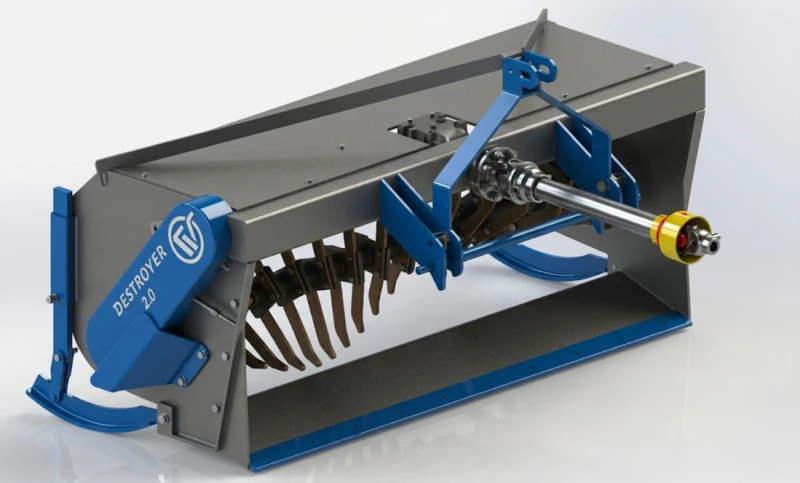
| DESTROYER 2.0 | 75 | 85-100 | 540 | II |
| DESTROYER 3.0 | 80 | 90-110 | 540 | II |
| PSW-3200 Rotavator | 160 | 185-215 | 1,000 | III |
| THOR 2.4 Stone Crusher | 180 | 210-260 | 1,000 | III |
| THOR 3.0 Stone Crusher | 250 | 290-340 | 1,000 | III |
| THOR ST Stabilizer | 180 | 210-260 | 1,000 | III |
Frequently Asked Questions
|
Q1: My tractor badge says 200 HP. How much reaches the PTO? Approximately 160 to 180 PTO HP on most modern tractors (80 to 90 percent of engine HP). Check the manufacturer’s published PTO test results for your exact model. For older tractors or those in less-than-perfect mechanical condition, assume the lower end of the range (80 percent). |
|
Q2: What if I am 10 HP below the minimum? The implement will work — but at reduced performance. You may need to reduce forward speed, reduce working depth, or accept that the implement cannot operate at full capacity in heavy conditions. Being 10 HP below minimum is manageable on light workloads but will cause problems on heavy stone, deep soil, or steep terrain. We do not recommend it for sustained professional use. |
|
Q3: Does using 4WD affect available PTO power? 4WD engagement adds a small parasitic load (the front axle drive consumes a few HP), but the effect is negligible for PTO-driven implements. The bigger benefit of 4WD is traction — on soft ground, 4WD prevents wheel slip that wastes engine power. For implements that combine PTO drive and draft (like rotavators and crushers), 4WD is strongly recommended to maintain forward progress without wheel slip. |
|
Q4: My farm is at 2,000 m altitude. How much HP do I lose? A turbocharged tractor at 2,000 m loses approximately 10 to 13 percent of sea-level power. A naturally aspirated tractor loses approximately 20 to 27 percent. At 2,000 m with a turbo engine, a 200 HP sea-level tractor delivers approximately 174 to 180 HP. Factor this into your matching calculation — you may need a larger tractor than the sea-level recommendation suggests. |
|
Q5: Can I use one tractor for all your implements? It depends on the range of implements. A 250 HP tractor with Cat III hitch, dual PTO (540 + 1,000 RPM), and adequate lift capacity can power every implement in our range — from the 75 HP DESTROYER (using only a fraction of available power) to the 250 HP THOR 3.0 (at full capacity). However, using a 250 HP tractor for a 75 HP implement is significantly overpowered and wastes capital. Most farms use 2 to 3 tractors of different sizes to match their implement range efficiently. |
|
Q6: How do I confirm the right tractor for my implement purchase? Contact our team with your tractor model, rated engine HP, PTO HP (if known), altitude, and the implement you are considering. We will confirm whether your tractor delivers adequate PTO power with the recommended safety margin and advise on any adjustments needed. |
Match the Power. Maximize the Performance.
The right tractor-implement match ensures full performance, safe operation, and optimal fuel efficiency. The wrong match wastes money — either through an implement that cannot reach its potential or a tractor that costs more than it needs to. Use the HP table above, apply the safety margin formula, and confirm with our team before ordering. Factory-direct pricing, worldwide delivery.
|
HP Compatibility Check Your tractor + our implement |
Equipment Quote HP-matched recommendation |
Dealer Inquiries Full product range |