A Simple Idea Is Transforming Dairy Housing Around the World
The dairy industry has housed cows the same way for decades: concrete cubicles (freestalls), rubber mats, steel divisions, and mechanical scraper systems that push slurry into collection tanks. This model works — but it comes with chronic problems that every dairy farmer recognizes: lameness from hard floors, hock injuries from cubicle divisions, mastitis from wet lying surfaces, restricted movement that suppresses natural behaviour, high building costs for the steel-and-concrete infrastructure, and substantial ongoing maintenance for scrapers, mattresses, and slurry systems.
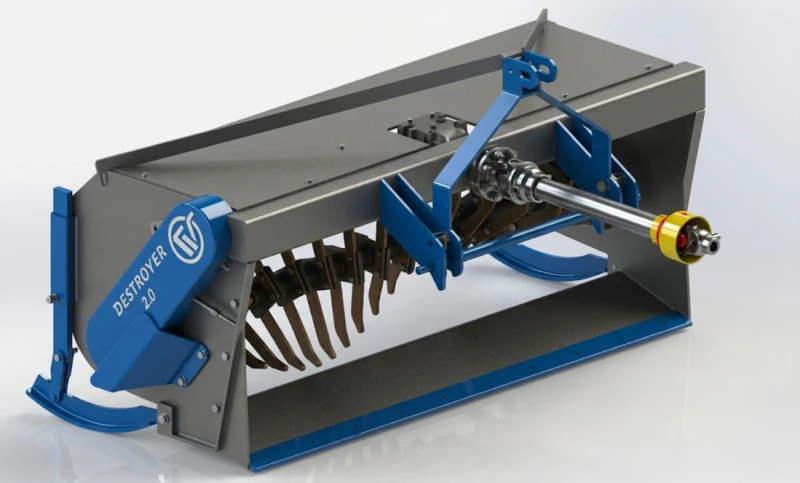
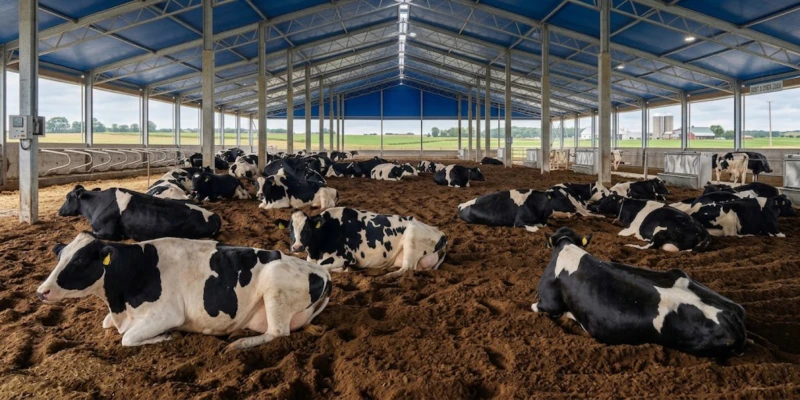
The compost bedded pack barn — often simply called a “compost barn” — replaces all of this with a single, open, deep-bedded pack of composting organic material where cows lie, walk, and rest freely. No cubicles, no steel divisions, no scrapers, no rubber mats. Just a deep bed of composting sawdust, wood shavings, or other carbon-rich material that is mechanically stirred twice daily to maintain aerobic decomposition, control moisture, and produce a warm, dry, comfortable surface.
What started as a niche concept in Minnesota and Kentucky in the early 2000s has become a global movement. Compost barns are now operating on every continent — from Brazil (the world’s largest adopter) to the Netherlands, from Turkey to New Zealand, from China to South Africa. This article examines why compost barns are spreading, what problems they solve, and what equipment makes the system practical.
Why Compost Barns Are Spreading: The 5 Problems They Solve
|
1. Lameness — The Dairy Industry’s Biggest Welfare and Economic Problem Lameness affects 20 to 35 percent of dairy herds in conventional cubicle housing. Concrete floors abrade hooves. Standing on hard surfaces for 18+ hours per day causes sole ulcers and white line disease. Cubicle design flaws create awkward rising and lying movements that injure hocks and knees. Compost barn solution: The deep, soft composting bed eliminates concrete contact entirely. Cows walk, stand, and lie on a surface with the consistency of soft garden soil. Lameness rates in well-managed compost barns consistently fall below 5 percent — a 70 to 85 percent reduction compared to cubicle housing. For the detailed data, see: Compost Barn vs. Freestall: A Complete Comparison. |
|
2. Mastitis and Somatic Cell Count (SCC) Mastitis — udder infection — is driven by bacterial exposure during lying. Wet, dirty cubicle mattresses and inadequate bedding are primary risk factors. In conventional housing, managing SCC (the mastitis indicator used by milk buyers) is a constant battle requiring antibiotic treatment, teat dipping, bedding management, and culling of chronically infected cows. Compost barn solution: The aerobic composting process generates internal temperatures of 40 to 60°C in the active composting zone — hot enough to suppress pathogenic bacteria (E. coli, Klebsiella, Streptococcus) that cause mastitis. Combined with the dry surface produced by twice-daily stirring, compost barns consistently achieve SCC levels 20 to 40 percent lower than cubicle housing. See: How Compost Barns Reduce Mastitis and Lower SCC. |
|
3. Cow Comfort and Natural Behaviour In cubicle housing, every cow is confined to a fixed-size stall that may not match her body size. She can only lie in one orientation. She cannot stretch, groom freely, or choose her resting position. Social interactions are restricted by steel divisions. Compost barn solution: The open pack allows cows to lie anywhere, in any orientation, next to any companion they choose. They stretch, groom, socialise, and rest naturally. Lying times increase from 10 to 12 hours per day (cubicles) to 12 to 14 hours per day (compost barn) — a direct indicator of comfort. More lying time correlates with higher milk production and lower stress hormones. |
|
4. Building Cost and Complexity Cubicle barns require precision-placed concrete foundations, steel cubicle frames, rubber mattresses, mechanical scrapers, slurry channels, and collection tanks — all of which must be designed for the specific cow size, stocking density, and slurry management system. The building is expensive, complex, and difficult to modify or expand. Compost barn solution: A compost barn is fundamentally a covered open space with a compacted earth floor covered by 40 to 80 cm of composting bedding material. No cubicle frames, no scrapers, no slurry channels, no rubber mattresses. Building cost is typically 20 to 40 percent lower than equivalent cubicle housing. Existing buildings (old sheds, former machine halls) can be converted to compost barns with minimal structural modification. |
|
5. Fertilizer Value of Composted Bedding Cubicle slurry is a liquid waste that requires storage, agitation, and application equipment — and its nutrient content per tonne is relatively low due to dilution with wash water. It smells, attracts flies, and must be stored in sealed tanks to prevent environmental contamination. Compost barn solution: The composted bedding is a solid, crumbly, nearly odourless material with concentrated nutrient content — a high-value organic fertilizer. It is easy to store (open heap), easy to spread (standard manure spreader), and easy to incorporate into soil. Many compost barn operators report that the fertilizer value of the composted bedding partially or fully offsets the cost of the fresh bedding material. |
Global Adoption: Where Compost Barns Are Growing Fastest
| Region | Driver | Scale |
|---|---|---|
| Brazil | Hot climate, lower building cost, rapid dairy expansion, cow comfort in heat | Thousands of farms — the world’s largest compost barn market by farm count |
| Turkey | Government dairy modernization programs, welfare regulations, hot summers | Rapidly growing — hundreds of new barns per year |
| Netherlands / Northern Europe | Animal welfare legislation, consumer pressure, environmental regulations | Growing — premium milk programs reward compost barn welfare standards |
| Middle East / North Africa | Extreme heat stress, need for cow comfort in 40°C+ climates | Emerging — dairy intensification creating demand for heat-stress solutions |
| China | Massive dairy expansion, environmental regulation, welfare awareness | Growing rapidly — large-scale farms adopting compost barns for 500+ cow herds |
| Southern Africa | Lower building cost, available bedding, emerging dairy sectors | Early adoption — strong growth potential as dairy sectors mechanize |
The Critical Success Factor: Mechanical Stirring
A compost barn without stirring is just a deep litter barn — and deep litter barns fail. Without mechanical stirring, the bedding compacts under cow traffic, anaerobic zones develop (producing ammonia, methane, and pathogens), surface moisture rises (increasing mastitis risk), and the composting process stalls. The bedding becomes a wet, cold, anaerobic mat — the opposite of the warm, dry, aerobic surface that makes compost barns work.
Twice-daily stirring is the non-negotiable management practice that separates a successful compost barn from a failed deep litter experiment. The stirrer breaks the surface crust, introduces oxygen to restart aerobic decomposition, redistributes moisture from the surface to drier layers below, and fluffs the material to maintain the soft, comfortable lying surface. See: Stirring Depth: 30 cm vs. 80 cm — What Science and Practice Tell Us.
|
Without Stirring (or Poor Stirring) Surface compacts and seals → anaerobic zones form → ammonia and odour increase → surface stays wet → bacteria multiply → mastitis risk rises → cow comfort drops → lying time decreases → lameness increases → milk yield drops. This is why makeshift stirring with a bucket or cultivator fails — insufficient depth and mixing quality to maintain the composting process. |
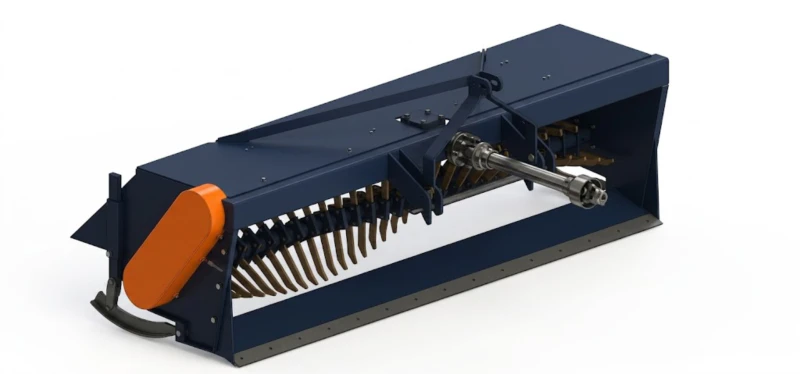
With Proper Stirring (DESTROYER) Surface broken and fluffed → oxygen introduced → aerobic composting resumes → internal heat reaches 40-60°C → pathogens suppressed → surface dries → cow comfort maximized → lying time 12-14 hours → lameness below 5% → SCC drops → milk yield maintained or increased. The DESTROYER 2.0/3.0 achieves 30 to 80 cm stirring depth with a PTO-driven rotor — the correct depth for full-pack aeration. |
The Equipment That Makes It Practical: DESTROYER 2.0 and 3.0
| Specification | DESTROYER 2.0 | DESTROYER 3.0 |
|---|---|---|
| Working width | 2.0 m | 3.0 m |
| Stirring depth | 30 to 80 cm (adjustable) | |
| Min. tractor HP | 75 hp | 80 hp |
| PTO speed | 540 RPM | |
| Hydraulics required | Zero — pure PTO mechanical drive | |
| Weight | 460 kg | 660 kg |
| Hitch | Cat II three-point | |
| Stirring time (500 m² barn) | ~15 minutes | ~10 minutes |
The DESTROYER’s zero-hydraulic, PTO-only design is specifically engineered for the compost barn’s unique demand: twice daily, 365 days per year, with no tolerance for breakdown. No hydraulic hoses to leak in the barn. No hydraulic fluid to contaminate bedding if a seal fails. No hydraulic pump to overheat in the warm barn environment. Just a direct mechanical drive from the tractor’s PTO to the stirring rotor — the simplest, most reliable architecture for the world’s most demanding daily-use application. See: Why Maintenance-Free Equipment Design Is the Future.
.webp "Twice Daily, 365 Days: DESTROYER Keeps the Composting Process Active")
Getting Started: What You Need for a Compost Barn
|
Space: 10 to 15 m² per cow (lying area only) More space per cow than cubicle housing (6 to 8 m²), but the space is simpler and cheaper to build. A covered open area with compacted earth floor and adequate ventilation is sufficient. Existing buildings can be converted by removing cubicle hardware and adding bedding depth. |
|
Bedding material: Sawdust, wood shavings, or other dry carbon source Initial fill: 40 to 60 cm depth across the entire lying area. Ongoing: 1 to 3 m³ per cow per month of fresh material to replace composted volume and maintain depth. Sawdust availability and cost are the primary feasibility factor in most regions. |
|
Stirring equipment: DESTROYER 2.0 or 3.0 The essential management tool. Stir twice daily while cows are at milking. The DESTROYER mounts on any 75+ hp tractor with Cat II hitch and 540 RPM PTO — the same tractor used for other farm tasks. Stirring a 500 m² barn takes 10 to 15 minutes per session. |
|
Tractor: 75 to 80 hp, compact enough for barn operation The tractor must fit through the barn’s entry width and manoeuvre within the lying area. Standard utility tractors (75 to 100 hp) work well. The DESTROYER’s light weight (460 to 660 kg) means even compact tractors carry it without ballast issues. |
For the complete startup guide, see: How to Start a Compost Barn: Equipment, Bedding, and Management.
Frequently Asked Questions
|
Q1: Does a compost barn increase milk production? Many farms report a 5 to 15 percent yield increase after switching to compost barns — driven by increased lying time, reduced stress, lower lameness, and improved overall cow health. The yield increase alone often covers the bedding material cost. However, results vary with management quality: a well-stirred compost barn outperforms cubicles; a poorly managed one does not. |
|
Q2: Is compost barn bedding expensive? Bedding cost depends on local sawdust/shavings availability. In regions with active timber industries, sawdust is inexpensive and abundant. In regions without local sawdust supply, alternative materials (rice hulls, coffee husks, dried manure solids) can work. The bedding cost is partially or fully offset by reduced cubicle maintenance, reduced lameness treatment, lower SCC-related milk penalties, and the fertilizer value of the composted output. |
|
Q3: Can I convert an existing barn to a compost barn? Yes — and this is one of the strongest economic arguments. Remove the cubicle frames, scrapers, and mattresses from an existing building. Level the floor, add 40 to 60 cm of sawdust, purchase a DESTROYER stirrer, and begin. Conversion cost is a fraction of new-build cubicle housing. The removed cubicle hardware has scrap value that further reduces net conversion cost. |
|
Q4: Do compost barns work in cold climates? Yes. The composting process generates internal heat (40 to 60°C in the active zone), which keeps the lying surface warm even in sub-zero ambient temperatures. Cows on a warm compost bed in winter are more comfortable — and produce more milk — than cows on cold concrete in a cubicle barn. Adequate ventilation remains important to manage moisture in winter. |
|
Q5: What size DESTROYER do I need? The DESTROYER 2.0 (2.0 m width, 75 hp, 460 kg) suits barns up to approximately 800 m² or herds up to 60 to 80 cows. The DESTROYER 3.0 (3.0 m width, 80 hp, 660 kg) covers larger barns faster — recommended for herds above 60 cows or barns exceeding 800 m². For multi-barn operations, one DESTROYER can serve multiple barns sequentially. |
|
Q6: How do I get started? Contact our team with your herd size, existing barn dimensions (or new-build plan), available bedding material, and tractor HP. We will recommend the right DESTROYER model, provide factory-direct pricing, and share compost barn startup guidance based on operations running our equipment worldwide. |
The World’s Best Dairy Farmers Are Choosing Compost Barns. Here Is How to Join Them.
Lower lameness, lower SCC, lower building cost, higher cow comfort, higher milk yield, and valuable composted fertilizer as a by-product. The compost barn is not just a housing system — it is a complete upgrade to the economics and welfare performance of your dairy operation. The DESTROYER 2.0/3.0 makes it practical — zero hydraulics, PTO-only reliability, 10 to 15 minutes per stirring session, 365 days per year. Factory-direct pricing, worldwide delivery.
|
DESTROYER Quote 2.0 or 3.0, factory-direct |
Compost Barn Startup Guide Building, bedding, management |
Dealer Opportunities Growing global market |
Contact Us — Start Your Compost Barn With the Right Equipment