You Are Probably Buying 20-40% More Fertilizer Than Your Crop Can Use
Fertilizer is the largest input cost on most arable farms after seed — and it is also the input where the most money is wasted. The waste does not come from buying the wrong product or applying the wrong nutrient. It comes from where the fertilizer is placed. Broadcasting spreads fertilizer uniformly across the entire field surface — including the 40 to 50 percent of the surface area between rows where no crop roots exist. Every granule that lands in the inter-row space contributes nothing to yield. It leaches into groundwater, feeds weed growth, and appears on the invoice as a cost without a return.
Precision fertilizer application — specifically banded placement — eliminates this waste by delivering 100 percent of the fertilizer into a narrow band within the active root zone. The crop receives the same nutrient supply (or more, because the concentration is higher at the root), but the total amount of product purchased, transported, and applied drops by 20 to 40 percent. The saving is not from applying less nutrient — it is from stopping the waste of nutrient that was never reaching the plant.
This article quantifies the saving, explains the science, and identifies the equipment that makes precision application practical for every farm size.
The Science: Why Placement Matters More Than Quantity
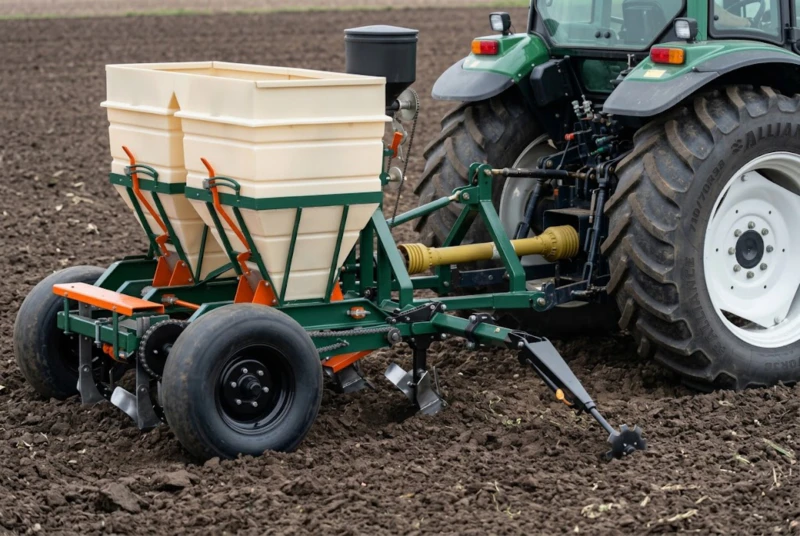
Plant roots do not forage across the entire soil volume equally. In row crops like potatoes, the active root zone — where 80 to 90 percent of nutrient uptake occurs — is concentrated in a zone approximately 10 to 15 cm either side of the plant row and 5 to 25 cm below the soil surface. This is where the root density is highest, where root hairs are most active, and where nutrient uptake is fastest.
|
Broadcasting: Fertilizer Everywhere Fertilizer is spread uniformly across the entire surface — row zone AND inter-row zone. At 75 cm row spacing, the active root zone covers approximately 30 cm of the 75 cm row width — about 40 percent. The remaining 60 percent of the fertilizer lands in the inter-row space where root density is minimal. Result: Only 40 to 60 percent of the applied fertilizer is within immediate root access. The rest must migrate laterally through the soil to reach roots (slow, distance-dependent) or is lost to leaching, fixation, and weed uptake before the crop can access it. |
Banding: Fertilizer in the Root Zone Only Fertilizer is placed in a concentrated band 5 to 10 cm from the seed piece, at 8 to 15 cm depth — directly within the highest root density zone. 100 percent of the applied fertilizer is immediately accessible to the developing root system. Result: The same nutrient supply to the plant is achieved with 20 to 40 percent less total product — because none is wasted on non-productive soil. Additionally, the higher local concentration around the roots can stimulate early root proliferation and faster early growth. |
The efficiency difference is especially dramatic for phosphorus — the most immobile major nutrient. Broadcast phosphorus moves less than 2 cm laterally through most soils. If it lands 20 cm from the nearest root, it stays there — locked in the soil, unavailable to the crop, and wasted. Banded phosphorus placed 5 cm from the seed piece is accessed by roots within days of emergence. This is why phosphorus banding consistently shows the largest yield response of any nutrient placement improvement. See: Banded vs. Broadcast Fertilizer for Potatoes.
The Economics: What 20-40% Saving Looks Like on Real Farms
| Metric (100 ha potato farm) | Broadcast | Banded (25% saving) | Banded (40% saving) |
|---|---|---|---|
| NPK application rate | 1,000 kg/ha | 750 kg/ha | 600 kg/ha |
| Total fertilizer purchased (100 ha) | 100,000 kg | 75,000 kg | 60,000 kg |
| Fertilizer saved per year | — | 25,000 kg | 40,000 kg |
| Transport savings (fewer truck loads) | — | 1 fewer truck load | 1-2 fewer truck loads |
| Yield impact | Baseline | Equal or higher (+5-10%) | Equal or higher (+5-10%) |
| Net economic benefit | Baseline | 25-40% input cost saving + 5-10% yield gain = double benefit | |
The double benefit: Banded application does not just save fertilizer — it often increases yield simultaneously, because the higher nutrient concentration in the root zone accelerates early root and canopy development. Less fertilizer, more yield. The savings fund the banding equipment; the yield increase is pure additional profit.
Beyond NPK: Precision Placement for Every Input
Banded placement is not limited to NPK fertilizer. The same precision principle applies to every input applied to the soil:
|
Insecticide (in-furrow at planting) The PANTHER and PAI planters apply granular or liquid insecticide directly into the planting furrow — placing the active ingredient in the soil zone where soil-dwelling pests (wireworm, potato cyst nematode) attack the seed piece. In-furrow placement uses 60 to 80 percent less active ingredient than broadcast incorporation for the same protection level. See: In-Furrow Insecticide at Planting. |
|
Lime (pH correction — targeted spreading) Soil pH varies across a field — some zones need lime, others do not. The DCW 2.2 Binder Spreader applies lime at a calibrated rate per linear metre, allowing rate variation as the tractor moves between soil zones. This prevents over-liming already-correct areas (which wastes lime and can raise pH above crop tolerance) while adequately treating acidic zones. See: How to Read a Soil Test Report. |
|
Starter fertilizer (at-planting, beside the seed) A concentrated dose of high-phosphorus fertilizer placed 5 cm from the seed tuber at planting provides immediate nutrient access to the emerging root system — eliminating the 2 to 3 week delay while roots grow out to find broadcast fertilizer. The PANTHER and PAI planters with integrated fertilizer hoppers deliver this starter dose in the same pass as planting — no additional field pass needed. |
The Dual-Band Strategy: Two Depths, Maximum Efficiency
The most advanced precision application strategy places fertilizer at two depths in two separate operations — each targeting a different growth phase:
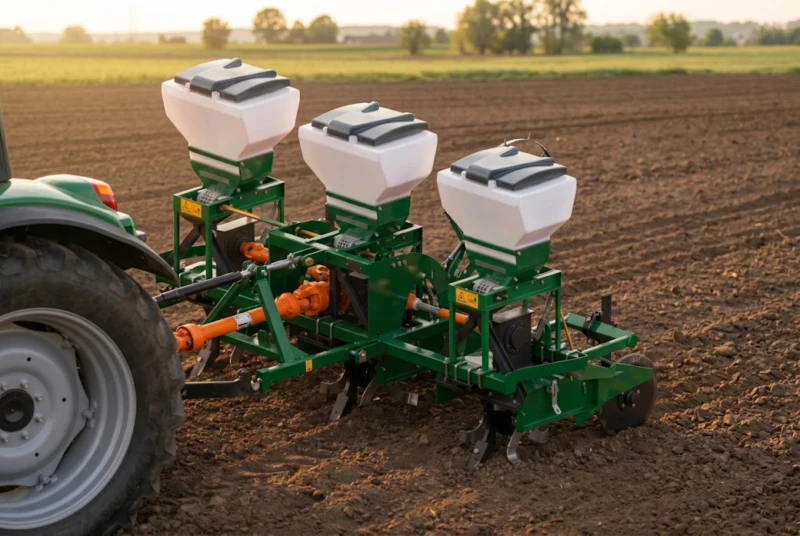
| Band 1: Base dressing (deep) | Applied 12 to 18 cm deep during seedbed preparation by the ERA cultivator or ADB-380/480 applicator. Contains 60 to 70 percent of total K₂O and a portion of N and P₂O₅. This deep band provides a nutrient reservoir that roots access during mid-season bulking when demand peaks. |
| Band 2: Starter dressing (shallow) | Applied 5 to 8 cm beside the seed tuber at planting by the PANTHER or PAI planter. Contains high phosphorus (for immediate root establishment) and a portion of N (for early canopy development). This shallow band feeds the plant during the critical first 4 to 6 weeks when root volume is limited. |
| Combined effect | The plant is fed from two sources simultaneously — shallow-early and deep-sustained — ensuring continuous nutrient availability from emergence through to maturity without any period of nutrient stress. This dual-band approach consistently outperforms single-band or broadcast application in yield trials by 5 to 15 percent. |
For the complete dual-band strategy, see: How Dual Fertilizer Application at Two Depths Improves Potato Yield.
Equipment for Precision Application: Our Complete Range
| ผลิตภัณฑ์ | Application Type | Band Depth | Best For |
|---|---|---|---|
| ERA Rotary Cultivator | Base dressing (banded) | 12-18 cm | 3-in-1 seedbed + fertilizer + ridge in one pass |
| ADB-380 (3-row) | Dedicated banding | 10-18 cm | Standalone banding pass — flexible timing |
| ADB-480 (4-row) | Dedicated banding | 10-18 cm | Higher throughput for 4-row operations |
| PAI-2100 Planter | Starter dressing at planting | 5-8 cm beside seed | Entry-level 2-row with fertilizer |
| PANTHER 2/3/4-Row | Starter dressing at planting | 5-8 cm beside seed | Large hopper capacity for extended runs |
| PAI-480-AR | Dual-band (both depths) | Deep + beside seed | Complete dual-band in single planting pass |
| DCW 2.2 Spreader | Agricultural lime (pH correction) | Surface | Calibrated lime spreading for soil pH management |
The Environmental Bonus: Less Fertilizer = Less Leaching
Precision application is not just an economic strategy — it is an environmental strategy. Reducing total fertilizer applied by 20 to 40 percent directly reduces the nutrient load entering groundwater and waterways through leaching and run-off. This matters increasingly as governments worldwide tighten environmental regulations on agricultural nutrient use:
|
Nitrogen leaching reduction Banded nitrogen stays concentrated in the root zone where plant uptake is fastest — reducing the window during which dissolved nitrate is vulnerable to leaching. Broadcast nitrogen spread across the surface has more area exposed to rainfall percolation and longer travel distance to roots, resulting in higher leaching losses. |
|
Phosphorus run-off reduction Surface-applied broadcast phosphorus is vulnerable to run-off during rainfall events — particulate P attached to soil particles and dissolved P in surface water flowing to ditches and streams. Banded phosphorus placed at 10 to 18 cm depth is below the run-off zone entirely — virtually eliminating P loss to surface water. |
|
Regulatory compliance In many regions (EU Nitrates Directive, various national water quality regulations), farms face nutrient application limits expressed as maximum kg N/ha or maximum kg P₂O₅/ha. Precision application that achieves the same yield with 20 to 40 percent less total nutrient gives farms headroom within regulatory limits — or allows them to meet targets that would be impossible with broadcast application at the same yield level. |
Frequently Asked Questions
|
Q1: Will my yield drop if I reduce fertilizer by 20-40%? No — if the reduction comes from eliminating inter-row waste through banded placement. The crop receives the same nutrient concentration in its root zone. In most field trials, banded application at 60 to 75 percent of broadcast rates produces equal or higher yield — because the root-zone concentration is actually higher than broadcast, and early nutrient access is immediate rather than delayed. Only reduce rates based on banded efficiency, not arbitrarily. |
|
Q2: Can I band-apply organic fertilizer (manure, compost)? Granular organic fertilizer can be banded through any of our mechanical metering systems. Liquid slurry requires a different injection system (not covered by our current range). Composted manure from compost barns (see: How Compost Barns Change Dairy) can be broadcast as a base layer and supplemented with banded mineral fertilizer for the precision component — combining organic soil improvement with mineral precision nutrition. |
|
Q3: Is the ERA the only way to band base dressing? No — the ADB-380 and ADB-480 are dedicated banding applicators that can be used in a separate pass before planting. The ERA’s advantage is that it combines banding with seedbed preparation and ridge formation in a single pass — saving one or two additional field passes and their associated fuel, time, and compaction costs. See: ERA One-Pass Potato Bed Preparation. |
|
Q4: How quickly does banding equipment pay for itself? On a 100-hectare potato farm applying 1,000 kg/ha NPK, a 25 percent fertilizer saving equals 25,000 kg of fertilizer per year not purchased. At any reasonable fertilizer price, this saving exceeds the annual depreciation cost of the banding equipment within the first season. Payback is typically under 2 years — often within the first season for farms with high fertilizer consumption. |
|
Q5: Does this work for crops other than potatoes? Yes — banded fertilizer placement benefits any row crop where inter-row waste occurs: maize, sugar beet, carrots, onions, cotton, soybeans. The efficiency gain is proportional to the inter-row area wasted by broadcasting. At 75 cm row spacing (potatoes), the waste is approximately 60 percent; at 30 cm row spacing (narrow-row cereals), the waste is less — and the banding advantage is correspondingly smaller but still meaningful. |
|
Q6: How do I get started with precision fertilizer application? Contact our team with your current fertilizer programme (product, rate, method), crop type, and soil test results. We will recommend the equipment configuration that converts your broadcast programme to banded precision application — and calculate the expected saving for your specific situation. Factory-direct pricing, worldwide delivery. |
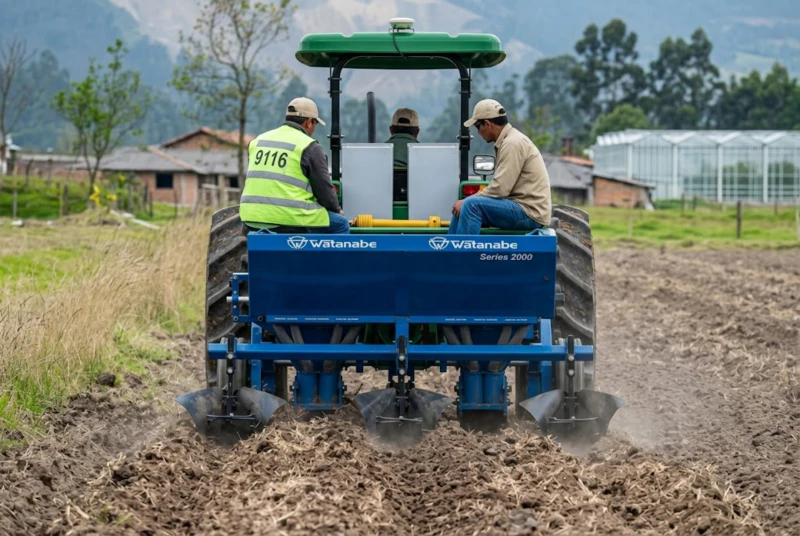
Stop Feeding the Space Between Your Rows. Start Feeding Your Crop.
Every kilogram of broadcast fertilizer that lands between rows is money wasted. Banded application delivers 100 percent of your investment to the root zone — saving 20 to 40 percent on inputs while maintaining or increasing yield. The ERA cultivator, ADB applicator, and PANTHER/PAI planter range make precision application practical from 10 hectares upward. Factory-direct pricing, worldwide delivery.
|
Equipment Quote ERA / ADB / Planter range |
Saving Calculation Your specific fertilizer saving |
Dealer Inquiries Full product range |
Contact Us — Calculate Your Fertilizer Saving and Get Your Quote