The Housing System That Puts Cow Comfort First — and Pays You Back for It
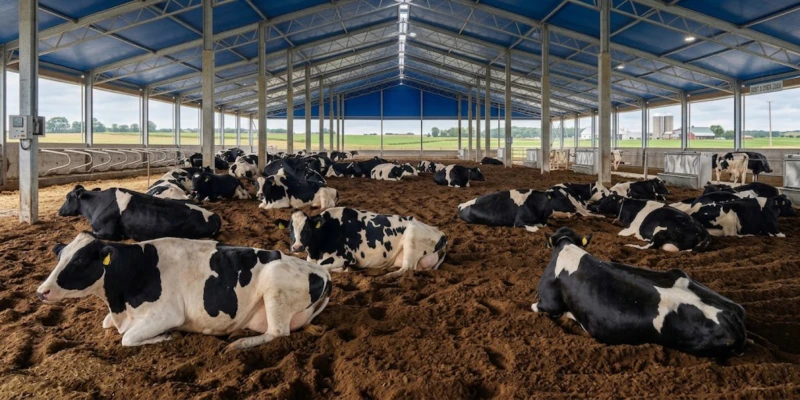
A compost barn — also known as a compost-bedded pack barn (CBP barn) or compost dairy barn — is a loose-housing system where dairy cows rest on a deep bed of composting organic material (typically sawdust, wood shavings, or dry wood chips) that is stirred and aerated twice daily to promote active aerobic composting. The composting process generates heat (45 to 65 degrees Celsius inside the pack), which dries the bedding surface, kills mastitis-causing pathogens, and provides cows with a warm, dry, cushioned resting surface that is unlike anything conventional housing systems can offer.
Dairy farms that switch to compost barns consistently report higher milk production (5 to 15 percent), lower somatic cell counts (30 to 50 percent reduction), fewer lameness cases (50 to 80 percent reduction), longer productive cow life, and dramatically improved animal welfare scores. These are not aspirational claims — they are documented outcomes from thousands of commercial compost barns operating worldwide, from Brazil and Israel to the Netherlands and the United States.
This guide covers everything you need to plan, build, and operate a compost barn — from design dimensions and bedding selection through daily management protocols and the critical role of deep stirring equipment.
Why Compost Barns Are Replacing Conventional Freestall Housing
|
Cow Health and Welfare Cows lie on a warm, dry, cushioned surface with zero hard contact points — no concrete, no metal dividers, no rubber mat edges. Hock lesions virtually disappear. Teat injuries from cubicle hardware are eliminated. Cows lie down 12 to 14 hours per day (versus 9 to 11 hours in freestall) because the surface is genuinely comfortable. More lying time correlates directly with higher milk production — every additional hour of lying adds approximately 1 to 1.5 kg of daily milk yield. |
Mastitis and SCC Reduction The composting process generates sustained internal temperatures of 45 to 65 degrees Celsius — sufficient to kill E. coli, Klebsiella, Streptococcus, and other mastitis-causing bacteria in the bedding. Somatic cell counts (SCC) typically drop 30 to 50 percent within the first year of switching to a well-managed compost barn. Lower SCC means fewer antibiotic treatments, fewer discarded-milk days, and premium milk pricing in SCC-graded markets. |
|
Hoof Health and Lameness Cows walk on soft, dry bedding instead of wet concrete. Digital dermatitis, sole ulcers, and white line disease — all primarily caused or worsened by wet, abrasive walking surfaces — are reduced by 50 to 80 percent. Fewer lame cows means higher feed intake, better reproduction rates, and dramatically lower veterinary and hoof-trimming costs. |
Milk Production Increase The combined effect of more lying time, less stress, lower disease incidence, and better hoof health translates to 5 to 15 percent higher daily milk yield per cow. For a 100-cow herd averaging 30 liters/day, a 10 percent increase is 300 additional liters per day — significant revenue that compounds across the entire lactation and the entire herd. |
Step 1: Barn Design — Dimensions, Layout, and Ventilation
A compost barn has a simple layout: one large open resting area filled with deep composting bedding, a feed alley along one side, and a milking parlor access point. There are no cubicles, no partitions, and no stalls in the resting area — cows choose where to lie freely.
| Compost Barn Design Parameters | |
| Resting area per cow | Minimum 10 to 12 m2 per cow (15 m2 preferred for optimal composting and cow space). Overcrowding reduces lying time, increases bedding moisture, and slows composting. Never exceed 1 cow per 10 m2. |
| Bedding depth | 60 to 100 cm of composting material. Deeper is better — it provides more thermal mass for composting, more cushion for the cow, and a larger reservoir for moisture absorption. |
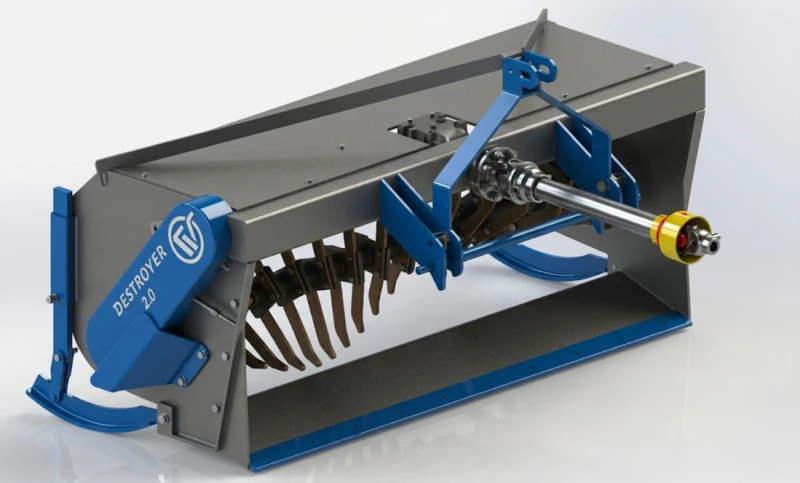
| Barn width | Typically 15 to 30 m. Must accommodate the stirring machine (DESTROYER 2.0 at 2 m width or DESTROYER 3.0 at 3 m width) with adequate turning space at each end. Minimum 3 m clearance at the ends for turning. |
| Roof height | 4 to 5 m at the eaves, higher at the ridge. Adequate height is essential for ventilation — warm, moist air from the composting bedding must be able to rise and exit through the ridge opening. |
| Ventilation | Open ridge ventilation (continuous ridge opening, 0.3 to 0.5 m wide) is mandatory. Open sidewalls or curtain sidewalls for cross-ventilation. In warm climates, fans may be needed. The barn must breathe — inadequate ventilation traps moisture and kills the composting process. |
| Floor | Concrete slab (150 mm minimum, with drainage slope) or well-compacted earth. Concrete is preferred for longevity and ease of cleaning when the barn is emptied for bedding replacement (every 6 to 12 months). |
| Feed alley | Concrete feed alley along one long side of the barn, 3.5 to 4.5 m wide, with a curb or step (30 to 40 cm height) separating the bedding area from the alley. Cows step up from the alley onto the bedding to rest. |
| Doorway width | Minimum 2.5 m for the DESTROYER 2.0 or 3.5 m for the DESTROYER 3.0, including tractor clearance. The stirring machine must be able to enter and exit the barn at least twice daily. |
Step 2: Bedding Material Selection
|
Kiln-Dried Sawdust (Preferred) The gold standard for compost barns. Low initial moisture (under 20 percent), fine particle size for rapid composting, high carbon content, and excellent absorption. Provides the best composting performance, fastest heat generation, and driest surface. Availability varies regionally; source from sawmills, woodworking shops, or dedicated suppliers. |
|
Dry Wood Shavings Second choice. Slightly coarser than sawdust, which slows initial composting but provides good long-term performance. Must be dry (under 25 percent moisture). Widely available from planing mills. Avoid treated or painted wood — chemicals can harm cows and inhibit composting. |
|
Other Materials Rice hulls, peanut shells, coconut coir, and dry wood chips are used regionally. All require high carbon content, low initial moisture, and small enough particle size to support active composting. Green (fresh, wet) materials should not be used — they are too wet and too low in carbon to compost effectively. |
Initial fill quantity: To fill a 100-cow barn (1,000 to 1,200 m2 resting area) to 80 cm depth requires approximately 800 to 1,000 m3 of loose sawdust or shavings. Plan for top-up additions of 10 to 15 percent of initial volume per month as material decomposes and compacts. Budget bedding material as an ongoing operating cost — typically the largest variable cost of compost barn management.
Step 3: The Critical Factor — Deep Bedding Stirring
A compost barn without regular, deep stirring is not a compost barn — it is a deep-litter barn. And the difference matters enormously. Without stirring, the bedding surface becomes compacted, wet, and anaerobic within days. Composting stops. Pathogen counts rise. Ammonia levels spike. The warm, dry, self-sanitizing surface that defines a compost barn disappears, and you are left with a cold, wet, bacteria-rich resting surface that is worse than the cubicle system it was supposed to replace.
Stirring frequency: Minimum twice daily — ideally while cows are in the milking parlor (so the machine operates in an empty barn). In hot, humid climates, three times daily may be needed. Consistency is non-negotiable: missing a single stirring event allows the surface to compact and begin the anaerobic slide. The composting process is maintained by momentum — once it stalls, it is difficult and time-consuming to restart.
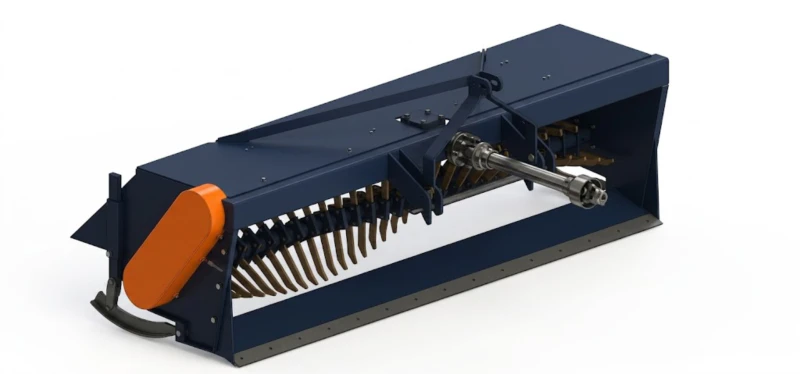
Stirring depth: This is where equipment choice is decisive. Most compost barn stirrers work to only 30 to 50 cm depth. The DESTROYER series stirs to a full 80 cm — reaching the bottom of the composting pack where anaerobic conditions develop first. This complete, bottom-to-top turnover is the difference between a pack that composts fully and one that composts only in the top half while the bottom half turns anaerobic, cold, and wet.
| Specification | DESTROYER 2.0 | DESTROYER 3.0 |
|---|---|---|
| Working Width | 2 m | 3 m |
| Working Depth | 80 cm (deepest in class) | |
| Min. Tractor Power | 75 hp | 80 hp |
| Weight | 460 kg | 660 kg |
| PTO Speed | 540 RPM | |
| Hydraulics Required | None — pure PTO drive | |
| Stirring time (100-cow barn) | 45-60 min | 30-45 min |
| Best For | Smaller barns, narrow doorways, poultry | Larger dairy barns, maximum coverage |
Step 4: Daily Management Protocol
| Time | Action |
| Morning milking | Move cows to parlor. While barn is empty: run DESTROYER through entire bedding area (30-60 minutes). The stirring aerates the pack, brings wet surface material down into the hot composting zone, and lifts dry subsurface material to the top. Add fresh bedding to any low spots or wet areas. |
| Mid-day (optional) | In hot, humid climates: a third stirring pass during the mid-day milking or feed push-up. This additional aeration helps manage moisture during the hottest part of the day when evaporation is highest. |
| Evening milking | Move cows to parlor. Run DESTROYER again through entire bedding area. Check pack temperature (target: 45-65 degrees Celsius at 20-30 cm depth). Check surface moisture (should feel dry and warm to the touch). If surface feels damp or cool, increase stirring frequency or add dry bedding. |
| Weekly | Add 5 to 10 cm of fresh sawdust or shavings across the entire bedding surface to replenish decomposed material and maintain pack depth. Check for any compacted or wet zones that may need extra attention. Inspect DESTROYER: grease PTO driveline, check gearbox oil level, inspect tine condition. |
| Every 6-12 months | Complete bedding replacement: remove all old composted bedding (excellent fertilizer for crop fields), clean the floor, and refill with fresh sawdust to the target 60-80 cm depth. The removed compost is a valuable soil amendment with high nutrient content and excellent soil-conditioning properties. |
Step 5: The Getting-Started Checklist
|
1. Calculate barn size Number of cows × 12 to 15 m2 = resting area in m2. Add feed alley width (4 m) × barn length. Total gives the building footprint. A 100-cow barn typically requires a building of approximately 30 × 50 m overall. |
|
2. Source bedding material Identify a reliable local supplier of kiln-dried sawdust or dry wood shavings. Calculate initial fill volume (area × 0.8 m depth) plus monthly top-up requirements (10-15 percent of initial volume). Secure a long-term supply contract — running out of bedding is not an option once cows are in the barn. |
|
3. Order your DESTROYER stirrer Choose the DESTROYER 2.0 (2 m, 75 hp) for barns up to 100 cows, or the DESTROYER 3.0 (3 m, 80 hp) for larger barns. The stirrer must be on-farm and operational before the first cow enters the barn. Production time is 15-20 days; order at least 6 weeks before planned move-in. |
|
4. Ensure tractor availability The DESTROYER requires a dedicated twice-daily tractor commitment (30-60 minutes per stirring). Your farm tractor (75-80 hp minimum) can double-duty if the stirring schedule aligns with milking times. Alternatively, a dedicated compact tractor for the barn simplifies logistics. |
|
5. Establish monitoring protocol Invest in a compost thermometer (long-probe, 50+ cm). Check pack temperature daily at 3 to 5 points (target 45-65 degrees Celsius at 20-30 cm depth). Monitor surface moisture by hand (should feel dry and warm). Track SCC at each milking to measure the health improvement as the system establishes. |
5 Common Mistakes That Kill a Compost Barn
|
Mistake 1: Inconsistent stirring Missing stirring events — even for one day — allows the surface to compact and go anaerobic. The composting process stalls, the surface becomes cold and wet, and bacteria multiply. Twice-daily stirring is non-negotiable. The DESTROYER‘s simple PTO-only design ensures reliability for this critical daily task. |
|
Mistake 2: Shallow stirring (under 50 cm) If your stirrer only reaches 30 to 50 cm, the bottom half of the pack becomes an anaerobic swamp — cold, wet, and odorous. The DESTROYER’s 80 cm depth ensures the entire pack is aerated from bottom to top. This is the single most important specification when choosing a compost barn stirrer. |
|
Mistake 3: Overcrowding Putting more cows in the barn than the bedding area supports (less than 10 m2 per cow) generates more moisture than the composting process can evaporate. The surface stays wet. Mastitis risk increases instead of decreasing. Respect the minimum: 10 to 12 m2 per cow, 15 m2 preferred. |
|
Mistake 4: Wet bedding material Starting with green (fresh) sawdust, wet shavings, or rain-soaked material prevents composting from initiating. Bedding material must be dry (under 25 percent moisture) at delivery. Store bedding under cover to prevent re-wetting before use. |
|
Mistake 5: Inadequate ventilation A closed or poorly ventilated barn traps moisture above the bedding, preventing evaporation. The composting process generates heat and moisture — if the moisture cannot escape upward through natural ventilation, it condenses on the bedding surface and the barn interior. Open-ridge ventilation is mandatory. |
.webp "Daily Stirring in Action: DESTROYER Creating the Perfect Cow Comfort Surface")
Frequently Asked Questions
|
Q1: How much does it cost to build a compost barn? Building costs vary widely by region and specification. The barn structure itself is simpler and often cheaper than a freestall barn because there are no cubicle hardware, mattresses, or manure scrapers. The major cost items are the building shell, concrete floor, ventilation system, and initial bedding fill. The DESTROYER stirrer is a fraction of the building cost and is the one item that determines whether the system works or fails. |
|
Q2: Can I convert an existing barn to a compost barn? Often yes — especially open-sided or loose-housing barns. Remove cubicle hardware, level the floor (install concrete if needed), ensure adequate ventilation and ridge opening, fill with bedding, and begin stirring. Many successful compost barns are conversions rather than new builds. Confirm doorway width is sufficient for the DESTROYER before converting. |
|
Q3: How long before I see results? SCC improvements typically become visible within 4 to 8 weeks as the composting process establishes and pathogen counts in the bedding drop. Lameness improvements take 2 to 6 months as damaged hooves heal. Milk production increases become measurable within 1 to 3 months. Full benefits are realized within the first lactation (10 to 12 months). |
|
Q4: What about the smell? A well-managed compost barn smells earthy and warm — like a forest floor, not like a manure pit. Aerobic composting produces CO2 and water vapor, not the ammonia and hydrogen sulfide that characterize anaerobic decomposition. If your compost barn smells bad, the composting process has failed — increase stirring depth and frequency immediately. The DESTROYER’s 80 cm depth prevents the anaerobic conditions that cause odor. |
|
Q5: Does the system work in hot climates? Yes — some of the most successful compost barns are in Brazil, Israel, and the Middle East. Hot climates actually accelerate composting. The main challenge is moisture management in humid conditions, which requires more frequent stirring (three times daily), adequate ventilation, and potentially supplemental fans. The DESTROYER’s fast stirring time (30-45 minutes for the 3.0) makes three-times-daily stirring practical. |
|
Q6: What about organic certification? Compost barns are increasingly favored by organic dairy certification bodies because they demonstrably improve animal welfare — a core requirement of organic standards. The natural composting process, absence of chemical bedding treatments, and superior cow comfort align well with organic principles. Check your specific certification body’s requirements for bedding material sourcing. |
|
Q7: DESTROYER 2.0 or 3.0 — which do I need? DESTROYER 2.0 (2 m, 75 hp) for barns up to approximately 100 cows or with narrow doorways (under 3 m). DESTROYER 3.0 (3 m, 80 hp) for larger barns over 100 cows — the 50 percent wider working width covers the same area in 30 to 40 percent less time. Both stir to the same 80 cm depth. If doorway width allows, the 3.0 is always more time-efficient. |
|
Q8: How do I get started? Contact our compost barn team with your herd size, existing barn situation (new build or conversion), tractor power, and climate zone. We will recommend the right DESTROYER model, confirm doorway and barn compatibility, and provide factory-direct pricing including shipping to your location. |
Give Your Cows the Best Surface in Dairy Farming
A compost barn is the single most impactful investment in cow comfort and dairy productivity. The system works — thousands of farms worldwide prove it daily. But it only works with consistent, deep stirring. The DESTROYER series delivers the deepest stirring (80 cm) at the lowest power requirement (75-80 hp) of any compost barn stirrer on the market. Factory-direct pricing, worldwide delivery, 15-20 day production.
|
DESTROYER Quote 2.0 or 3.0 model pricing |
Barn Design Consultation Sizing and layout advice |
Dealer Inquiries Compost barn equipment range |