The Best Machine Is the One That Works Every Day Without Asking for Attention
Farm equipment traditionally demands constant maintenance: greasing, adjusting, replacing worn parts, topping up fluids, tightening bolts, checking tensions, and repairing breakdowns. These tasks consume hours of labour every week, require a workshop inventory of spare parts, depend on mechanical skill that many operators lack, and — most critically — stop the machine from doing productive work while they are being performed. Every hour spent under the machine with a grease gun is an hour not spent in the field earning revenue.
A new generation of agricultural equipment is designed around a different philosophy: minimize or eliminate routine maintenance by engineering out the components that cause it. Sealed bearings replace greaseable bearings. PTO-only drives replace hydraulic circuits. Tungsten carbide tools replace hardened steel that needs frequent replacement. Heavy-gauge wear plates replace thin panels that crack and bend. The result is machinery that works reliably, day after day, season after season, with dramatically less attention — leaving the operator free to manage the operation rather than manage the machine.
This article explores the design principles behind maintenance-free equipment, how they apply across our product range, and why the total cost of ownership favours machines designed for minimum maintenance — even when their purchase price is higher.
6 Design Principles That Eliminate Maintenance
|
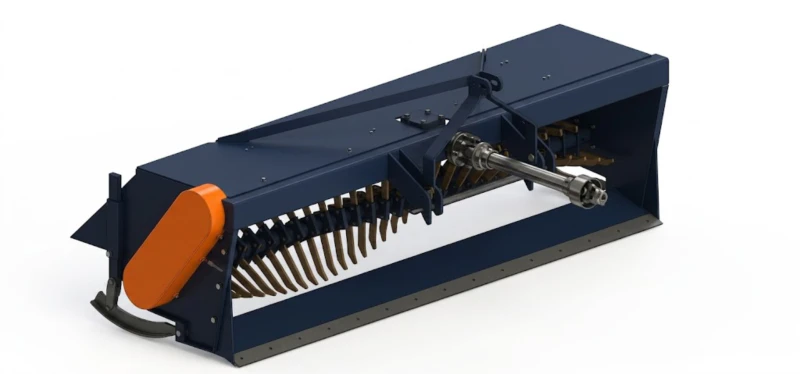
Principle 1: PTO-Only Drive — Eliminate Hydraulic Complexity Hydraulic systems are the single largest source of maintenance, downtime, and repair cost on farm equipment. Hoses age and burst. Fittings leak. Pumps wear. Fluid overheats. Cylinders develop seal failures. Every hydraulic connection is a potential failure point that requires inspection, fluid level checks, hose replacement, and specialist repair when it fails. Our approach: The DESTROYER 2.0/3.0 compost barn stirrer uses zero hydraulics — pure PTO mechanical drive through a sealed gearbox. No hoses, no hydraulic fluid, no pumps, no cylinders, no fittings. The drive system has exactly two maintenance points: PTO driveline greasing and gearbox oil level check. For a machine used twice daily, 365 days per year, this simplicity is transformative — the DESTROYER runs reliably in the most demanding daily-use application in agriculture with near-zero maintenance input. |
|
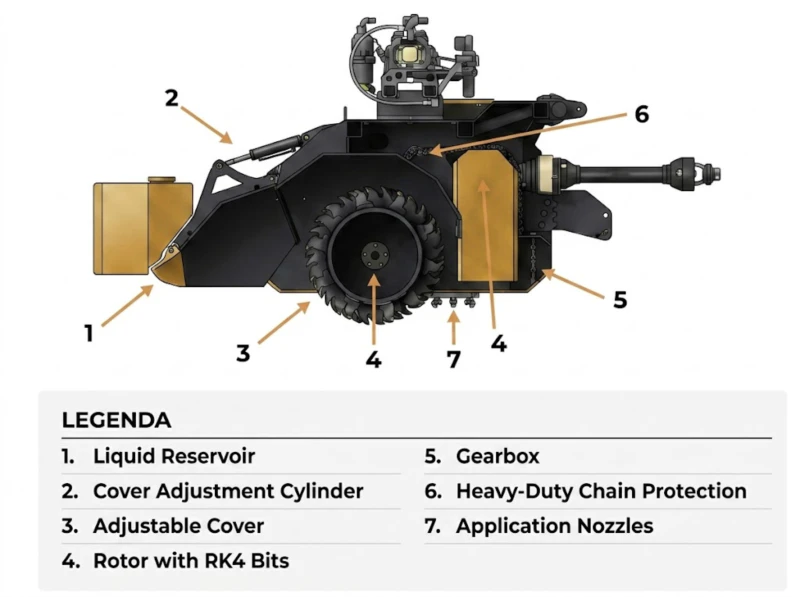
Principle 2: Tungsten Carbide Tools — Extend Replacement Intervals 3-5x Cutting tools are the primary consumable on crushers, stabilizers, and rotavators. Hardened steel tools wear quickly on abrasive material, requiring replacement every 20 to 60 hectares. Each replacement stop costs 1 to 2 hours of downtime plus the labour and parts cost of the swap. Our approach: The THOR stone crusher and THOR ST stabilizer use tungsten carbide tools as standard — lasting 3 to 5 times longer than steel. On a 500-hectare project, carbide tools require 3 replacement stops versus 12 for steel. That is 9 fewer maintenance events, 18 fewer hours of downtime, and a machine that stays productive instead of sitting idle. See: Tungsten Carbide vs. Hardened Steel. |
|
Principle 3: Sealed Bearings — Eliminate Greasing Schedules Traditional bearings require regular greasing — typically every 8 to 50 operating hours depending on the application. Miss a greasing interval and the bearing runs dry, overheats, and fails — often causing secondary damage to shafts, housings, and adjacent components. Greasing schedules are the most commonly neglected maintenance task on farms, and bearing failure is correspondingly the most common mechanical breakdown. Our approach: Sealed-for-life bearings at non-PTO rotation points eliminate greasing entirely for those positions. The bearing is packed with lubricant at the factory and sealed — it runs for its entire design life without any greasing input. When it eventually reaches end of life, the entire sealed unit is replaced in minutes. No greasing schedule, no missed intervals, no bearing failures from neglected lubrication. |
|
Principle 4: Heavy-Gauge Wear Components — Outlast Thin-Panel Alternatives Thin steel panels, housings, and frames save manufacturing cost but require frequent repair or replacement as they bend, crack, and wear through in agricultural service. A crusher housing made from 8 mm standard steel wears through in 2 to 3 seasons of heavy use; the same housing in 12 to 15 mm wear-resistant steel (Hardox or equivalent) lasts 5 to 10+ seasons. Our approach: Critical wear surfaces — crusher housings, counter-bars, sieve frames, digger shares — are manufactured from wear-resistant steel at thicknesses that provide multi-season life in the most abrasive conditions. The higher material cost at manufacture is recovered many times over through eliminated repair, replacement, and downtime across the machine’s working life. |
|
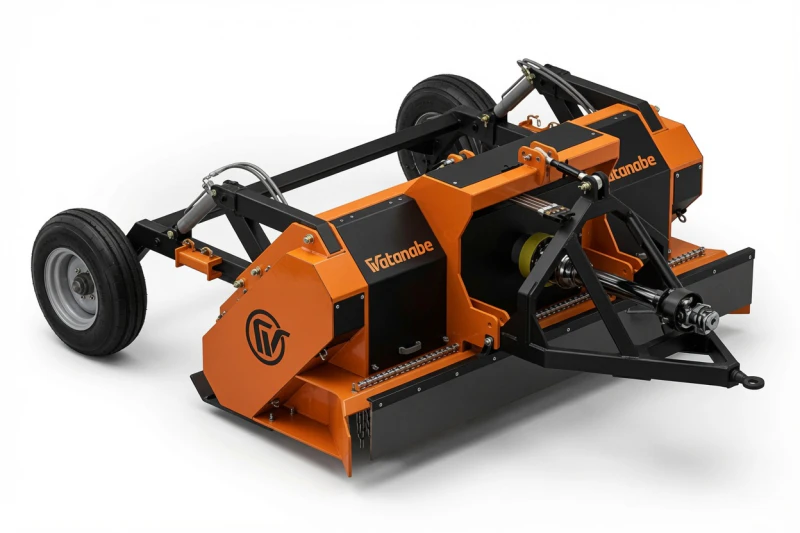
Principle 5: Bolted Replaceable Wear Parts — No Welding, No Workshop When wear parts do eventually need replacement — tools, shares, tines — the replacement should be a field operation, not a workshop operation. Welded-on components require a welder, cutting equipment, and skilled fabrication. Bolted components require a wrench and 15 minutes. Our approach: All replaceable wear parts across our range — crusher tools, rotavator blades, digger shares, stirrer tines — are bolted to the carrier with standard fasteners. An operator with a socket wrench replaces any worn part in the field without welding equipment, without a workshop, and without specialist skills. Carry a spare set on the tractor and downtime for wear-part replacement is measured in minutes, not hours. |
|
Principle 6: Simple Mechanical Design — Fewer Components, Fewer Failures Every component in a machine is a potential failure point. Electronic sensors fail in dusty, vibrating environments. Complex linkages wear and develop play. Multi-stage transmissions require more lubrication points and more alignment checks. The simplest design that achieves the required function is also the most reliable design. Our approach: Our equipment uses mechanical simplicity wherever possible. The DESTROYER achieves 80 cm stirring depth with a direct PTO-to-gearbox-to-rotor drivetrain — no intermediate clutches, no electronic controls, no variable-speed drives. The PANTHER planter’s cup-belt metering is a proven mechanical system that requires no electronic calibration. Fewer parts means fewer things that can break — and when nothing breaks, no maintenance is needed. |
Total Cost of Ownership: Why Cheaper Machines Cost More Over 10 Years
| Cost Component | Budget Machine | Maintenance-Free Design |
|---|---|---|
| Purchase price | Lower | Higher (heavier materials, carbide tools) |
| Annual repair costs | High (frequent breakdowns, worn parts) | Low (infrequent replacements) |
| Consumable parts cost (10 yr) | High (cheap parts × many replacements) | Lower (quality parts × few replacements) |
| Downtime hours per year | 40-100+ hours | 5-15 hours |
| Operator time on maintenance | Significant (greasing, adjusting, repairing) | Minimal (visual check, occasional oil) |
| Specialist repair needed? | Yes (hydraulic, electrical, welding) | Rarely (bolt-on parts, standard tools) |
| Resale value at 10 years | Low (worn, repaired, unreliable) | Higher (still functional, low wear) |
| 10-year total cost of ownership | Higher (low purchase + high running) | Lower (higher purchase + low running) |
The insight: Purchase price is a one-time number. Maintenance cost is a permanent number that compounds every year. A machine that costs 20 percent more to buy but requires 60 percent less maintenance over its life is the cheaper machine by year 3 or 4 — and the gap widens every year after that. Total cost of ownership, not purchase price, determines the true cost of equipment.
Maintenance-Free Features Across Our Product Range
| Продукт | Key Maintenance-Free Features |
|---|---|
| DESTROYER 2.0/3.0 | Zero hydraulics, pure PTO drive, 460-660 kg lightweight, bolted tines, sealed gearbox |
| THOR 2.4/3.0 Crusher | Tungsten carbide tools (standard), heavy-gauge Hardox housing, bolted tool replacement, belt-drive shock absorption |
| THOR ST Stabilizer | Tungsten carbide tools (standard), heavy-gauge housing, bolted tools, proven rotor design from THOR crusher platform |
| ERA Cultivator | Mechanical metering (no electronics), bolted blades, simple spring furrowers, PTO-driven rotary unit |
| PANTHER/PAI Planters | Mechanical cup-belt metering (no electronic calibration), ground-driven or mechanical seed/fertilizer distribution, bolted shares |
| AWB Digger / CWB-2L Harvester | Bolted digging shares, replaceable sieve webs, PTO-driven sieve mechanism, heavy-gauge frame construction |
Where Maintenance-Free Design Matters Most
|
Remote operations without workshop access Farms, plantations, and construction sites far from equipment dealers or welding shops cannot afford complex repairs that require specialist tools or skills. A maintenance-free machine runs reliably with the tools on the tractor and the spare parts in the cab — no workshop needed. |
|
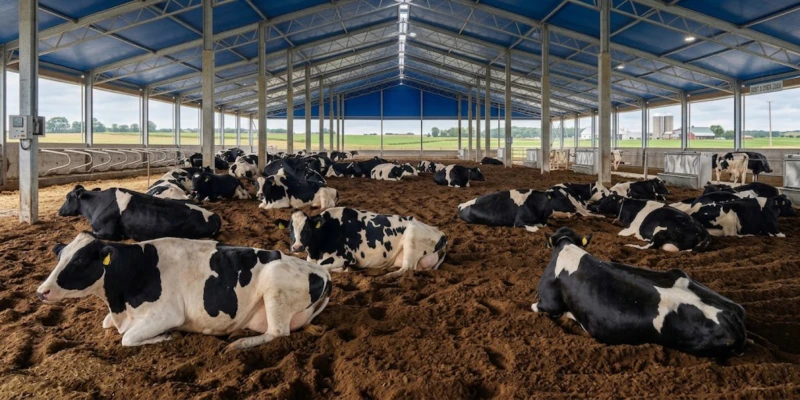
Daily-use equipment (compost barn stirrers) The DESTROYER operates twice daily, 365 days per year — over 700 uses per year. Any maintenance requirement multiplied by 700 events becomes a significant burden. Zero-hydraulic PTO-only design means the daily routine is: hitch, start PTO, stir, unhitch. No pre-use checks, no fluid levels, no hose inspections. |
|
Contractor operations with tight schedules Contractors billing per hectare or per day cannot afford downtime for maintenance. Every hour of maintenance is an hour of unbilled capacity. Machines designed for maximum uptime — long tool life, sealed bearings, simple drives — keep the contractor productive and profitable. |
|
Operations with limited mechanical skill Not every tractor operator is a trained mechanic. Complex maintenance procedures that require torque specs, alignment checks, or hydraulic diagnostics are beyond many operators’ skill sets. Simple, bolted, PTO-driven equipment can be operated and field-serviced by any competent tractor driver without specialist training. |
Frequently Asked Questions
|
Q1: Does “maintenance-free” really mean zero maintenance? Not literally zero — every machine needs periodic attention. The PTO driveline still needs greasing. Gearbox oil still needs checking. Wear parts still eventually need replacing. But the daily and weekly maintenance burden is reduced by 70 to 90 percent compared to hydraulically complex, thin-gauge, steel-tooled alternatives. The maintenance that remains is simple, fast, and requires only basic tools. |
|
Q2: Why do some manufacturers still use hydraulic drives on stirrers? Hydraulic drives offer variable speed control and can transmit power around corners — useful for complex implements with multiple moving components. But for a compost barn stirrer, which operates at a constant speed in a straight line, hydraulic complexity adds no functional benefit while dramatically increasing maintenance, failure risk, and cost. The DESTROYER’s PTO-only design delivers the same stirring performance without the hydraulic penalty. |
|
Q3: Is heavier always better for wear resistance? Heavier gauge steel resists wear and deformation better — but the weight must be in the right places. Critical wear surfaces (crusher housing, sieve frame, digger shares) benefit from heavy gauge. Non-wear structural components can be lighter without compromising durability. The design goal is “heavy where it wears, optimized where it does not” — maximizing wear life without unnecessarily increasing total machine weight and power demand. |
|
Q4: Can I get spare parts easily? Yes. All wear parts — tools, blades, shares, tines — are available direct from us at factory pricing with worldwide shipping. We recommend ordering one spare set with the machine to ensure on-site availability during extended work campaigns. Standard fasteners (metric bolts) mean no proprietary tooling is needed for replacement. |
|
Q5: How do I get equipment designed for minimum maintenance? Contact our team with your application and operating conditions. Every product in our range is designed around the maintenance-free principles described in this guide. We will recommend the model that delivers maximum field uptime for your specific situation — factory-direct pricing, worldwide delivery, and spare parts support from one source. |
Buy a Machine That Works. Not One That Needs Work.
Every product in our range is designed around the same philosophy: maximum field time, minimum workshop time. PTO-only drives, tungsten carbide tools, sealed bearings, heavy-gauge wear surfaces, and bolted replaceable parts — engineering choices that add a little to purchase price and subtract a lot from lifetime cost. Factory-direct pricing on every product, worldwide delivery, and parts support from one manufacturer.
|
Equipment Quote Any product in our range |
Spare Parts Factory-direct, worldwide |
Dealer Opportunities Low-maintenance product range |