One Band Is Good. Two Bands Are Better. Here Is Why.
Standard banded fertilizer application places a single band of NPK compound in the root zone — either during seedbed preparation or at planting. This is already a major improvement over broadcasting: 20 to 40 percent less fertilizer for equal or better yield, precise placement in the root zone, reduced leaching, and zero inter-row waste.
But a single band has a limitation: it puts all nutrients at one depth and one distance from the seed tuber. Early roots may be too far from the band to access nutrients immediately. Later in the season, the single band may be depleted before tuber bulking is complete. The timing and position of a single application cannot perfectly match the potato plant’s changing nutritional needs across its entire development cycle.
Dual fertilizer application solves this by placing two separate bands — a base dressing deeper in the root zone during seedbed preparation, and a starter dressing directly alongside the seed tuber at planting. Two bands at two depths, two timings, often with two different product formulations — each optimized for a different stage of crop development. The result is faster establishment, stronger canopy development, extended nutrient availability, and measurably higher yield and quality at harvest.
How Dual-Band Fertilizer Placement Works
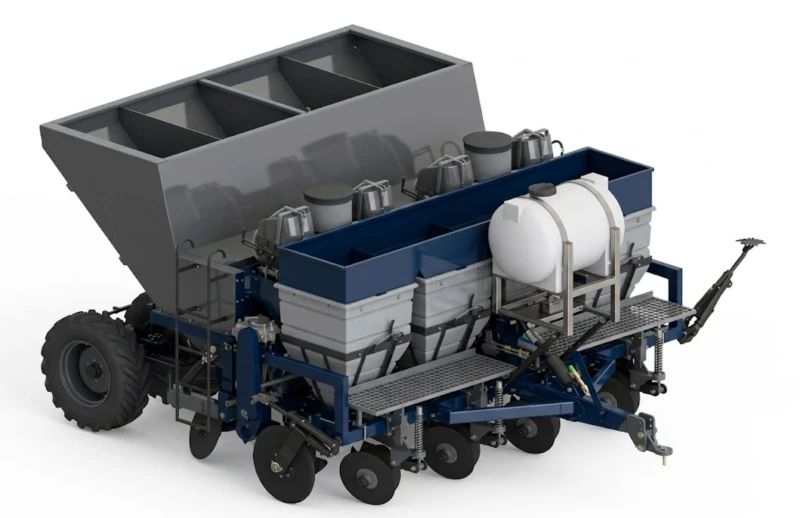
The dual-band strategy uses two separate application events to place nutrients at two different positions in the soil profile, each targeting a different phase of the potato plant’s growth:
|
Band 1: Base Dressing (60-70% of total) When: During seedbed preparation — 1 to 7 days before planting. Where: 8 to 15 cm below the ridge surface, in the zone where the main root system will develop. What: A complete NPK compound or high-phosphorus blend providing the bulk nutrition for canopy development and tuber initiation. Equipment: ERA Rotary Cultivator (125 kg/row built-in), ADB-380/480 Applicator (350 kg/row), or PSW-3200B Rotavator (2,000 kg bunker). |
Band 2: Starter Dressing (30-40% of total) When: At planting — simultaneously with seed tuber placement. Where: 5 to 8 cm from the seed tuber, at planting depth — immediately accessible to the first emerging roots. What: A starter blend high in available phosphorus and nitrogen for rapid early root and shoot development. Often a different product from the base dressing. Equipment: PANTHER planters (600-680 kg integrated hopper) or PAI-480-AR (2,000 + 500 kg dual system). |
Together, the two bands create a vertical nutrient gradient in the ridge: high-concentration starter nutrients near the seed for immediate uptake, and a deep reservoir of base nutrients for sustained feeding as roots extend downward through the season. The plant never experiences a nutrient gap — it transitions seamlessly from starter to base as root depth increases.
The Agronomic Science: Why Two Bands Outperform One
|
Faster Early Establishment (Week 1-4) The starter band is positioned within 5 to 8 cm of the seed tuber — the zone where the first roots emerge within days of planting. These young roots immediately contact high-concentration nutrients, accelerating shoot emergence, early canopy development, and root system expansion. With a single deep base band only, the first roots may take 7 to 14 additional days to reach the nutrient zone. This delay costs growing degree days that translate directly to lower final yield. |
|
Extended Nutrient Availability (Week 4-16) As the starter band is consumed during the first 3 to 5 weeks, the root system has grown deep enough to access the base band below. This provides a second reservoir of nutrients precisely when the plant transitions from canopy building to tuber bulking — the most nutrient-demanding phase. A single shallow band may be depleted before bulking peaks; the deep base band sustains feeding through to maturity. |
|
Optimized Phosphorus Placement Phosphorus is immobile in soil — roots must grow to it, it cannot travel to roots. Placing high-P starter fertilizer within centimeters of the seed tuber ensures immediate P uptake when the plant’s demand is highest (root initiation, stolon formation). A second P source in the base band sustains P availability as roots extend deeper. This dual-placement strategy is the most efficient way to deliver phosphorus to a potato crop. |
|
Tailored Formulations for Each Stage The dual-band approach allows two different fertilizer products — each optimized for its target growth stage. The base band can be a balanced NPK compound for overall nutrition. The starter band can be a high-P, high-N formulation for rapid establishment. With a single-band approach, you must compromise on one formulation that serves both stages imperfectly. |
|
Improved Tuber Quality Consistent, uninterrupted nutrient supply throughout the season produces more uniform tuber development. Tubers that experience a nutrient gap develop growth cracks, hollow heart, or uneven sizing. The dual-band approach minimizes these quality defects by ensuring the plant never transitions between “well-fed” and “hungry” during the tuber development phase. |
Quantified Impact: Single Band vs. Dual Band
| Parameter | Single Band | Dual Band |
|---|---|---|
| Days to full emergence | 18-24 | 14-18 (3-6 days earlier) |
| Days to canopy closure | 35-45 | 28-38 (5-10 days earlier) |
| Nutrient availability duration | Peaks early, fades mid-season | Sustained through bulking |
| Tuber count per plant | Baseline | +5 to 15% (more stolons initiated) |
| Tuber size uniformity | Moderate variation | More uniform (continuous feeding) |
| Growth cracks / hollow heart | More likely (nutrient gap) | Reduced (no gap) |
| Estimated yield improvement vs. single band | Baseline | +5 to 12% |
The 5 to 12 percent yield improvement from dual-banding is on top of the 20 to 40 percent fertilizer efficiency gain already achieved by switching from broadcast to banded application. Total improvement versus broadcast: 25 to 50 percent better nutrient utilization with equal or higher yield — a compounding financial advantage.
Equipment Configurations for Dual-Band Application
There are three ways to implement the dual-band strategy, depending on your existing equipment:
|
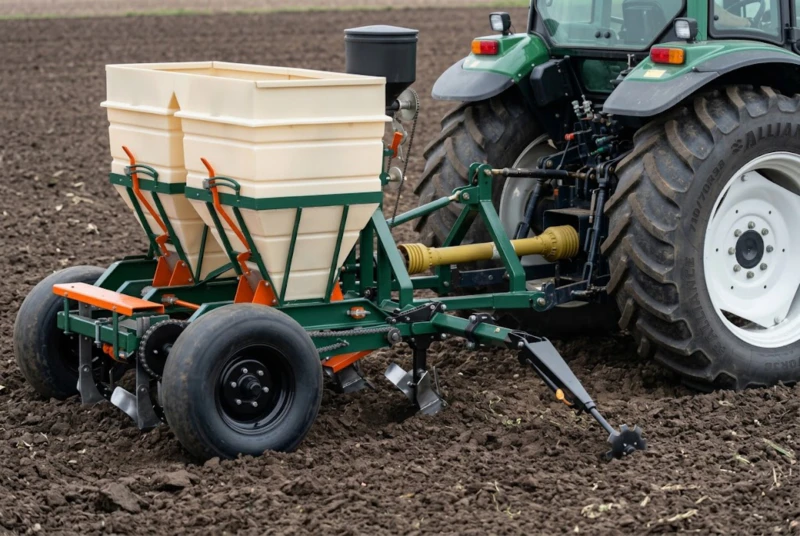
Configuration A: ERA/ADB + PANTHER Planter (Two Machines, Two Passes) Band 1: ERA Rotary Cultivator (125 kg/row) or ADB-380/480 (350 kg/row) applies the base dressing during seedbed preparation. Band 2: PANTHER 2 or 3-Row planter (600-680 kg hopper) applies the starter dressing at planting. Two separate machines on separate passes. Each band uses the equipment you are already running for that operation — zero additional passes, zero additional cost beyond the fertilizer product itself. |
|
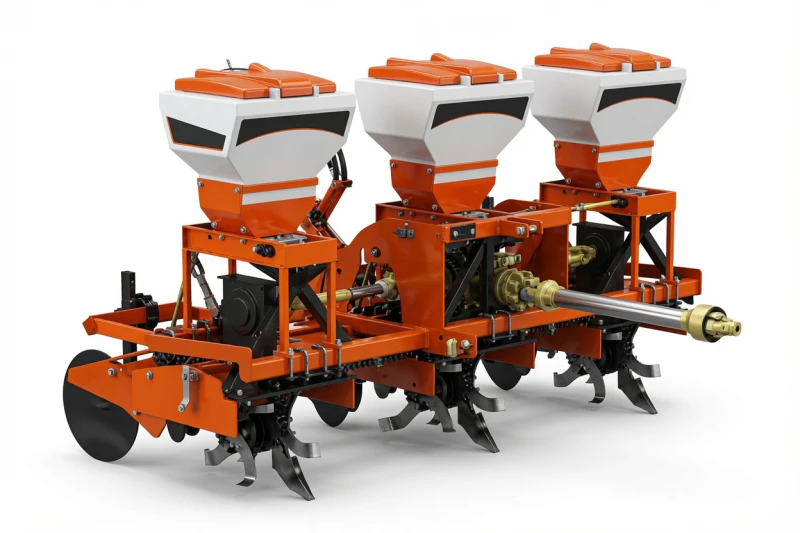
Configuration B: PAI-480-AR (One Machine, One Pass — Dual Band at Planting) Band 1 + Band 2 simultaneously: The PAI-480-AR carries two independent fertilizer systems — a 2,000 kg primary hopper and a 500 kg secondary hopper. Each system has its own metering mechanism, its own delivery coulters, and its own placement depth. Two different products are placed at two different depths in a single planting pass. This is the most advanced configuration: both bands applied simultaneously with planting, in one pass, by one machine. No pre-plant fertilizer pass needed. Maximum precision, minimum field traffic. |
|
Configuration C: PSW-3200B + Any Planter (Two Machines, Simpler) Band 1: PSW-3200B Rotavator (2,000 kg bunker) applies the base dressing during secondary tillage. Band 2: Any planter with integrated fertilizer (PANTHER 2/3-Row or PAI-2100) applies the starter at planting. The PSW-3200B provides the largest single-fill base dressing capacity in the range — ideal for high-rate base applications on large fields. |
The PAI-480-AR: The Only Planter With True Dual-Band Capability
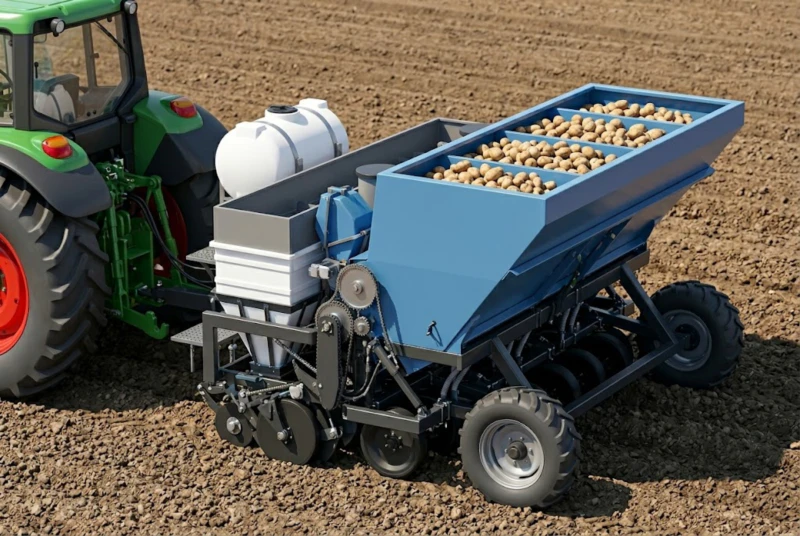
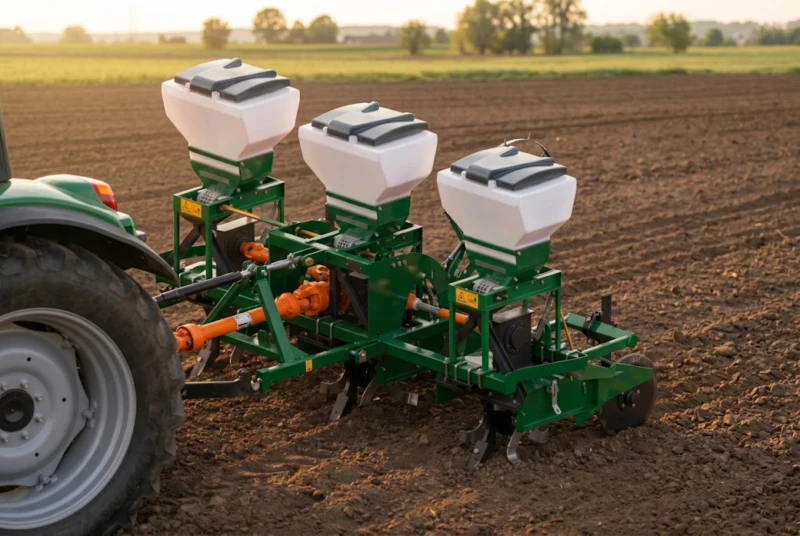
The PAI-480-AR is the only planter in our range — and one of very few in the global market — that delivers true dual-band fertilizer placement from a single machine in a single pass:
| Primary hopper | 2,000 kg capacity. Delivers the base dressing (typically NPK compound) in a deep band below and to the side of the seed tuber. Independent metering with adjustable rate. |
| Secondary hopper | 500 kg capacity. Delivers the starter dressing (typically high-P or high-N blend) in a shallow band directly alongside the seed tuber. Separate metering, separate rate control, separate product. |
| Two products simultaneously | Each hopper can contain a different fertilizer product — no mixing, no compromise formulation. Each band is optimized for its target growth stage independently. |
| Two depths simultaneously | Each delivery coulter is set to a different depth — primary deep for sustained base nutrition, secondary shallow for immediate starter access. True vertical nutrient zoning in a single pass. |
| Total fertilizer capacity | 2,500 kg — the highest in the range. Covers 2 to 3 hectares per fill at typical dual rates, minimizing refilling stops. |
Recommended Product Pairings for Dual-Band Application
| Band | Rate (typical) | Product Examples | Purpose |
|---|---|---|---|
| Base (deep) | 600-900 kg/ha | NPK 10-20-20, 12-12-17+Mg, or similar balanced compound | Sustained full-season nutrition; high K for tuber bulking |
| Starter (shallow) | 200-400 kg/ha | DAP (18-46-0), MAP (11-52-0), or high-P starter blend | Rapid root initiation, early P availability, early N for shoot emergence |
Total application: 800 to 1,300 kg/ha combined (base + starter). This is typically 10 to 20 percent less total fertilizer than a broadcast program targeting the same yield, because dual-banding delivers nutrients directly to roots at both depths rather than diluting them across the entire field surface.
Complete Comparison: Broadcast vs. Single Band vs. Dual Band
| Factor | Broadcast | Single Band | Dual Band |
|---|---|---|---|
| Placement precision | Entire surface | One zone in root area | Two zones at two depths |
| Time to first root contact | 14-21 days | 7-14 days | 3-5 days |
| Nutrient duration | Fades mid-season | Fades mid-late season | Sustained through maturity |
| Product flexibility | One product | One product | Two products (stage-optimized) |
| Fertilizer volume needed | Highest | 20-40% less | 25-45% less |
| Tuber quality (uniformity) | Variable | Good | Best (continuous feeding) |
| Yield vs. broadcast | Baseline | +5 to 10% | +10 to 20% |
Frequently Asked Questions
|
Q1: Does dual-band really produce more yield than single band? Yes. Research from potato agronomic institutes across multiple climates and varieties consistently shows 5 to 12 percent yield improvement from dual-banding versus single-band placement at the same total nutrient rate. The improvement comes from faster establishment, extended nutrient availability, and reduced quality defects — not from applying more fertilizer. |
|
Q2: Is dual-banding worth the complexity for a small farm? If you already use the ERA for seedbed preparation (Band 1) and a PANTHER planter with integrated fertilizer (Band 2), you are already dual-banding without any additional equipment or complexity. The dual-band strategy adds zero extra cost or passes — it simply recognizes that two operations you are already performing can carry different fertilizer products optimized for different stages. |
|
Q3: What if my planter does not have a fertilizer hopper? The PANTHER 4-Row does not carry fertilizer. In this case, use the ERA or ADB applicator for a single base band, and the 4-Row handles pure planting. You get banded application benefits but not the dual-band advantage. For full dual-band capability with a 4-row planter, upgrade to the PAI-480-AR which has the dual hopper system built in. |
|
Q4: Can I use the PAI-480-AR’s dual system with only one product? Yes. Load the same product in both hoppers for a single-product, dual-depth placement. Or use only the primary hopper and leave the secondary empty for single-band operation. The system is fully flexible — use one hopper, both hoppers, same product, or different products depending on the field and season. |
|
Q5: What is the optimal split between base and starter? Most agronomists recommend 60 to 70 percent of total application as the base dressing and 30 to 40 percent as the starter. The exact split depends on soil fertility, variety demand, and growing season length. Higher starter proportions favor early-maturing varieties; higher base proportions favor late-maturing, high-yielding varieties. |
|
Q6: Does dual-banding reduce the need for top-dressing during the season? Often yes. The deep base band provides sustained nutrition through the bulking phase, reducing or eliminating the need for a mid-season nitrogen top-dress that single-band programs frequently require. This saves an additional field pass and the associated compaction during the growing season. |
|
Q7: Do you supply all the equipment needed for dual-band application? Yes. We manufacture every option: ERA cultivators (base band during seedbed prep), ADB-380/480 applicators (dedicated base band), PSW-3200B rotavator (base band during tillage), PANTHER planters (starter band at planting), and the PAI-480-AR (both bands in one pass). One manufacturer, every configuration, factory-direct pricing. |
|
Q8: How do I get a dual-band recommendation for my farm? Contact our agronomic team with your soil test results, current fertilizer program, target yield, variety, and existing equipment. We will recommend the optimal base/starter split, suggest product pairings, and quote the equipment configuration that best fits your operation. |
One Band Is Good. Two Bands Pay Better.
Dual-band fertilizer application delivers 5 to 12 percent more yield than single-band, 25 to 45 percent less fertilizer than broadcast, and better tuber quality than either alternative. Whether you implement it with two machines over two passes or with the PAI-480-AR in a single pass, the agronomic and financial returns are proven. We supply every configuration at factory-direct pricing.
|
PAI-480-AR Quote Dual-band in one pass |
ERA + Planter Package Two-machine dual-band |
Agronomic Consultation Product pairing advice |