Three Passes. One Perfect Seedbed. Zero Wasted Trips.
The traditional potato seedbed preparation process involves five to six separate field passes: plough, secondary tillage, fertilizer application, ridge formation, another fertilizer pass, then planting. Each pass costs fuel, compresses soil, takes time, and risks missing the narrow planting window that defines a successful potato season. On a 100-hectare farm at six passes per hectare, that is 600 tractor passes across your land before a single seed tuber is in the ground.
Modern equipment has made most of those passes unnecessary. With the right machines in the right sequence, a commercial-quality potato seedbed — ploughed, tilled, fertilized, ridged, and planted — can be built in just three field passes. Fewer passes means less fuel, less compaction, less labor, and faster planting. The seedbed quality is not compromised — it is actually improved, because each pass happens on soil that has been compressed fewer times.
This guide shows you exactly how to achieve the 3-pass seedbed, which machines make it possible, and how to execute each pass for maximum quality.
Prerequisite: This guide assumes stone management has been completed. If your land has significant stones, address them first — see our guide: How to Clear Stones From Agricultural Land. On stone-free ground, the 3-pass workflow delivers the best seedbed achievable in modern potato production.
The 3-Pass Framework at a Glance
| Pass | Operation | Equipment | HP |
|---|---|---|---|
| 1 | Primary tillage — invert and open soil | Mouldboard plough (or deep cultivator) | 100+ |
| 2 | Seedbed + Fertilizer + Ridge — 3 operations in 1 pass | ERA Rotary Cultivator (3-in-1) | 75-100 |
| 3 | Planting — seed + fertilizer + insecticide | PANTHER or PAI Potato Planter | 75-140 |
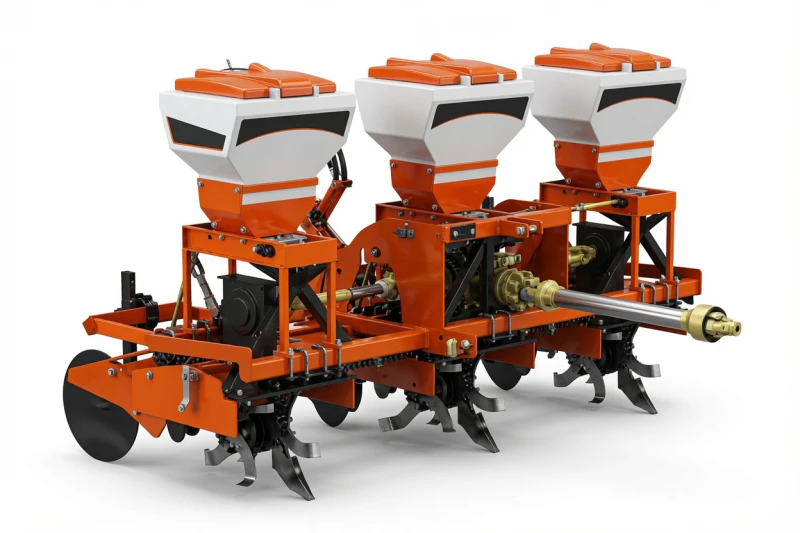
That is it. Three field passes, three machines, and the seedbed is complete. The key that makes this possible is Pass 2 — where the ERA Rotary Cultivator combines three traditional operations (secondary tillage, banded fertilizer, and ridge formation) into a single pass. This one machine eliminates two entire field operations from the traditional workflow.
Pass 1: Primary Tillage — Creating the Foundation
Equipment: Mouldboard plough (25-30 cm depth) or deep cultivator/chisel plough.
The first pass inverts or loosens the soil profile, incorporates surface residues from the previous crop, and breaks up compaction in the root zone. This creates the raw material that Pass 2 will refine into a finished seedbed.
Technical Keys for Pass 1:
| Target Depth | 25 to 30 cm for mouldboard ploughing. Deeper (35-40 cm) with a chisel plough or subsoiler if compaction layers exist. Potatoes need a loose root zone to at least 25 cm for unobstructed tuber development. |
| Optimal Timing | Autumn ploughing is preferred where climate allows. Winter weathering (freeze-thaw, wetting-drying cycles) naturally breaks down plough clods, reducing the work needed in Pass 2. In spring-only climates, plough as early as field conditions allow — typically when the soil can be walked without sticking to boots. |
| Soil Moisture | Plough when soil is moist but not wet. Ploughing saturated soil creates smeared furrow walls that impede drainage and root penetration. Ploughing bone-dry soil creates massive, hard clods that Pass 2 cannot break down. The ideal condition is when soil crumbles when squeezed, not when it smears or forms a hard ball. |
| Speed and Quality | 5 to 8 km/h depending on plough size and tractor power. Maintain consistent depth and even furrow turnover. Uneven ploughing creates uneven seedbed quality in Pass 2, which translates directly to uneven emergence after planting. |
On stone-crushed land: Pass 1 distributes the crushed stone particles from the surface throughout the plough depth, creating uniform drainage improvement across the entire root zone. This is one reason why crushing before ploughing is more effective than crushing after — the plough integrates the crushed material into the full soil profile.
Pass 2: The 3-in-1 — Seedbed, Fertilizer, and Ridge in One Pass
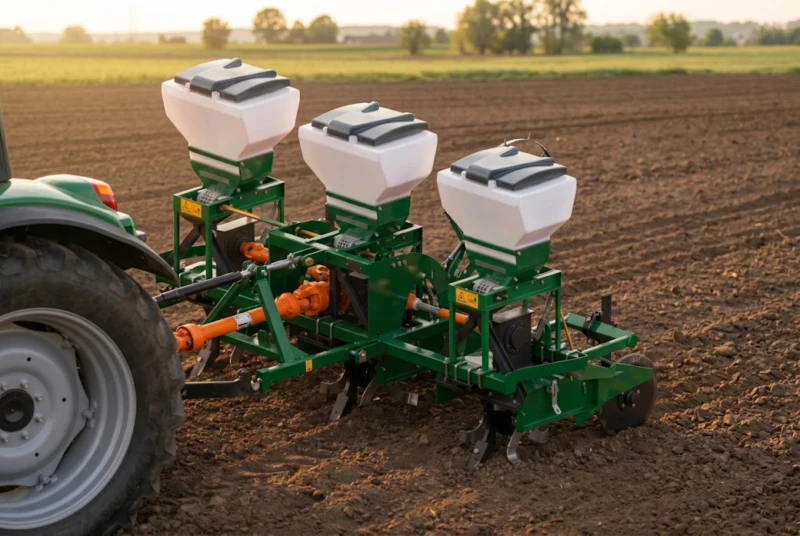
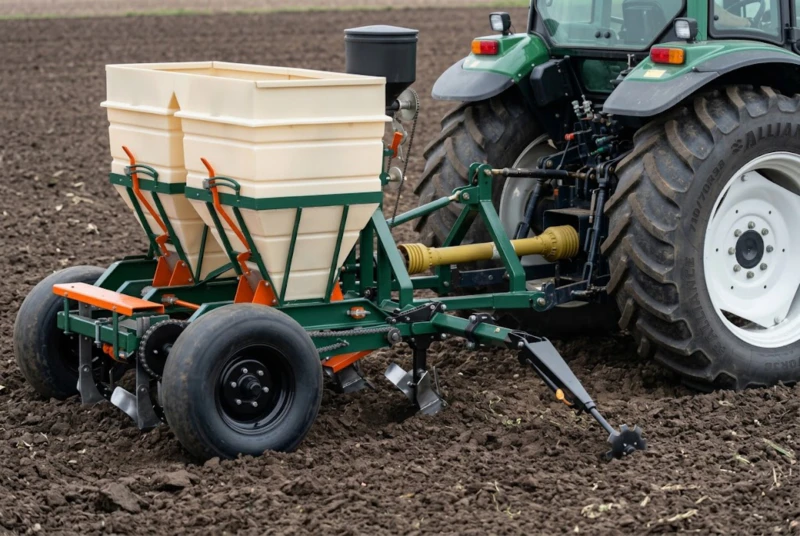
Equipment: ERA Series Rotary Cultivator (available in 2-row ERA-2100, 3-row ERA-3100, and 5-row ERA-5100).
This is the pass that makes the entire 3-pass workflow possible. The ERA performs three operations simultaneously as it travels across the ploughed field:
|
Function 1: Secondary Tillage PTO-driven rotary blades (one set per row) break down plough clods into a fine, uniform tilth. The blade speed and tractor forward speed are matched to produce the target particle size — fine enough for good soil-to-seed contact but not so fine that the surface caps after rain. On autumn-ploughed, winter-weathered soil, the ERA creates a premium-quality seedbed in a single pass. |
|
Function 2: Banded Fertilizer Application Individual fertilizer hoppers (125 kg capacity per row) meter granular NPK directly into the cultivated zone behind each set of rotary blades. The fertilizer is placed in the root zone, not on the surface — 20 to 40 percent more efficient than broadcasting. The operator sets the application rate from the tractor seat. Each row has independent flow control to prevent waste on headlands. |
|
Function 3: Ridge Formation Adjustable spring furrowers behind the rotary blades shape the cultivated, fertilized soil into planting ridges at the set row spacing (adjustable 60 to 100 cm). The ridges emerge behind the machine fully formed — raised, uniform, and ready for the planter in Pass 3. |
What the ERA replaces: In a traditional workflow, you would need three separate machines and three separate field passes: a rotavator for tillage, a fertilizer applicator for nutrient placement, and a furrower for ridge formation. The ERA does all three in one pass, saving two full field operations.
Technical Keys for Pass 2:
| PTO Speed | Match PTO speed to soil condition. Faster PTO on heavier, cloddier soil produces finer tilth. Slower PTO on already-friable soil prevents over-pulverization. The goal is an aggregate size of 5 to 20 mm — fine enough for seed contact but coarse enough to resist surface capping. |
| Forward Speed | 3 to 6 km/h depending on soil condition and row configuration. Slower on heavier, cloddy soil to allow more blade revolutions per meter. Faster on light, friable soil where less work is needed per meter. |
| Fertilizer Calibration | Calibrate the hopper metering gates before entering the field. Run a test pass at target speed and collect the output from each row to verify the application rate matches the agronomist’s recommendation (typically 800 to 1,500 kg/ha NPK for potatoes depending on soil fertility and yield target). |
| Ridge Profile | Adjust the spring furrower angle and depth to create ridges of the correct height (typically 15 to 20 cm above the furrow bottom) and shape (rounded top, not pointed). The ridge must be large enough to cover developing tubers against greening but not so large that it collapses during rain. |
Pass 3: Planting — Seed Into the Perfect Bed
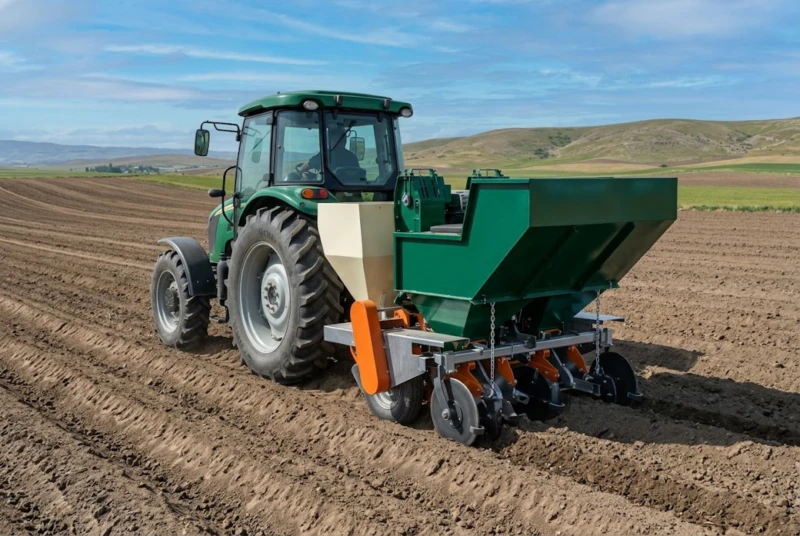
Equipment: PANTHER Potato Planter (2/3/4-row) or PAI Series Planter (PAI-2100 / PAI-480-AR).
Pass 3 places seed tubers at precise spacing and depth into the ridges formed in Pass 2. Modern planters also apply supplemental fertilizer (in addition to the base dressing from Pass 2) and in-furrow insecticide in the same planting pass — making Pass 3 itself a multi-function operation.
| Seed Spacing | Typically 25 to 35 cm between tubers in the row, depending on variety, seed size, and market (ware vs seed production). The planter’s cup-belt or pick mechanism is adjusted to match the target spacing. On the fine, uniform ridge created by the ERA in Pass 2, the planter achieves its best possible spacing accuracy. |
| Planting Depth | 5 to 10 cm below the ridge crest, measured to the top of the seed tuber. Consistent depth is critical for uniform emergence. The planter’s depth-control mechanism works most accurately in the fine, clod-free tilth produced by the ERA — without the stone impacts and rough surfaces that cause depth variation on poorly prepared ground. |
| Supplemental Fertilizer | PANTHER 2- and 3-row models carry integrated fertilizer hoppers (600 to 680 kg) for a secondary dressing placed alongside the seed tuber. Combined with the base dressing from Pass 2 (ERA), this dual-application strategy provides both immediate starter nutrients around the seed and sustained feeding from the base band below. |
| In-Furrow Insecticide | All PANTHER and PAI models carry liquid insecticide tanks (200 to 600 L) for in-furrow application at planting. This provides early-season protection against wireworm, Colorado beetle larvae, and aphids without a separate spraying pass — further reducing total field operations. |
Alternative Pass 2: If You Do Not Have an ERA Cultivator
If your equipment lineup includes separate machines rather than the ERA 3-in-1, you can still achieve a high-quality seedbed — but it takes more passes:
| Pass | Operation | Equipment |
|---|---|---|
| 1 | Plough | Mouldboard plough |
| 2 | Secondary tillage (+ stone burying + fertilizer) | PSW-3200B Rotavator (with fertilizer bunker) |
| 3 | Ridge formation | R-380 or R-580 Potato Furrower |
| 4 | Planting | PANTHER or PAI Planter |
This alternative is a 4-pass workflow (not 3) because the ridging step requires its own pass. The PSW-3200B saves one pass versus the fully separate approach (it combines tillage + fertilizer) but cannot form ridges. For the true 3-pass workflow, the ERA is the enabling machine.
| Comparison | 3-Pass (ERA) | 4-Pass (PSW-3200B + R-380) | Traditional (5-6 Pass) |
|---|---|---|---|
| Total field passes | 3 | 4 | 5-6 |
| Machines for tillage-fert-ridge | 1 (ERA) | 2 (PSW-3200B + R-380) | 3 (rotavator + spreader + furrower) |
| Relative fuel cost | Lowest | Medium | Highest |
| Soil compaction | Minimal | Moderate | Maximum |
How to Judge Seedbed Quality: 5 Checkpoints Before Planting
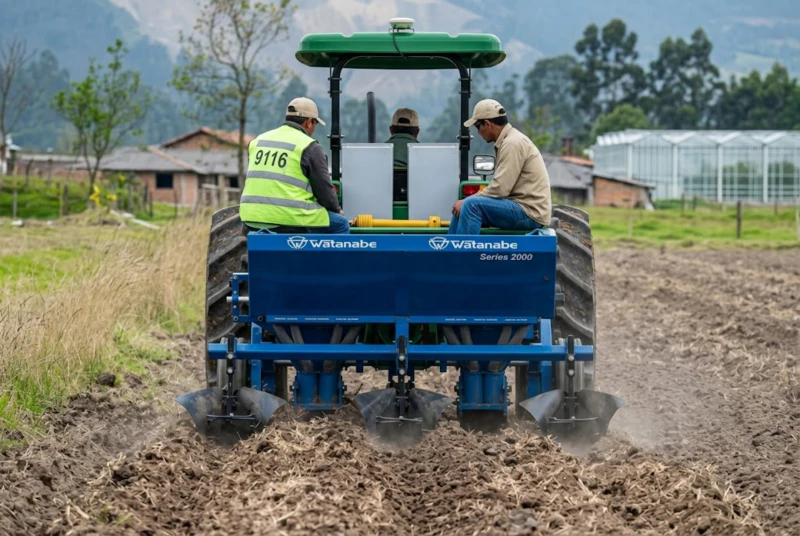
Before starting Pass 3 (planting), walk the prepared field and check these five quality indicators. If any fail, go back and address the issue before planting — it is far cheaper to fix a seedbed problem now than to live with a yield penalty all season.
|
Checkpoint 1: Aggregate Size Grab a handful of soil from the ridge. Ideal aggregate size is 5 to 20 mm — like coarse breadcrumbs. If you see lumps larger than 30 to 40 mm, the ERA or rotavator pass was too fast or the PTO speed too low. A second ERA pass at slower speed will fix it. If the soil is powder-fine (under 2 mm), it risks surface capping after rain — increase forward speed to leave slightly coarser aggregates. |
|
Checkpoint 2: Ridge Uniformity Sight along the ridges from the field end. They should be straight, parallel, uniform in height (15-20 cm), and consistent in shape. Irregular ridges cause uneven planting depth, uneven emergence, and harvesting problems. Adjust the ERA’s furrower springs or depth if ridges are uneven. |
|
Checkpoint 3: Soil Moisture Squeeze a handful of ridge soil. It should hold together loosely, then crumble apart when released. If it stays in a tight ball and feels sticky, the soil is too wet — wait for drying before planting. If it will not hold together at all, the soil may be too dry for good seed-to-soil contact — consider whether irrigation or rain is forecast within the first week after planting. |
|
Checkpoint 4: Stone-Free Ridge Zone Push your hand into the ridge to planting depth (5-10 cm). You should feel no stones larger than a walnut (approximately 30 mm). Any larger stones in the ridge zone will contact developing tubers during the season and damage them during harvest. On stone-crushed land this checkpoint is automatically satisfied. |
|
Checkpoint 5: Compaction Below the Ridge Push a screwdriver or metal rod into the soil below the ridge base. It should penetrate at least 25 to 30 cm without meeting a hard resistance layer. If it stops at 15 to 20 cm, there is a compaction pan below the ridge that will restrict root and tuber development. A subsoiler pass before Pass 1 (ploughing) would resolve this for next season. |
Frequently Asked Questions
|
Q1: Why can the ERA replace three separate machines? The ERA integrates three working elements on a single frame: rotary blades (tillage), metered fertilizer hoppers (banded application), and spring furrowers (ridge formation). As the machine advances, all three functions operate simultaneously on the same strip of soil. No separate machines or return passes are needed. |
|
Q2: Can I achieve 3 passes without the ERA? Not with the same quality. The closest alternative is the PSW-3200B (combines tillage + fertilizer in one pass), but ridging still requires a separate pass with a furrower, making it a 4-pass workflow. Only the ERA combines all three functions in a single pass. |
|
Q3: What if my soil has stones? Add a stone management step before Pass 1 (a THOR stone crusher for permanent elimination, or EW-4000 rake + CT-2100 picker for collection). This adds one pass to the workflow but permanently solves the stone problem that degrades every subsequent operation. |
|
Q4: How much fertilizer should the ERA apply? Follow your agronomist’s recommendation based on soil tests. The ERA’s per-row hopper capacity (125 kg) allows sufficient material for base dressings of 800 to 1,500 kg/ha. For higher total applications, split between the ERA (base dressing in Pass 2) and the planter’s fertilizer system (starter dressing in Pass 3). |
|
Q5: What ERA model size do I need? ERA-2100 (2-row, 75 hp) for smallholder operations up to 30 hectares. ERA-3100 (3-row, 85 hp) for commercial operations 30 to 100 hectares. ERA-5100 (5-row, 100 hp) for large-scale operations over 100 hectares. The 5-row model covers the most ground per pass — 5 rows at 75 cm spacing is 3.75 m working width. |
|
Q6: Does the 3-pass seedbed produce the same quality as the traditional 5-6 pass approach? Equal or better. The ERA passes over the soil once instead of three times, so there is less compaction — which means better root zone aeration, better drainage, and better tuber development. The fertilizer is placed more precisely (banded, not broadcast). The ridge is formed immediately after tillage, before the surface dries or weathers. |
|
Q7: What is the ideal time gap between passes? Pass 1 (ploughing) can be done weeks or months before Pass 2 — autumn ploughing with spring ERA pass is ideal. Pass 2 (ERA) and Pass 3 (planting) should follow closely — ideally within 2 to 5 days — to plant into fresh ridges before they dry out or are eroded by rain. |
|
Q8: How many hectares per day can the 3-pass system cover? Using the ERA-5100 (5-row) at 4 km/h: approximately 10 to 12 ha/day for Pass 2. With the PANTHER 4-Row at 5 km/h: approximately 8 to 10 ha/day for Pass 3. The bottleneck is usually Pass 3 (planting), not Pass 2. Plan accordingly and match row counts between the ERA and planter for a balanced workflow. |
|
Q9: Do you manufacture all the machines needed for the 3-pass system? Yes. We produce the ERA Series Rotary Cultivator (2/3/5-row), the PANTHER and PAI Potato Planters, the PSW-3200 Rotavator series, the R-380/R-580 Furrowers, and the ADB-380/480 Fertilizer Applicators — all options for building the optimal workflow for your farm. |
|
Q10: How do I get started? Contact our team with your hectarage, tractor power, current equipment, and row spacing. We will recommend the exact ERA model and planter combination to achieve the 3-pass workflow on your farm, with factory-direct pricing. |
Ready to Cut Your Seedbed Preparation in Half?
The 3-pass seedbed is not theoretical — it is the standard practice on farms using the ERA Rotary Cultivator. Three passes, three machines, one perfect seedbed. We supply the complete system at factory-direct pricing with worldwide delivery.
|
ERA Cultivator Quote 2 / 3 / 5-row pricing |
ERA + Planter System Complete 3-pass package |
Dealer Opportunities 3-pass system distribution |