You Do Not Need a Big Farm or a Big Tractor to Mechanize Potatoes
Most mechanization guides assume you have 200 hectares, a 250 hp tractor, and a fleet budget to match. If you are a smallholder farming 10 to 40 hectares of potatoes with a single 75 hp tractor, that advice is irrelevant — and it leaves you with the impression that mechanization is out of reach until you scale up. That impression is wrong.
A complete, fully mechanized potato production chain — from seedbed preparation through planting to harvest — can be built on a single 75 hp tractor. The equipment exists, the power is sufficient, and the economics work even at 10 hectares. In fact, the relative benefit of mechanization is often greater on small farms than large ones, because smallholders currently rely on manual labor for tasks where labor is the bottleneck, the cost driver, and the quality limiter.
This guide presents the complete 75 hp equipment chain for smallholder potato production, shows which machine to buy first for the fastest payback, and maps a staged investment path that lets you mechanize progressively as revenue grows.
The Complete 75 HP Potato Equipment Chain
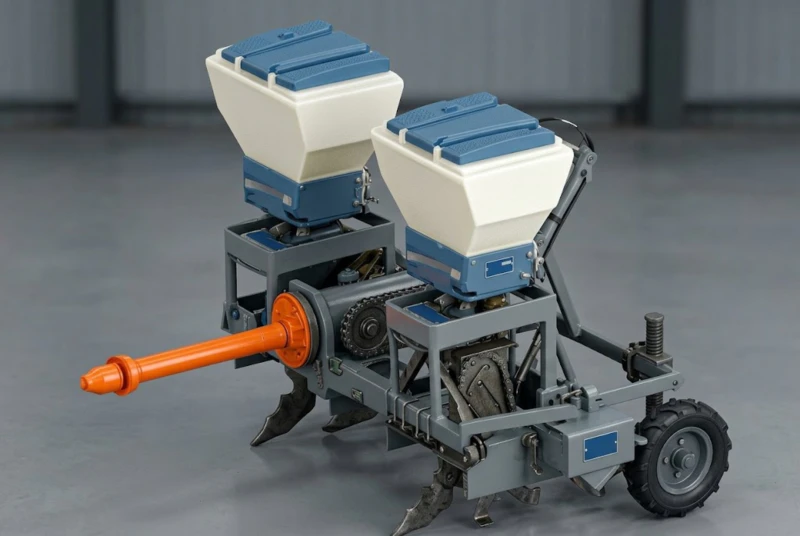
Every machine in this chain runs on a standard 75 hp utility tractor — John Deere 5E, New Holland T4/T5, Kubota M5/M6, Massey Ferguson 4700, Case IH Farmall, or equivalent. One tractor powers every implement. No upgrades, no second tractor, no compromise.
| Stage | Operation | Equipment | HP | Ha/day |
|---|---|---|---|---|
| 1 | Stone raking | EW-4000T Rock Rake | 75 | 8-15 |
| 2 | Plough | 2-3 furrow mouldboard plough | 75 | 3-5 |
| 3 | Seedbed + Fertilizer + Ridge (3-in-1) | ERA-2100 Rotary Cultivator | 75 | 4-6 |
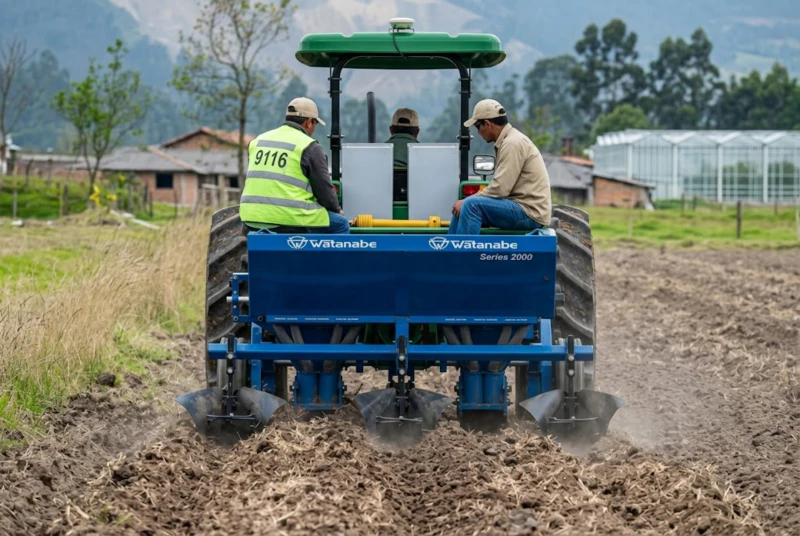
| 4 | Planting + Fertilizer + Insecticide | PAI-2100 Potato Planter | 75 | 3-5 |
| 5 | Hilling | R-380 Potato Furrower | 75 | 8-12 |
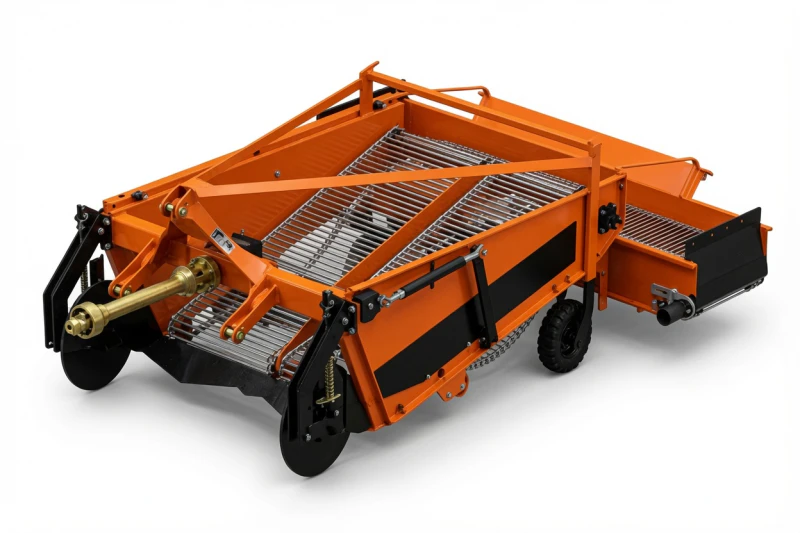
| 6 | Harvest (dig + sieve + windrow) | AWB-1600 Potato Digger | 75 | 4-6 |
Six implements, one tractor, zero power limitation. A 20-hectare potato farm can complete the entire production cycle — from stone clearing through planting to harvest — in approximately 25 to 35 working days using this chain. Compare that to the months of manual labor the same area requires without mechanization.
Why the ERA-2100 Is the Smallholder’s Most Important Machine
The ERA-2100 Rotary Cultivator deserves special attention because it replaces three separate machines that a smallholder would otherwise need to buy, store, maintain, and operate:
| Replaces rotavator | PTO rotary blades create fine seedbed tilth — same quality as a standalone PSW-3200, but only in the row zone (where it matters), reducing power demand to fit within 75 hp. |
| Replaces fertilizer applicator | 125 kg per-row hoppers apply granular NPK in bands within the root zone — replacing a separate ADB-380 pass. Banded application saves 20 to 40 percent on fertilizer volume compared to broadcasting. |
| Replaces furrower (for ridging) | Adjustable spring furrowers shape planting ridges behind the rotary blades — eliminating a separate R-380 furrower pass for initial ridge formation. (The R-380 remains useful for later hilling.) |
For a smallholder, this 3-in-1 capability is transformative: one purchase replaces three, one shed bay replaces three, one maintenance schedule replaces three, and one field pass replaces three. The ERA-2100 is the single machine that makes small-scale potato mechanization both affordable and practical.
What Mechanization Changes for the Smallholder
|
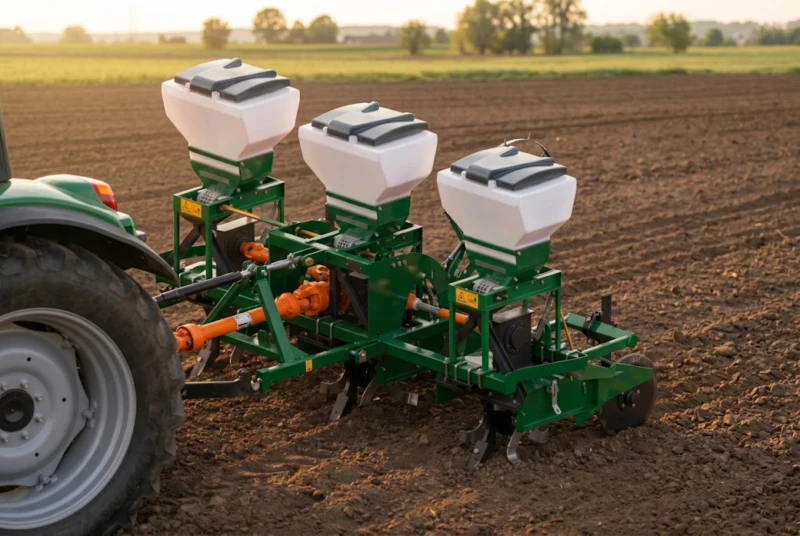
Planting Speed: 10x to 20x Faster A manual planting crew of 10 people covers approximately 0.5 to 1.0 hectare per day. The PAI-2100 planter covers 3 to 5 hectares per day with one tractor and one operator. A 20-hectare farm that takes 20 to 40 manual labor-days is planted in 4 to 7 machine-days. The entire farm is planted within the optimal window — no late-planted hectares losing yield to a shortened growing season. |
Yield Increase: 15-30% More Potatoes Mechanized planting delivers uniform spacing, consistent depth, precise seed placement, banded fertilizer, and in-furrow insecticide. Research consistently shows these precision advantages produce 15 to 30 percent higher yield than hand planting on the same land with the same variety. On 20 hectares at 30 t/ha, a 20 percent increase is 120 additional tonnes — significant revenue from the same land. |
|
Labor Cost: 70-90% Reduction Manual potato farming is extremely labor-intensive: 15 to 25 person-days per hectare across the season for planting, hilling, and harvest. Mechanized farming with the 75 hp chain requires 1 to 3 person-days per hectare (one tractor operator). On a 20-hectare farm, this is the difference between employing a seasonal crew of 10 to 15 people and operating with a single tractor driver. |
Fertilizer Saving: 20-40% Less Input Cost The ERA-2100 and PAI-2100 both deliver banded fertilizer directly into the root zone. This replaces broadcast spreading, which wastes 40 to 50 percent of applied fertilizer in the inter-row space. On a smallholder budget where every bag of fertilizer is a significant expense, a 20 to 40 percent reduction in fertilizer volume is an immediate, tangible financial benefit. |
Staged Investment: What to Buy First, Second, and Third
You do not need to buy the entire chain at once. A staged approach lets each purchase generate revenue that funds the next investment. Here is the recommended priority order based on payback speed:
|
Priority 1: PAI-2100 Planter (Fastest Payback) Why first: Planting is the operation with the widest gap between manual and mechanized performance. A PAI-2100 delivers 15 to 30 percent more yield through precision spacing and depth, eliminates the largest planting crew, and integrates fertilizer and insecticide. The yield increase alone typically pays for the planter within 1 to 2 seasons on a 15+ hectare farm. Specifications: 2-row, 350 kg seed, 200 kg fertilizer, 200/300 L insecticide, 75 hp minimum. |
|
Priority 2: ERA-2100 Cultivator (Highest Efficiency Gain) Why second: The ERA-2100 replaces three machines in one, delivering the most dramatic workflow simplification of any single purchase. It prepares a finished, fertilized, ridged potato bed from ploughed ground in one pass — eliminating two extra field operations and their associated fuel, time, and labor costs. The 20 to 40 percent fertilizer saving from banded application accelerates payback. Specifications: 2-row, 250 kg total fertilizer, 75 hp, rotary blades + hoppers + spring furrowers. |
|
Priority 3: AWB-1600 Digger (Harvest Mechanization) Why third: Once planting and seedbed preparation are mechanized, harvest is the remaining labor bottleneck. The AWB-1600 base model (800 kg, 75 hp, no hydraulics) is the most affordable entry into mechanized harvest — it digs and sieves 2 rows, depositing clean tubers in a windrow for a small picking crew. Even with a crew for pickup, the digger reduces total harvest labor by 50 to 70 percent compared to fully manual digging. Specifications: 2-row, 800 kg, 75 hp, 3-5 km/h, zero hydraulic valves required. |
|
Priority 4+: Stone Rake, Furrower, Upgrades EW-4000T Rock Rake (75 hp PTO) for stone management if your land is stony. R-380 Furrower (75 hp) for post-emergence hilling if needed beyond the ERA’s initial ridging. ADB-380 Fertilizer Applicator (75 hp) for dedicated pre-plant or side-dress banding if larger fertilizer capacity is needed than the ERA provides. These are “when budget allows” additions that further optimize the chain. |
The Growth Path: From 75 HP Starter to Commercial Scale
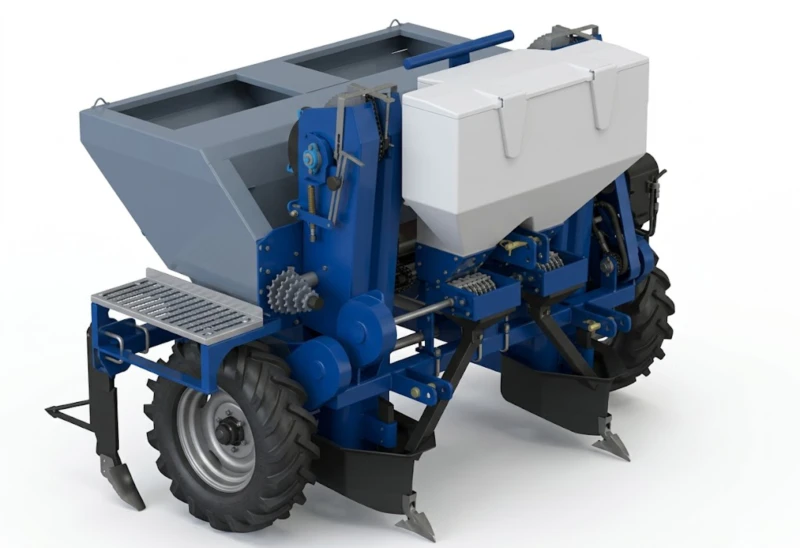
The 75 hp chain is not a dead end — it is a launchpad. As acreage expands and revenue grows, each machine can be upgraded to higher-capacity models without replacing the entire chain:
| Operation | Stage 1: Starter (75 hp) | Stage 2: Growing (100 hp) | Stage 3: Commercial (140+ hp) |
|---|---|---|---|
| Stone management | EW-4000T Rake | CT-2100 Picker | THOR Crusher (hire or buy) |
| Seedbed | ERA-2100 (2-row) | ERA-3100 (3-row) | ERA-5100 (5-row) |
| Planting | PAI-2100 (2-row) | PANTHER 3-Row | PAI-480-AR (4-row) |
| Harvest | AWB-1600 Mounted | AWB Trailed | CWB-2L Harvester |
| Potato hectares | 10-40 | 30-100 | 80-500+ |
Each upgrade step is additive, not revolutionary. The 75 hp starter machines retain resale value and can be sold to fund the upgrade, or kept as backup equipment. Nothing you buy at Stage 1 becomes obsolete — it is simply superseded by higher-capacity models when your operation outgrows it.
Real-World Economics: Does the 75 HP Chain Pay For Itself?
Consider a hypothetical 20-hectare smallholder farm switching from fully manual potato production to the 75 hp mechanized chain:
| Revenue/Cost Factor | Manual | Mechanized (75 hp) |
|---|---|---|
| Yield (t/ha) | 25-30 | 32-39 (+15-30%) |
| Total yield (20 ha) | 500-600 t | 640-780 t |
| Harvest loss | 10-15% | 5-8% (digger) |
| Seasonal labor (person-days) | 300-500 | 40-60 (operator + small crew) |
| Fertilizer efficiency | Broadcast (40-55% NUE) | Banded (65-80% NUE) |
| Planting window compliance | Often exceeds (late planting) | Fully within window |
The combined benefit — higher yield, lower harvest loss, drastically reduced labor, better fertilizer efficiency, and full planting-window compliance — typically generates enough additional net revenue in the first 1 to 2 seasons to cover the cost of the first machine (PAI-2100 planter). By season 3, the ERA-2100 is funded. By season 4 to 5, the AWB-1600 digger is added. The mechanization finances itself through the improvements it generates.
Frequently Asked Questions
|
Q1: Can a 75 hp tractor really power all these implements? Yes. Every machine in the 75 hp chain is specifically designed for this power class. The ERA-2100 works within 75 hp because it tills only the row zone (not the full width), the PAI-2100 is a compact 2-row planter, and the AWB-1600 is the lightest digger in our range (800 kg). None of these machines will overload a properly maintained 75 hp tractor. |
|
Q2: What if my land is very stony? The EW-4000T rock rake (75 hp) windrows surface stones for manual collection — a significant improvement over farming through stones. For serious stone problems requiring crushing, hire a contractor with a THOR stone crusher for a one-time treatment. The crusher requires 180+ hp but the treatment is permanent — your 75 hp tractor handles everything afterward on stone-free ground. |
|
Q3: Should I buy all three machines at once? No. The staged approach (planter first, cultivator second, digger third) lets each investment generate revenue before the next purchase. Start with the PAI-2100 planter — it delivers the fastest payback and the biggest single improvement. Each subsequent machine adds incremental benefit funded by the improvements already generated. |
|
Q4: Do I still need a picking crew for the AWB-1600 digger? Yes — the AWB-1600 deposits potatoes in a windrow on the ground. A small crew (4 to 8 people for a 2-row digger on 20 hectares) collects them into bags or bins. This is 50 to 70 percent fewer workers than fully manual digging. When budget allows, upgrade to the CWB-2L elevator harvester (100 hp) to eliminate the picking crew entirely. |
|
Q5: Is the ERA-2100 really cheaper than buying three separate machines? Significantly cheaper. The ERA-2100 costs less than any two of the three machines it replaces (rotavator + fertilizer applicator + furrower), while doing the work of all three. Add the savings in fuel (one pass vs. three), labor (one hookup vs. three), and storage (one shed bay vs. three), and the ERA is by far the most economical seedbed solution for a smallholder. |
|
Q6: Can this equipment be used for other crops besides potatoes? The ERA-2100 works for any ridged row crop (sweet potatoes, yams, cassava, vegetables). The R-380 furrower handles ridging for any row spacing from 60 to 100 cm. The EW-4000T rock rake is useful for general land clearing and landscaping. The PAI-2100 and AWB-1600 are potato-specific. Your 75 hp tractor remains a general-purpose farm tractor year-round. |
|
Q7: What if my tractor is 60 hp — is that enough? 60 hp is marginal for the ERA-2100 and PAI-2100 — they will work but at reduced speed and in lighter soil conditions only. The R-380 furrower and EW-4000T rake work well at 60 hp. If your tractor is under 75 hp, we recommend confirming compatibility with our technical team before ordering. A tractor upgrade to 75 hp opens the full chain. |
|
Q8: Do you supply equipment to Africa, Asia, and Latin America? Yes. The 75 hp chain is specifically designed for the global smallholder market. We export worldwide with CIF or FOB pricing and handle all documentation. The equipment operates in all climates and soil types. Contact us with your shipping destination for a delivered price quote. |
|
Q9: Can I finance the equipment? We work with buyers and dealers to structure payment terms where possible. The staged investment approach (buy one machine at a time, funded by yield improvements) is itself a form of self-financing. Contact our sales team to discuss options for your region. |
|
Q10: How do I get started? Contact our smallholder equipment team with your tractor model and HP, total potato hectares, current production method, and location. We will recommend the right starting point (usually the PAI-2100 planter) and provide factory-direct pricing including freight to your location. |
Start Mechanizing With What You Already Have: A 75 HP Tractor
You do not need to wait for a bigger tractor, a bigger farm, or a bigger budget. The 75 hp equipment chain is available now, works on your existing tractor, and pays for itself through the yield, labor, and efficiency gains it generates from season one. Start with one machine. Let the results fund the next. Factory-direct pricing, worldwide delivery.
|
Starter Package Quote PAI-2100 + ERA-2100 + AWB-1600 |
Single Machine Quote Start with just the planter |
Dealer Inquiries Smallholder product range |