The Single Number That Tells You Whether Your Ground Can Support a Road
When a road engineer evaluates whether a piece of ground is strong enough to carry traffic, the first number they look at is the CBR — California Bearing Ratio. This single value, expressed as a percentage, tells you how much load the soil can support before it deforms. A CBR of 3 percent means the soil is extremely weak — it will rut under even light vehicle traffic. A CBR of 80 percent means the soil is strong enough to serve as the base course of a major road carrying heavy trucks daily.
CBR is the universal language of road construction. It appears in every road design specification, every soil report, every pavement thickness calculation, and every soil stabilization project target. If you are building, improving, or stabilizing a road — whether a farm track, a rural highway, or a construction access route — CBR is the metric that defines where you start, where you need to finish, and whether the treatment worked.
This guide explains what CBR measures, how it is tested, what the numbers mean in practical terms, and how soil stabilization transforms low-CBR soil into high-CBR road material.
What CBR Actually Measures
CBR measures the resistance of a soil to penetration under a standardized load. The test was developed in the 1930s by the California Division of Highways — hence the name — and has since become the global standard for evaluating subgrade and base course strength.
The test works by pushing a standard-sized cylindrical piston (50 mm diameter) into a compacted soil sample at a constant rate (1.27 mm per minute) and measuring the force required to push it to specific depths (2.5 mm and 5.0 mm penetration). This force is then compared to the force required to push the same piston the same depth into a reference material — crushed California limestone — which is defined as CBR 100 percent.
| What is being measured | The ratio of force needed to penetrate the test soil versus the force needed to penetrate a reference crushed rock. Higher ratio = stronger soil. |
| Why it matters | CBR directly correlates with how much a road surface will deform under wheel loads. Low CBR = deep ruts under traffic. High CBR = firm, stable surface that resists deformation. |
| Unit | Percentage (%). CBR 100% equals the reference crushed rock. Values above 100% are possible for very dense, well-graded materials. |
| Test conditions | Performed on samples compacted to a target density (usually 95-98% of Modified Proctor maximum), often after 4 days of soaking in water to simulate worst-case wet conditions. Soaked CBR is the conservative design value. |
The CBR Scale: What the Numbers Mean in Practice
| CBR Range | Soil Classification | Practical Meaning | Road Suitability |
|---|---|---|---|
| 0-3% | Very poor subgrade | Soft clay, saturated silt, organic soil — deforms under foot traffic | Unusable — requires stabilization or replacement |
| 3-7% | Poor subgrade | Typical untreated clay — ruts under loaded vehicles | Fails rapidly under traffic — stabilization strongly recommended |
| 7-20% | Fair subgrade | Sandy clay, silty soil — supports light traffic in dry conditions | Marginal — serves as subgrade under thick pavement; stabilization improves performance |
| 20-50% | Good sub-base | Well-compacted gravel, lime-stabilized clay — firm under moderate traffic | Suitable for unpaved rural roads with moderate traffic |
| 50-80% | Good base course | Cement-stabilized soil, well-graded crushed aggregate — strong, load-bearing | Suitable for heavy-traffic unpaved roads and as base under pavement |
| 80-120+% | Excellent base course | Cement-stabilized gravel, dense crushed rock — highway-grade bearing strength | Suitable for any application including heavy-axle industrial routes |
The critical threshold for unpaved rural roads: CBR 20 to 30 percent is the minimum for an unpaved surface that can handle regular truck traffic without forming ruts. Most untreated rural soils test at CBR 3 to 10 percent — well below this threshold. Soil stabilization bridges this gap, raising CBR from single digits to 40 to 120+ percent depending on the binder type and dosage.
How Soil Stabilization Increases CBR
| Original Soil | Untreated CBR | Lime-Stabilized CBR | Cement-Stabilized CBR |
|---|---|---|---|
| Heavy clay (PI 25+) | 2-5% | 20-50% | Not recommended alone |
| Medium clay (PI 15-25) | 3-8% | 25-45% | 40-80% (after lime pre-treatment) |
| Silty clay (PI 8-15) | 5-12% | 15-35% | 50-100% |
| Sandy silt (PI under 8) | 8-15% | Minimal effect | 60-120% |
| Gravel/laterite | 15-40% | — | 80-150+% |
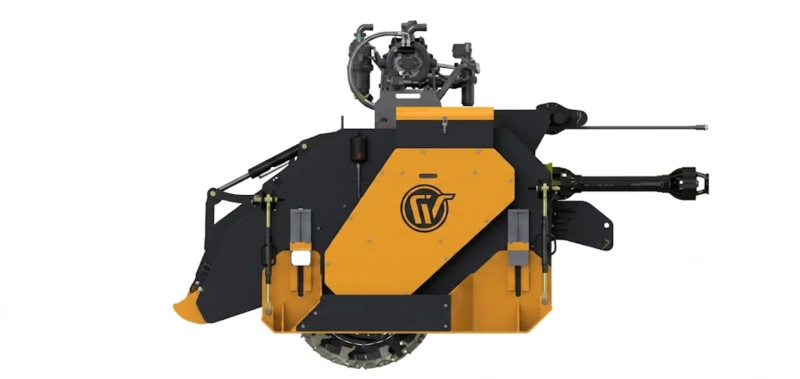
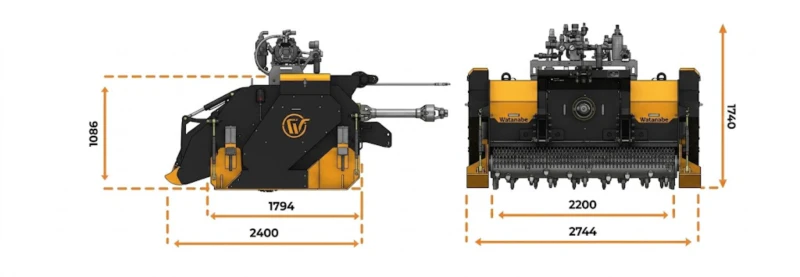
The improvement is dramatic. A clay soil at CBR 3 percent — too weak for any traffic — becomes a CBR 40 to 80 percent road base after stabilization. That is a 10 to 25 times increase in bearing strength from a single treatment with lime, cement, or both. The THOR ST Soil Stabilizer and DCW 2.2 Binder Spreader deliver this transformation on-site using the existing soil as the construction material.
How CBR Is Tested: Laboratory and Field Methods
|
Laboratory CBR Test How: Soil samples are collected from the site, compacted into a standard mould (150 mm diameter) at controlled moisture content, soaked in water for 4 days (to simulate worst-case conditions), then tested by pushing the standard piston into the sample while measuring force. When to use: Design stage — before construction. The lab test provides the baseline CBR of untreated soil and the expected CBR after stabilization (by testing samples mixed with different binder types and dosages). This determines the binder selection and dosage rate for the project. Accuracy: High — controlled conditions, repeatable, comparable between laboratories worldwide. |
In-Situ (Field) CBR Test How: A portable CBR testing rig is placed directly on the road surface or subgrade. The piston is pushed into the ground surface while a loaded truck or anchor provides the reaction force. The test measures the soil’s strength as-built, at its current moisture content, without laboratory preparation. When to use: Quality control — after construction. Verifies that the stabilized road has achieved the target CBR in the field, not just in the laboratory. Essential for confirming that the binder was mixed uniformly and compaction was adequate. Accuracy: Good — tests actual field conditions including natural moisture variation and compaction quality. |
A simpler field assessment — the Dynamic Cone Penetrometer (DCP) — is widely used for quick CBR estimation. The DCP drives a cone into the soil by dropping a standard weight from a standard height and measuring penetration per blow. Penetration rate correlates with CBR through published conversion tables. The DCP is fast, portable, and does not require laboratory equipment — making it ideal for on-site quality checks during stabilization projects.
How CBR Appears in Road Specifications
Road design specifications set minimum CBR values for each layer of the road structure. Meeting these values is the acceptance criterion for the finished work:
| Road Layer | Typical CBR Requirement | Typical Material |
|---|---|---|
| Subgrade (natural ground) | 3-15% (as-found) | Natural soil — often the weakest layer |
| Improved subgrade | 15-30% | Lime-stabilized clay, compacted select fill |
| Sub-base | 30-60% | Cement-stabilized soil, natural gravel |
| Base course | 80-120+% | Crushed rock, cement-stabilized gravel |
| Unpaved rural road (wearing surface) | 20-50% (light traffic) / 50-80% (heavy traffic) | Stabilized soil — the entire structure in one layer |
For unpaved rural roads — the primary application of our equipment — the stabilized layer serves as subgrade, sub-base, and wearing surface simultaneously. A single stabilization treatment that achieves CBR 30 to 50 percent is adequate for moderate farm traffic; CBR 50 to 80 percent handles heavy truck traffic and industrial loads.
Factors That Affect Achieved CBR After Stabilization
|
Binder type and dosage Higher binder dosage produces higher CBR — up to a point of diminishing returns. Cement typically achieves higher CBR than lime on the same soil. The optimal dosage balances target CBR against binder cost. Laboratory mix design testing identifies the most cost-effective dosage for your specific soil and target CBR. |
|
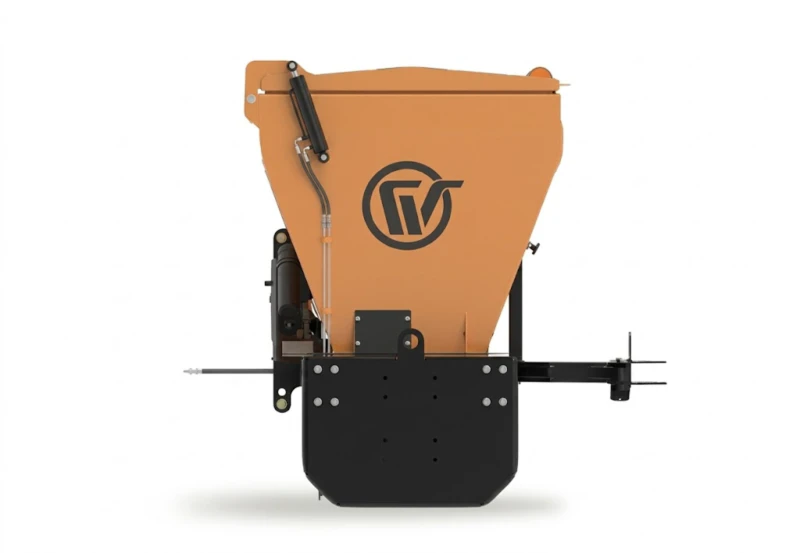
Mixing uniformity Uniform binder distribution produces uniform CBR. Uneven spreading (as with manual bag spreading) creates zones of high CBR and zones of low CBR — the road fails at the weakest zones. The DCW 2.2’s calibrated metering and the THOR ST’s thorough mixing ensure consistent CBR across the entire treated area. |
|
Compaction quality CBR increases with density. A stabilized layer compacted to 95 percent of Modified Proctor density achieves substantially higher CBR than the same mix at 90 percent density. Adequate roller weight, correct number of passes, and correct moisture content at compaction are essential for achieving the design CBR. |
|
Curing conditions (cement) Cement-stabilized CBR increases progressively over 7 to 28 days as hydration continues. Premature drying halts hydration and locks the CBR below its potential maximum. Proper curing (keeping the surface moist for 3 to 7 days) is essential for achieving the laboratory-predicted CBR in the field. |
|
Compaction timing (cement) Compacting cement-stabilized soil more than 2 to 4 hours after mixing breaks early cement bonds and reduces final CBR by 30 to 50 percent. Timely compaction within the working window is critical. Plan the daily production length so the roller always reaches each section within 2 hours of THOR ST mixing. |
Frequently Asked Questions
|
Q1: What CBR do I need for a farm road? For light traffic (pickups, empty trailers): CBR 20 to 30 percent. For moderate traffic (loaded grain trailers, milk tankers): CBR 30 to 50 percent. For heavy traffic (loaded sugar beet trucks, construction vehicles): CBR 50 to 80 percent. Lime stabilization achieves the lower range; cement stabilization achieves the upper range. |
|
Q2: Can I measure CBR myself? Laboratory CBR requires specialized equipment (a CBR press) — typically done by a geotechnical testing lab. Field CBR can be estimated quickly using a Dynamic Cone Penetrometer (DCP), which is portable and requires minimal training. For project planning and binder dosage design, a laboratory CBR test on your soil is strongly recommended — it costs relatively little and prevents expensive guesswork. |
|
Q3: What is the difference between soaked and unsoaked CBR? Soaked CBR is tested after 4 days of water immersion — simulating the worst case when the soil is fully saturated after prolonged rain. Unsoaked CBR is tested at the as-compacted moisture content — representing dry-weather conditions. Soaked CBR is always lower and is the conservative design value used for road specifications. Always use soaked CBR for design to ensure the road performs even in the worst conditions. |
|
Q4: Can CBR be too high? For unpaved road surfaces: very high CBR (above 100 percent) indicates an extremely hard, dense material that may behave more like a rigid pavement than a flexible surface. This is desirable for heavy-duty industrial routes but may be unnecessarily expensive for light farm traffic. Match the target CBR to your traffic load — CBR 30 to 50 percent is adequate for most rural roads and costs less binder than achieving CBR 80+. |
|
Q5: How does CBR relate to pavement thickness? On roads where asphalt or concrete pavement will be placed on top of the stabilized layer, higher subgrade CBR allows thinner pavement. A subgrade at CBR 3 percent might require 300 mm of pavement; the same subgrade stabilized to CBR 30 percent might require only 150 mm. The pavement material saved can exceed the cost of stabilization — making stabilization economically attractive even for fully paved roads. |
|
Q6: How do I get my soil tested and a stabilization recommendation? Contact our team with your location and intended road use. We can guide you to a local testing laboratory for CBR and Atterberg limits testing, interpret the results, recommend the binder type and dosage to achieve your target CBR, and quote the DCW 2.2 + THOR ST equipment for the project. |
CBR Is the Target. Stabilization Is the Method. THOR ST Is the Machine.
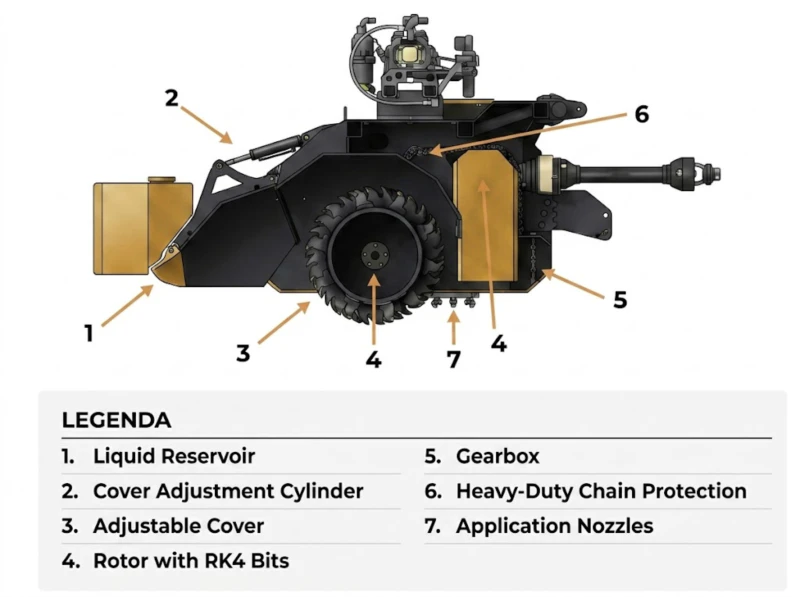
Every road project starts with a CBR number and ends with a better one. Soil stabilization with the DCW 2.2 and THOR ST takes your soil from CBR 3-10 percent to CBR 40-120+ percent — turning ground that cannot support traffic into ground that supports anything. Factory-direct pricing, worldwide delivery.
|
Equipment Quote DCW 2.2 + THOR ST |
CBR Target Advice Binder and dosage for your soil |
Contractor Inquiries Stabilization service equipment |
Contact Us — Achieve Your CBR Target With the Right Equipment