Why Stony Ground Is a Potato Grower’s Most Expensive Problem
Potatoes and stones are natural enemies. Unlike grain crops that grow above the soil surface, potatoes develop underground — surrounded by the very soil that contains the stones. Every rock in the ridge zone is a potential source of tuber damage at harvest, a cause of planter malfunction during planting, and a contributor to uneven seed spacing that reduces yield uniformity.
The damage is measurable and significant. Studies from European potato research institutes show that stony fields produce 10 to 20 percent more damaged tubers at harvest, suffer 5 to 15 percent higher grading losses (downgraded from ware to processing), and generate 20 to 40 percent higher equipment repair costs compared to stone-free fields growing the same variety under the same management. For seed potato producers, where skin quality is paramount, the penalties are even steeper.
The good news: with the right equipment sequence, even the stoniest land can be transformed into a high-quality potato seedbed. This guide presents the complete, step-by-step workflow from raw stony field to planting-ready potato beds — covering every stage, every machine option, and every decision point. Follow this workflow and your stony land will produce the same quality potatoes as the best stone-free fields in your region.
Step 1: Assess Your Stone Problem
Before choosing equipment, walk your fields and answer three questions that determine the entire workflow:
| Stone Density | Light: Scattered surface stones, most areas workable. Moderate: Consistent stone presence across the field, tillage equipment regularly impacted. Heavy: Dense stone coverage, fields difficult to plough or cultivate effectively. Your density level determines whether you need a rake, picker, crusher, or combination. |
| Stone Size | Small (under 100 mm): Manageable by rotavator/stone burier. Medium (100 to 300 mm): Requires picker or crusher. Large (300 to 500+ mm): Requires crusher or manual removal of the biggest boulders before machine processing. |
| Stone Depth | Surface only: Rake or picker is sufficient. Subsurface (down to plough depth): Crusher or rotavator needed to address stones that will be turned up by ploughing. Deep continuous stone layer: Crusher is the only practical solution for long-term management. |
Pro Tip: Dig three to five test holes (30 cm deep) across the field. Count and measure the stones in each sample. This gives a far more accurate picture of your subsurface stone burden than surface inspection alone. Many fields that appear lightly stony on the surface have a dense stone layer just below plough depth that will be exposed the moment you cultivate.
Step 2: Manage the Stones — Choose Your Method
Based on your assessment, select the stone management approach that matches your stone problem and available tractor power. Here are the three primary options, ordered from temporary to permanent:
|
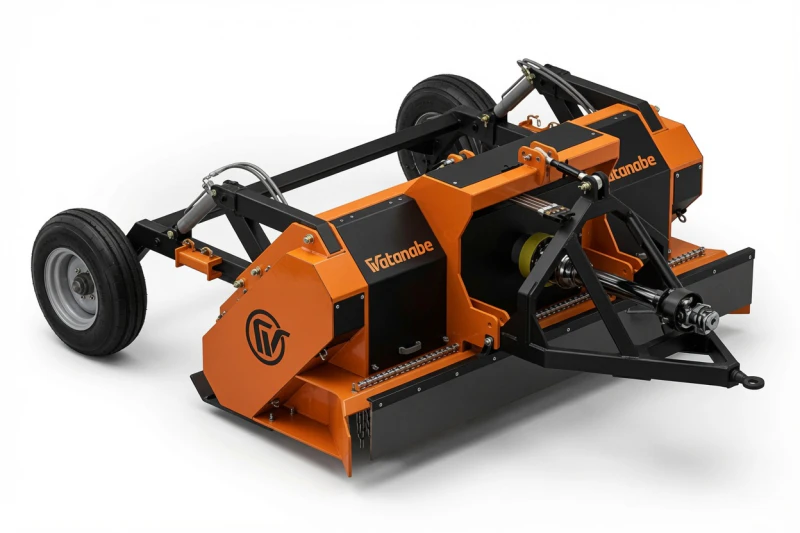
Option A: Rock Rake + Rock Picker (Collect and Remove) Best for: Moderate surface stones, 75-110 hp available. First pass with the EW-4000 Rock Rake to windrow stones, then second pass with the CT-2100 Rock Picker to collect and remove windrows. Stones are physically taken off the field. Must be repeated every 1 to 3 years as new stones surface. |
|
Option B: Stone Crusher (Permanent Destruction) Best for: Moderate to heavy stones, 180-230 hp available. Single pass with the THOR 2.4 or THOR 3.0 Stone Crusher pulverizes all stones into particles under 50 mm. No removal, no haulage, no recurrence. Crushed material improves soil drainage. One-time treatment lasts permanently. The recommended choice for serious potato operations. |
|
Option C: Rake + Crush Combined Best for: Heavy scattered stone density. Rake first to concentrate stones into windrows at 5-10 km/h, then crush only the windrows with the THOR. This minimizes the area the crusher must process, saving time and hammer wear. The most efficient workflow for the heaviest stone situations. |
Bottom Line for Potato Growers: If you have 180+ hp and grow potatoes commercially, the stone crusher is the strongest recommendation. Potatoes are uniquely vulnerable to stone damage at every stage (planting, growing, harvesting), and only crushing eliminates the problem permanently. The one-time investment pays back through reduced harvest damage, lower grading losses, and zero annual re-picking costs.
Step 3: Primary Tillage — Plough or Deep Cultivate
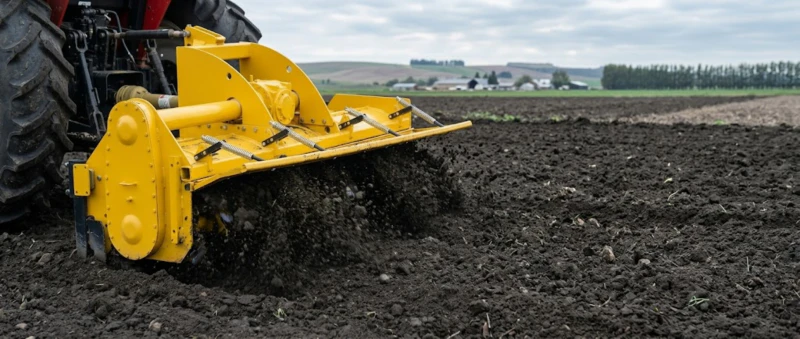
After stone management, the field needs primary tillage to break up compaction, incorporate crop residues, and create a workable soil profile. On land that has been stone-crushed, primary tillage also mixes the crushed stone particles into the deeper soil layer, distributing the drainage benefits throughout the root zone.
Ploughing (mouldboard plough) to 25 to 30 cm is the traditional approach. It inverts the soil, buries surface residues, and exposes a fresh surface for secondary tillage. On previously crushed land, ploughing also distributes crushed particles through the plough depth, creating a uniformly improved soil structure.
Deep cultivation (chisel plough or subsoiler) is an alternative that loosens soil without inversion. This preserves surface organic matter and soil biology while still breaking compaction. Many modern potato operations prefer non-inversion tillage for its soil health benefits.
Timing: Plough or deep-cultivate in autumn where climate permits, allowing winter weathering to further break down soil clods. In spring-only climates, plough as early as soil conditions allow.
Step 4: Secondary Tillage — Create the Planting Tilth
After primary tillage, the soil needs to be worked into a fine, uniform tilth suitable for ridge formation and seed placement. This is where the stone-burying rotavator excels, even on land that has already been crushed or picked. The rotavator’s PTO-driven blades break down clods, level the surface, and push any remaining small stones below the cultivated layer — creating the ideal fine seedbed for potato planting.
The PSW-3200 Rotavator (3.2 m, 140 hp) processes the ploughed ground into a uniform, fine-textured seedbed while simultaneously burying any residual stone fragments below the ridge zone. For fields that were crushed in Step 2, this step ensures that even the smallest remaining particles are positioned below the tuber development zone.
Alternative — PSW-3200B with fertilizer: The PSW-3200B model integrates a 2,000 kg fertilizer bunker with the rotavator, allowing simultaneous secondary tillage and base fertilizer application in a single pass. This eliminates one field operation.
Step 5: Fertilizer Application
Potatoes are heavy feeders requiring significant NPK inputs. On stony land that has been crushed, the improved drainage means nutrients can leach faster than on heavy clay, making banded fertilizer application (placing fertilizer in the root zone rather than broadcasting across the entire surface) especially valuable. Banding delivers 20 to 40 percent higher nutrient efficiency than broadcasting.
Two approaches depending on your workflow:
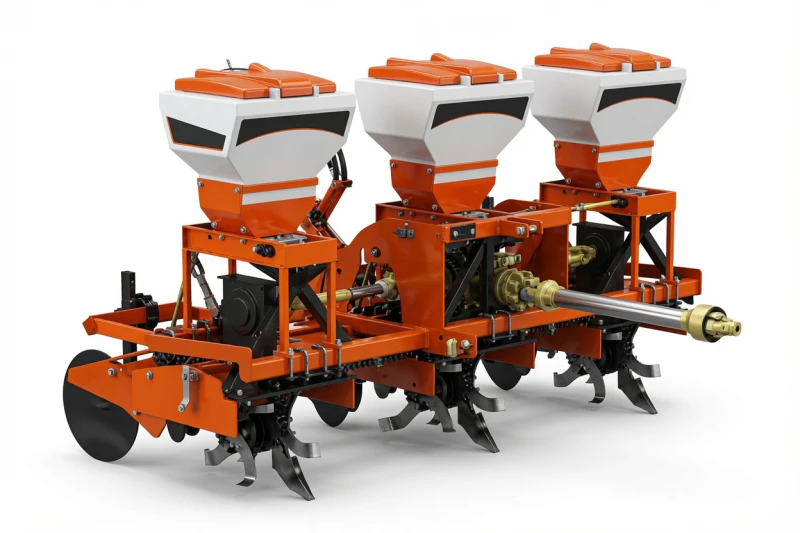
| Dedicated Fertilizer Pass | Use the ADB-380 (3-row) or ADB-480 (4-row) Fertilizer Applicator to band-apply granular NPK into the furrow before or during ridging. The 350 kg per-row hopper capacity allows extended field runs. Independent row control prevents waste on headlands. |
| Combined Cultivate + Fertilize + Ridge | Use the ERA Series Rotary Cultivator (2/3/5-row) to cultivate, apply fertilizer (125 kg per row), and form ridges in a single pass. This 3-in-1 approach replaces three separate operations, saving time, fuel, and compaction passes. |
Step 6: Ridge Formation (Furrowing)
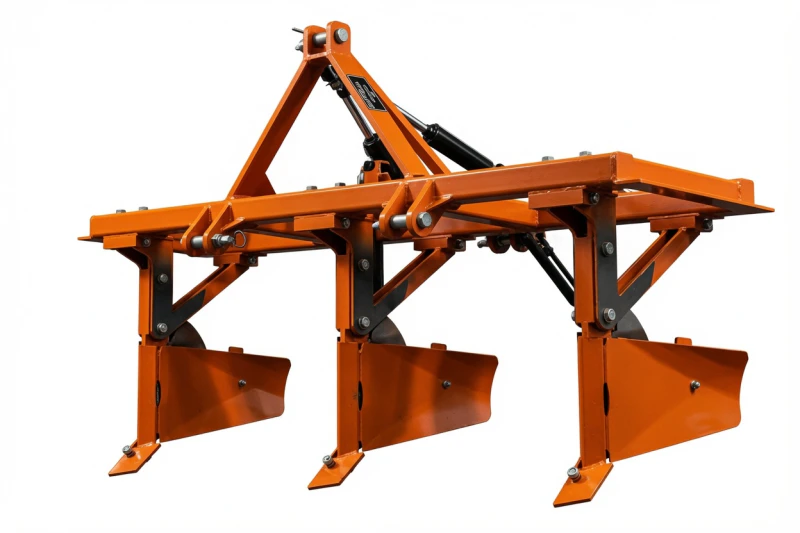
If you did not use the ERA cultivator (which forms ridges as part of its 3-in-1 operation), a separate ridging pass is needed to shape the prepared seedbed into planting ridges at the correct row spacing (typically 75 cm for potatoes).
The R-380 Potato Furrower (3-row, 75 hp) or R-580 Potato Furrower (5-row, 85 hp) creates uniform planting ridges at 5 to 8 km/h. The ridges provide a raised, well-drained planting zone for the seed tubers, protect developing potatoes from greening, and establish the row pattern for the subsequent planting and harvesting operations.
On properly prepared, stone-free ground (Steps 1-4 completed), the ridges will be smooth, uniform, and free of the stone lumps that cause uneven surfaces and harvester problems. This is where all the previous preparation work pays off — clean ridges mean clean planting, even emergence, and clean harvesting.
Step 7: Planting
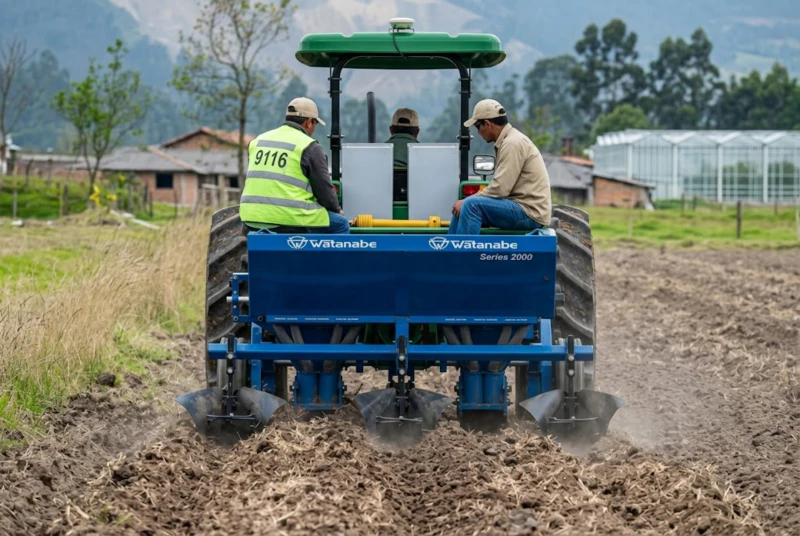
With the stone-free, fertilized, ridged seedbed complete, planting can proceed with confidence. The PANTHER Potato Planter (2/3/4-row) or PAI Series Planter (PAI-2100 entry-level or PAI-480-AR industrial-scale) places seed tubers at precise spacing and depth, applies additional fertilizer, and optionally treats with in-furrow insecticide — all in a single planting pass.
On properly prepared stone-free ground, the planter operates at its designed speed without the jarring impacts, cup-belt jams, and depth inconsistencies that stones cause on unprepared land. The result is uniform seed spacing, consistent planting depth, and even emergence — the foundation of a high-yielding crop.
Complete Workflow Summary — Two Pathways
Depending on your equipment lineup and time availability, you can follow either a multi-pass or a streamlined pathway:
| Step | Operation | Multi-Pass Pathway | Streamlined Pathway |
|---|---|---|---|
| 1 | Stone Management | Rake + Pick or Crush | Crush (THOR) |
| 2 | Primary Tillage | Plough | Plough |
| 3 | Secondary Tillage | PSW-3200 Rotavator | ERA Cultivator (3-in-1: cultivate + fertilize + ridge) |
| 4 | Fertilizer Application | ADB-380/480 Spreader | |
| 5 | Ridge Formation | R-380/580 Furrower | |
| 6 | Planting | PANTHER / PAI Planter | PANTHER / PAI Planter |
| Total Field Passes | 5 to 6 passes | 3 to 4 passes | |
The streamlined pathway replaces three separate operations (secondary tillage + fertilizer + ridging) with a single ERA Rotary Cultivator pass — reducing total field passes from 5-6 down to 3-4. Fewer passes mean less fuel, less compaction, less labor, and a faster path from stone management to planted crop.
Frequently Asked Questions
|
Q1: Can I skip stone management and just plant on stony land? Technically yes, but the consequences are significant: damaged tubers at harvest (10 to 20 percent more bruising and cutting), higher planter maintenance, uneven seed spacing from jammed mechanisms, and increased harvester breakdowns. The cost of stone-related damage over a single season often exceeds the cost of a one-time stone crushing treatment. |
|
Q2: Is stone crushing worth the investment for potato land? For commercial potato operations, crushing is the highest-return stone management investment. The combination of permanently eliminated harvest damage, zero annual re-picking costs, improved soil drainage, and smoother equipment operation typically delivers payback within 2 to 4 seasons on moderately stony land. |
|
Q3: What is the minimum tractor power needed for the complete workflow? The streamlined pathway (crush + plough + ERA + plant) requires 230 hp for the crusher, with smaller tractors handling the subsequent steps (75 to 100 hp for the ERA and planter). The multi-pass pathway can start from 75 hp using a rock rake and smaller implements, with a contractor brought in for the high-power crushing step. |
|
Q4: How many hectares per day can this workflow process? Stone crushing (the slowest step) processes approximately 5 to 7 hectares per day with the THOR 3.0. Rotavating, fertilizing, and ridging are faster (8 to 15 ha/day depending on equipment). Planting covers 4 to 12 ha/day depending on row count. The bottleneck is always the stone management step, which is why it should be scheduled well ahead of planting season. |
|
Q5: When should I do the stone management step? Stone crushing and picking can be done at any time — autumn, winter (if conditions allow), or early spring. Ideally, crush or pick in autumn so the field weathers over winter and is ready for spring tillage without delay. Never leave stone management to the last minute before planting, as delays in this step cascade through the entire planting schedule. |
|
Q6: Do I need both a rotavator and a furrower? Not necessarily. The ERA Series Rotary Cultivator combines secondary tillage, fertilizer application, and ridge formation in one machine and one pass. If you choose the ERA, you do not need a separate rotavator, separate fertilizer applicator, or separate furrower — saving the cost and storage of three machines. |
|
Q7: What row spacing should I use? Standard potato row spacing is 75 cm in most regions. Some markets use 80 or 90 cm. All our furrowers, cultivators, and planters are adjustable from 60 to 100 cm to match your regional standard. Confirm your required spacing when ordering — we will pre-configure the equipment. |
|
Q8: Can I do this workflow on rented land? Yes. Even on rented land, the crop-season benefits (reduced harvest damage, higher marketable yield, lower equipment repair) justify the preparation cost in most cases. If the lease is 5+ years, stone crushing delivers a positive return on investment from the permanent improvement. |
|
Q9: Do you supply the complete equipment range for this workflow? Yes. We manufacture every machine in this workflow: rock rakes (EW-4000), rock pickers (CT-2100), stone crushers (THOR), rotavators (PSW-3200), fertilizer applicators (ADB-380/480), rotary cultivators (ERA), potato furrowers (R-380/580), and planters (PANTHER/PAI). One manufacturer, one point of contact, factory-direct pricing on the complete system. |
|
Q10: How do I get a customized workflow recommendation? Contact our engineering team with your stone assessment results, farm size, tractor fleet, and potato variety/market. We will design a customized step-by-step workflow with specific equipment recommendations and pricing for your operation. |
Ready to Transform Your Stony Land Into Productive Potato Fields?
We manufacture the complete equipment chain for this workflow — from stone crushers and rock rakes through rotavators, furrowers, and fertilizer applicators to potato planters. Tell us about your land and we will design the optimal preparation pathway with factory-direct pricing on every machine.
|
Custom Workflow Design Send your field details |
Full System Pricing Complete equipment quote |
Dealer Opportunities Full-chain distribution |