Two Systems. One Question. The Cow Answers It Every Time She Lies Down.
Dairy cow housing is not an aesthetic choice or a tradition to maintain — it is a productivity decision that determines milk yield, health costs, herd longevity, and daily welfare for every animal in the barn. The two dominant housing systems in modern dairying — compost-bedded pack barns (compost barns) and freestall cubicle barns — approach cow comfort from fundamentally different philosophies, and the measurable outcomes differ accordingly.
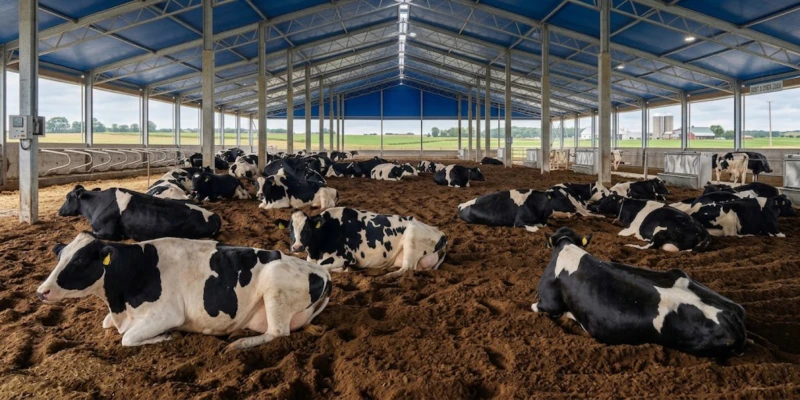
A freestall barn divides the resting area into individual cubicles with fixed dimensions, separated by metal dividers, each containing a mattress or sand bed. Cows must enter, position themselves within, and exit a confined space every time they lie down and stand up. A compost barn provides a single open resting area filled with deep composting bedding — no dividers, no cubicles, no constraints. Cows choose where, when, and how to lie freely.
This guide compares the two systems across every factor that matters to a dairy farmer — cow health, milk production, building cost, operating cost, labor, and longevity — so you can make the housing investment that delivers the best returns for your herd and your business.
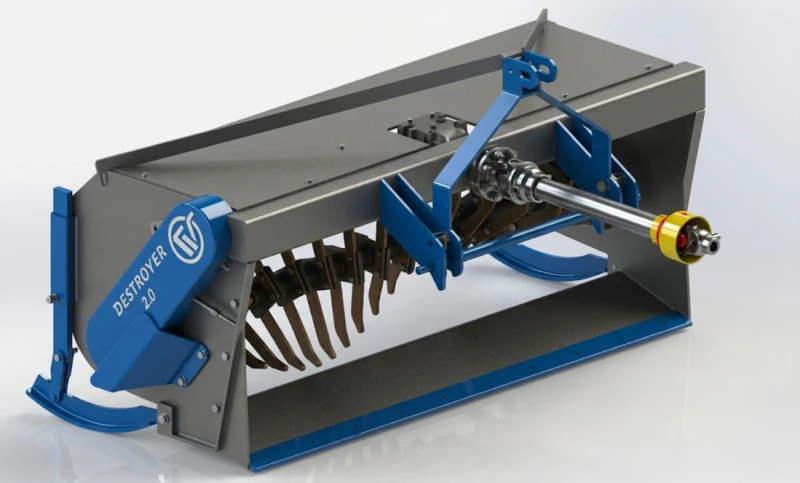
Complete Head-to-Head Comparison
| Factor | Compost Barn | Freestall Cubicle |
|---|---|---|
| Resting surface | Deep composting bedding (warm, dry, cushioned) | Mattress, sand, or rubber mat in individual cubicle |
| Freedom of movement | Unrestricted — cows lie anywhere | Restricted — must fit within cubicle dimensions |
| Daily lying time | 12-14 hours | 9-11 hours |
| Somatic Cell Count (SCC) | 30-50% lower (self-sanitizing bedding) | Baseline (depends on management) |
| Lameness incidence | 50-80% lower (soft, dry surface) | Higher (concrete exposure, cubicle injuries) |
| Hock lesions | Near zero (no hard contact points) | Common (cubicle surfaces, dividers) |
| Milk yield effect | +5 to 15% (more lying time, less stress) | Baseline |
| Cow longevity | Extended (fewer health culls) | Shorter (lameness/mastitis culls) |
| Building complexity | Simple (open area, no hardware) | Complex (cubicles, scrapers, mattresses) |
| Daily management | Twice-daily stirring (30-60 min) | Scraping, cubicle grooming, mattress management |
| Bedding cost | Higher (continuous sawdust supply) | Lower (mattress/sand replacement periodic) |
| Manure handling | Composted in place — high-value fertilizer output | Scraped or flushed — slurry storage required |
| Animal welfare score | Highest | Moderate to good |
The Health Evidence: What the Data Shows
|
Lying Time: 12-14 vs 9-11 Hours Cows in compost barns lie down 2 to 4 hours longer per day than cows in freestall cubicles. This is not because compost barn cows are lazier — it is because the surface is genuinely more comfortable and there are no physical barriers (dividers, neck rails) that make lying down and standing up difficult. The research consensus is clear: every additional hour of lying time correlates with approximately 1 to 1.5 kg more daily milk production. This simple metric alone accounts for a significant portion of the yield difference between the two systems. |
|
Mastitis and SCC: 30-50% Reduction The composting process generates sustained temperatures of 45 to 65 degrees Celsius inside the bedding pack — well above the thermal kill point for E. coli, Klebsiella, Streptococcus uberis, and other mastitis-causing bacteria. In freestall cubicles, contaminated mattress surfaces and wet alleys maintain pathogen populations year-round. The compost barn’s self-sanitizing bedding breaks this cycle. Farms switching from freestall to compost barn typically see bulk tank SCC drop from 250,000-350,000 to 150,000-200,000 cells/ml within the first 6 to 12 months. |
|
Lameness: 50-80% Reduction Lameness is the most economically damaging health condition in dairy farming — lame cows eat less, produce less milk, conceive later, and are culled earlier. The primary causes — digital dermatitis, sole ulcers, white line disease — are all associated with wet, abrasive walking surfaces and hard lying surfaces that concentrate pressure on the hoof. In a compost barn, cows walk and lie on soft, dry bedding. The mechanical forces that cause hoof damage are dramatically reduced. Farms routinely report lameness prevalence dropping from 20-30 percent to under 5 percent. |
|
Cow Longevity: 0.5-1.5 Additional Lactations Lower mastitis, lower lameness, and better overall welfare translate directly into longer productive life. Cows that would have been culled for health reasons in a freestall system remain productive for one or more additional lactations in a compost barn. Every additional lactation avoids the cost of a replacement heifer and adds a full year of milk revenue from a mature, high-producing cow. |
The Economics: Total Cost of Ownership Over 10 Years
| Cost/Revenue Factor | Compost Barn | Freestall |
|---|---|---|
| Building cost per cow place | Often lower (simpler structure) | Often higher (cubicles, scrapers, mattresses) |
| Equipment needed | Stirrer (DESTROYER) + tractor | Scraper system + mattress replacements |
| Annual bedding cost | Higher (sawdust ongoing) | Lower (mattress/sand periodic) |
| Veterinary costs | Significantly lower (less mastitis, lameness) | Higher |
| Milk revenue per cow | +5 to 15% (more production) | Baseline |
| SCC premium/penalty | Premium (low SCC) | Variable |
| Replacement heifer savings | Significant (longer cow life) | Higher culling rate |
| Compost value (output) | High-value soil amendment | Slurry (lower value, storage cost) |
| Net economic outcome (10 yr) | Higher revenue, lower health cost → higher net profit | Lower bedding cost offset by higher vet/cull cost |
The Bottom Line: The compost barn’s higher bedding cost is more than offset by increased milk production, reduced veterinary expenses, lower culling/replacement costs, SCC premiums, and the value of composted bedding as a high-quality soil amendment. Over a 10-year horizon, most analyses show the compost barn delivering higher total net profit per cow place than a freestall of equivalent construction quality.
When a Freestall Is Still the Better Choice
|
Sawdust/shavings are unavailable or extremely expensive in your region The compost barn’s ongoing bedding cost is its primary operating expense. In regions without a reliable, affordable supply of dry carbon-rich bedding material, the cost balance may shift in favor of a sand-bedded or mattress-based freestall system. Check local sawdust availability and pricing before committing. |
|
Very large herds (500+ cows) with existing freestall infrastructure Converting a large, functioning freestall to compost barn requires significant capital and the bedding volume for 500+ cows is substantial. For very large herds with well-managed existing freestall systems (low SCC, low lameness already), the incremental improvement from switching may not justify the conversion cost. New builds are a different calculation — compost barn design is often simpler and cheaper per cow place from scratch. |
|
Robotic milking systems requiring cow traffic management Some robotic milking installations require controlled cow traffic through gates and pathways that a fully open compost barn layout may complicate. Freestall layouts integrate more naturally with robot traffic management. However, compost barns with robot-compatible layouts do exist and are becoming more common as the two technologies co-evolve. |
The Factor That Determines Success or Failure: Stirring
A compost barn’s advantages — warm surface, pathogen kill, dry bedding, cow comfort — exist only when the bedding is stirred deeply and consistently. Without adequate stirring, the bedding compacts, goes anaerobic, becomes cold and wet, and the system fails. This is why the choice of stirring equipment is not a secondary decision — it is the single most important management tool in the entire system.
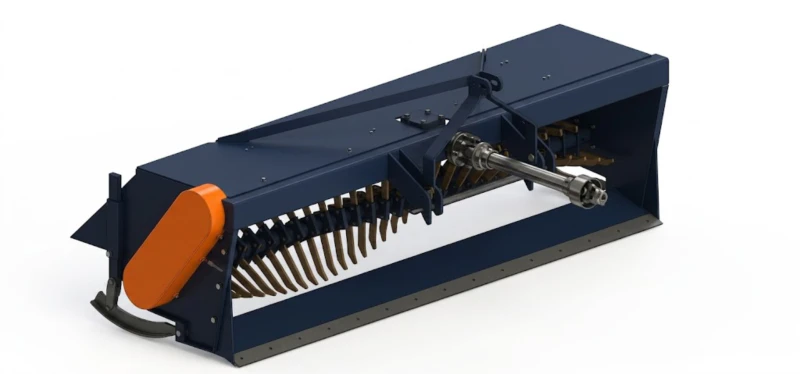
The DESTROYER series stirs to 80 cm depth — reaching the bottom of the composting pack where anaerobic conditions develop first. Competing stirrers that reach only 30 to 50 cm leave the lower half of the pack untreated, creating a wet, cold, odorous layer beneath an apparently dry surface. The difference between 50 cm and 80 cm stirring depth is the difference between a compost barn that works and one that fails.
| Factor | DESTROYER (80 cm) | Typical Competitors (30-50 cm) |
|---|---|---|
| Pack fully aerated? | Yes — bottom to top | No — bottom half anaerobic |
| Composting temperature | 45-65°C throughout | 45-65°C top half only |
| Odor risk | Minimal (fully aerobic) | Higher (anaerobic bottom layer) |
| Min. tractor power | 75-80 hp | Often 100+ hp |
| Machine weight | 460-660 kg | Often 800-1,500+ kg |
Decision Matrix: Which System Fits Your Farm?
| Your Situation | Best Choice |
|---|---|
| New build, affordable sawdust available | Compost Barn |
| High SCC or mastitis problems in current system | Compost Barn |
| High lameness rate in current system | Compost Barn |
| Organic or welfare-certified dairy | Compost Barn |
| Herd under 200 cows, want simplest management | Compost Barn |
| No reliable local sawdust supply | Freestall (sand or mattress) |
| 500+ cows with existing well-managed freestall | Keep Freestall (evaluate conversion case) |
| Robotic milking with complex traffic routing | Freestall (easier robot integration) |
Frequently Asked Questions
|
Q1: Do compost barns really produce more milk? Yes. The 5 to 15 percent increase is documented across hundreds of commercial farms. The mechanism is straightforward: more lying time means more rumination means more feed digestion means more milk. Add lower stress, better hoof health, and fewer disease setbacks, and the cumulative effect on lactation performance is substantial and consistent. |
|
Q2: How much sawdust does a 100-cow compost barn use per year? Approximately 800 to 1,200 m3 per year (initial fill plus monthly top-ups plus 1 to 2 complete replacements). This is the most significant ongoing cost. However, the spent compost has high value as a soil amendment for crop fields — some farms recover 30 to 50 percent of the bedding cost through compost sales or on-farm use. |
|
Q3: Can I convert my existing freestall barn? Often yes. Remove cubicle hardware, level and seal the floor, ensure adequate ventilation (open ridge is mandatory), confirm doorway width for the DESTROYER, fill with bedding, and begin stirring. Many successful compost barns are freestall conversions. The building shell is reused; only the internal layout changes. |
|
Q4: Is the compost barn system proven in cold climates? Yes. Compost barns operate successfully in Canada, Scandinavia, the northern US, and other cold climates. The composting process generates internal heat (45-65 degrees Celsius) that keeps the bedding surface warm even in sub-zero ambient temperatures. Cows lying on warm compost in winter are more comfortable than cows on cold concrete or frozen mattresses in a freestall. |
|
Q5: What about flies and insects? Active composting at 45-65 degrees Celsius kills fly larvae in the bedding. Well-managed compost barns typically have lower fly populations than conventional barns with exposed manure. If the composting process stalls (surface becomes wet and cool), fly populations can increase — another reason why consistent deep stirring with the DESTROYER is essential. |
|
Q6: Can heifers and dry cows use the same compost barn? Yes. Many farms house the entire herd — milking cows, dry cows, and bred heifers — on compost bedding, with the milking herd in the main barn and dry/heifer groups in a separate section or adjacent barn. The system works for all cattle types and ages. |
|
Q7: How do I get started? Contact our team with your herd size, current housing type, local sawdust availability, and climate. We will recommend the right DESTROYER model, confirm barn compatibility, and provide factory-direct pricing. See our complete setup guide: How to Start a Compost Barn. |
.webp "The Result: Comfortable Cows, More Milk, Lower Costs")
Your Cows Deserve Better. Your Business Deserves the Returns.
The evidence is overwhelming: compost barns deliver better cow health, higher milk production, and stronger financial returns than conventional freestall housing for the majority of dairy farms. The one piece of equipment that makes it all work is the deep-stirring machine. The DESTROYER series delivers 80 cm stirring depth at 75-80 hp — the deepest, lightest, lowest-power compost barn stirrer available. Factory-direct pricing, worldwide delivery.
|
DESTROYER Quote 2.0 or 3.0 pricing |
Conversion Assessment Can your barn convert? |
Dealer Opportunities Dairy equipment range |