Stones Do Not Appear on Your Profit-and-Loss Statement — But They Should
Every farm with stony ground pays a stone tax. It is not called that on any invoice, but it is present in every budget line: higher repair costs, shorter equipment life, slower working speeds, more bruised product, more downtime, more rejected loads, more fuel consumed per hectare. These costs accumulate silently — spread across dozens of invoices, invisible to any single transaction — but their combined impact on profitability is enormous. Farmers on stony land consistently operate at 15 to 30 percent higher cost per tonne than farmers on stone-free land, without realizing how much of that gap is caused by the stones themselves rather than by other variables.
This article catalogues every cost that stones impose on a farming operation, quantifies the annual financial impact on a representative 100-hectare potato farm, and presents the economic case for eliminating stones permanently with a one-time crushing treatment.
The 7 Hidden Costs of Stony Farmland
|
Cost 1: Tillage Equipment Damage — Blades, Shares, and Tines Plough shares, rotavator blades, cultivator tines, and disc harrow blades are designed to cut through soil — not to smash into rock. When a blade strikes a stone, the impact bends, chips, or breaks the blade. On severely stony ground, a full set of rotavator blades (PSW-3200) may last only 50 to 100 hectares instead of the 200 to 400 hectares achievable on stone-free ground. That is 2 to 4 times more blade replacements per season — multiplied by the cost per set, the downtime per replacement, and the frustration of unpredictable breakdowns. Typical annual cost (100 ha stony ground): 3 to 6 extra blade/share sets per year × replacement cost + 6 to 12 hours unplanned downtime. |
|
Cost 2: Planter Jams and Skips — Lost Plant Population Stones in the seed zone jam the planter’s cup-belt mechanism, causing skips (empty stations where no tuber was placed) and doubles (two tubers in one station). Each skip reduces plant population; each double produces two undersized plants competing for the same space. On stony ground, skip rates of 3 to 8 percent are common — compared to under 1 percent on stone-free ground. On a 100-hectare crop at 44,000 plants/ha, a 5 percent skip rate represents 220,000 missing plants — directly reducing yield by approximately 5 percent. Typical annual cost (100 ha): 5% yield loss on a 40 t/ha crop = 200 tonnes of lost production. |
|
Cost 3: Harvest Bruising — Ware Downgraded to Processing Stones are the primary cause of mechanical tuber bruising during harvest. As the harvester (CWB-2L) or digger lifts the ridge, stones travel alongside tubers through the sieve chain. Each stone-to-tuber impact creates internal bruising (black spot) that downgrades the tuber from premium ware to lower-value processing grade. The price difference between ware and processing grade is typically 20 to 40 percent of the sale price. Typical annual cost (100 ha): If 10% of the crop is downgraded from ware to processing due to stone bruising at a price gap of 30%, the revenue loss = 4,000 tonnes × 10% × 30% price gap = equivalent of 120 tonnes of production value lost. |
|
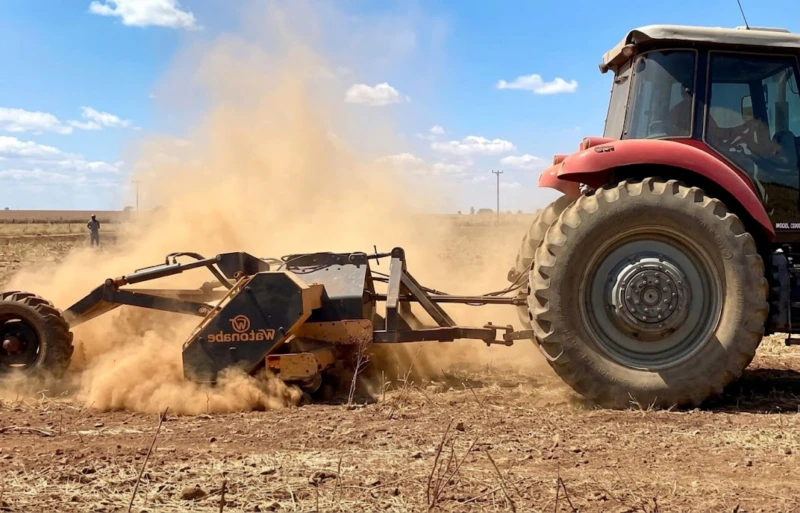
Cost 4: Harvester Wear and Damage — Sieves, Chains, and Shares Stones passing through the harvester accelerate wear on every surface they contact: digging shares, sieve web bars, star wheels, rubber rollers, and elevator chain flights. A CWB-2L harvester operating on stony ground may need sieve web replacement every 1 to 2 seasons instead of every 3 to 5 seasons on stone-free ground. Shares wear to half life in half the hectares. Large stones can jam the sieve mechanism, causing emergency stops and potential structural damage to the sieve frame. Typical annual cost (100 ha): 2 to 3 times higher annual harvester maintenance and parts budget versus stone-free operation. |
|
Cost 5: Reduced Working Speed — Everything Takes Longer Operators on stony ground instinctively reduce forward speed to protect equipment from stone impacts. The rotavator that could work at 3 to 4 km/h on clean ground runs at 1.5 to 2.5 km/h on stony ground. The harvester that could manage 5 to 6 km/h slows to 3 to 4 km/h to allow the sieve time to separate stones from tubers. Every operation takes 30 to 50 percent longer — consuming more fuel, more operator hours, and more machine hours per hectare. Typical annual cost (100 ha): 30 to 50 percent more tractor hours per season = 30 to 50 percent more fuel, operator wages, and machine depreciation per hectare. |
|
Cost 6: Stone Contamination Penalties — Processor and Buyer Rejections Potatoes delivered to processors or packhouses with stone contamination above the specification limit (typically 1 to 3 percent by weight) are either rejected outright (returned to sender at farmer’s transport cost) or accepted at a contractual penalty deduction of 5 to 15 percent of the load value. On stony land without dedicated de-stoning at the grading line, stone contamination rates of 3 to 10 percent are common — triggering penalties on every load. Typical annual cost (100 ha): 5 to 15 percent price penalty on contaminated loads, or the additional cost of de-stoning equipment at the grading line. |
|
Cost 7: Uneven Ridge Formation — Greening and Misshapen Tubers Stones embedded in the ridge zone prevent the furrower (R-380/R-580) from forming a smooth, uniform ridge. Stones create gaps and voids in the ridge surface where sunlight penetrates, causing greening (solanine production) that makes affected tubers unsaleable. Stones also physically deflect growing tubers, producing misshapen or cracked tubers that are downgraded or discarded. On stony ground, greening and shape rejection rates of 2 to 5 percent are common. Typical annual cost (100 ha): 2 to 5 percent of the crop unsaleable due to greening and deformation = 80 to 200 tonnes discarded or downgraded. |
Total Annual Impact: The Stone Tax on a 100-Hectare Potato Farm
| Cost Category | Annual Impact |
|---|---|
| 1. Tillage equipment damage | 3-6 extra blade sets + downtime |
| 2. Planter skips (5% yield loss) | 200 tonnes lost production |
| 3. Harvest bruising (10% downgrade) | 120 tonnes equivalent value lost |
| 4. Harvester wear (2-3x maintenance) | Doubled parts and repair budget |
| 5. Reduced working speed (+30-50% time) | 30-50% more fuel and labour |
| 6. Stone contamination penalties | 5-15% price deduction on loads |
| 7. Greening and misshapen tubers | 80-200 tonnes discarded |
| Combined annual “stone tax” | 15-30% higher cost per tonne vs. stone-free land |
The critical insight: No single stone cost is catastrophic in isolation. Each one looks like “normal farming” — a broken blade here, a downgraded load there, slightly slower progress. But combined, they add 15 to 30 percent to the cost of every tonne produced. Over 10 years on 100 hectares, the cumulative stone tax dwarfs the cost of a one-time crushing treatment that eliminates all seven costs permanently.
The Solutions Spectrum: Which Costs Does Each Method Eliminate?
| Cost | Rock Rake | Rock Picker | Rotavator | THOR Crusher |
|---|---|---|---|---|
| 1. Tillage damage | Partially | Partially | No (stones still there) | Yes — permanently |
| 2. Planter jams | Partially | Partially | Temporarily | Yes — permanently |
| 3. Harvest bruising | No | Partially | Temporarily | Yes — permanently |
| 4. Harvester wear | No | Partially | Temporarily | Yes — permanently |
| 5. Slow working speed | Slightly | Slightly | Temporarily | Yes — permanently |
| 6. Contamination penalties | No | Partially | Temporarily | Yes — permanently |
| 7. Greening / misshapen | No | Partially | Temporarily | Yes — permanently |
| Permanence | Repeat annually | Repeat annually | Repeat with tillage | One-time, 10-20+ yrs |
Only stone crushing addresses all seven costs permanently. Raking and picking remove surface stones temporarily — but new stones surface with every tillage pass. Rotavating buries stones below tillage depth temporarily — but deep ploughing or frost heave brings them back. Crushing destroys the stone at the molecular level. It cannot reform, resurface, or reappear. For the complete comparison, see: Rock Rake vs. Rock Picker vs. Stone Crusher: Which One Do You Need?
.webp "Before and After: The THOR Eliminates All 7 Stone Costs Permanently")
The Payback: Crushing Cost vs. Annual Stone Tax
|
One-time crushing cost The THOR 2.4 or 3.0 treats 2 to 8 hectares per day depending on stone density. For 100 hectares at contractor rates, the total crushing cost is a fixed, one-time investment. For farms with ongoing needs (multiple fields over years), purchasing the THOR reduces the per-hectare cost further. |
|
Annual stone tax eliminated After crushing: tillage equipment lasts 2 to 5 times longer, planter skip rates drop to under 1 percent, harvest bruising from stones drops to near zero, harvester maintenance returns to manufacturer-standard intervals, working speeds increase 30 to 50 percent, contamination penalties disappear, and greening from stone-induced ridge gaps is eliminated. These savings recur every season for 10 to 20+ years. |
|
Typical payback period On most stony potato farms: 1 to 3 seasons. The combined annual stone tax typically exceeds the one-time crushing cost within the first 1 to 3 years. Every season after payback is pure saving — the cost is gone, and the savings continue for the life of the treatment. |
Frequently Asked Questions
|
Q1: How do I know if my stone costs are significant enough to justify crushing? Add up your annual expenditure on tillage blade replacement, harvester parts replacement, bruised-product downgrading, stone-contamination penalties, and the extra fuel from slow working speeds. If this total exceeds the per-hectare crushing cost amortized over 10 years, crushing pays for itself. On most stony potato farms, the answer is yes. |
|
Q2: Can I hire a crusher instead of buying one? Yes. Contractor crushing services are available in many regions. For a one-time treatment of 50 to 200 hectares, hiring a contractor with a THOR is often more economical than purchasing. For farms with ongoing needs (new fields each year, contractor business model), purchasing provides scheduling independence and lower per-hectare cost. Contact us for both purchase and contractor referral. |
|
Q3: Does crushing work on all stone types? The THOR crushes limestone, sandstone, shale, granite, basalt, flint, and mixed glacial deposits. Extremely hard rock (dense granite, quartzite) requires more power and slower forward speed but is still processable. Tungsten carbide tools are standard for all stone types. See: What Is a Stone Crusher and How Does It Work? |
|
Q4: My stones are only on the surface — do I still need crushing? Surface-only stones can be managed with a rock rake (EW-4000) or rock picker (CT-2100). However, if tillage brings new stones to the surface every year, the surface stones are symptoms of a deeper stone profile — and crushing the full tillage depth produces a permanent solution while raking and picking must be repeated annually. |
|
Q5: Does this apply to crops other than potatoes? Yes — but potatoes are the most sensitive crop to stone costs because of harvest bruising, planter sensitivity, and processor quality standards. Other crops affected include carrots, onions, sugar beet (harvester damage), and any crop with precision planting requirements. Stone costs also apply to non-crop operations: road building, construction site preparation, and pasture improvement. |
|
Q6: How do I get a crushing quote or stone assessment? Contact our team with your total hectarage, stone density (light/moderate/heavy), predominant rock type, and current tractor HP. We will recommend the right THOR model, provide factory-direct pricing, and connect you with local contractor services if hiring is preferred. |
Every Stone in Your Field Is Costing You Money. Crushing Stops the Bill — Permanently.
The stone tax is invisible because it is distributed across every operation, every repair invoice, and every downgraded load. But add it up and it represents 15 to 30 percent of your production cost — year after year, decade after decade. One crushing treatment with the THOR 2.4 or THOR 3.0 eliminates all seven costs permanently. The investment pays back in 1 to 3 seasons. After that, every saved euro goes straight to margin. Factory-direct pricing, worldwide delivery.
|
THOR Quote 2.4 or 3.0, purchase or hire |
Stone Cost Analysis Your farm’s stone tax calculated |
Contractor Services Hire crushing in your region |