The Specification No One Talks About — That Determines Whether Your Compost Barn Works or Fails
When dairy farmers evaluate compost barn stirrers, they compare working width, tractor power, price, and brand. What they rarely compare — and what matters more than any other specification — is stirring depth. How deep the tines penetrate into the composting bedding pack determines whether the entire pack composts actively or whether only the top half works while the bottom half becomes an anaerobic, cold, wet, odorous failure hidden beneath an apparently functional surface.
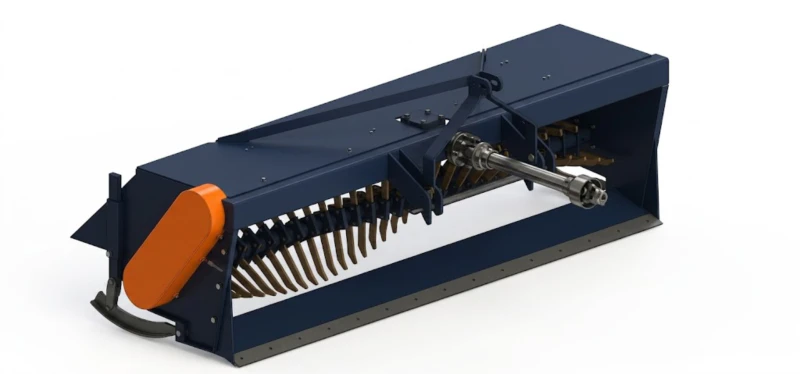
Most compost barn stirrers on the market work to 30 to 50 cm depth. The DESTROYER series works to 80 cm. This is not a minor incremental difference — it is the difference between aerating the entire composting zone and aerating only the top third. The consequences for bedding temperature, moisture management, pathogen kill, odor control, and ultimately cow health are profound and measurable.
This article explains the science behind why depth matters, shows what happens at each layer of the compost pack, and demonstrates why 80 cm is the minimum depth required for a fully functional compost barn.
Inside the Pack: What Happens at Each Depth Layer
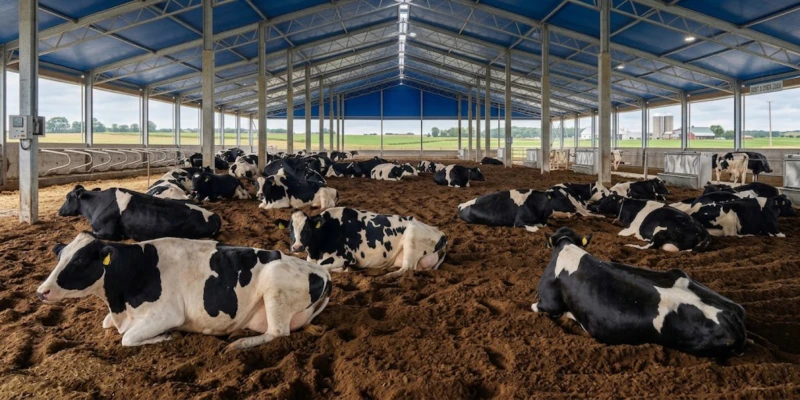
A typical compost barn bedding pack is 60 to 100 cm deep. Within this depth, distinct zones develop based on oxygen availability, temperature, and moisture content. Understanding these zones is essential to understanding why stirring depth determines the success of the entire system:
|
Surface Layer (0 to 15 cm) — The Cow Contact Zone This is where cows lie. It must be dry, warm, and pathogen-free. Moisture from urine and manure accumulates here. Without stirring, this layer becomes wet and compacted within hours — creating exactly the cold, damp conditions that promote mastitis bacteria. Stirring brings dry, warm material from the interior to the surface while pushing the wet surface material down into the hot composting zone for drying. Every stirrer reaches this zone — it is the minimum functional depth. |
|
Active Composting Zone (15 to 50 cm) — The Heat Engine This is where aerobic decomposition generates the heat (45 to 65 degrees Celsius) that drives the entire system. Aerobic bacteria break down organic matter, consume oxygen, and produce heat, CO2, and water vapor. This heat dries the surrounding bedding and kills pathogens. As long as oxygen is supplied through stirring, this zone operates efficiently. A 30 to 50 cm stirrer reaches this zone and maintains it — but misses everything below. |
|
Deep Zone (50 to 80+ cm) — The Hidden Failure Zone Below 50 cm, oxygen supply from surface diffusion alone is insufficient. Without mechanical stirring reaching this depth, the deep zone becomes anaerobic — oxygen-depleted. Anaerobic decomposition produces methane, hydrogen sulfide (rotten-egg smell), and ammonia instead of heat and CO2. The temperature drops. Moisture accumulates (anaerobic decomposition produces water rather than consuming it). Pathogen populations that thrive in low-oxygen conditions build up. This cold, wet, odorous layer sits beneath the apparently functional upper half, acting as a reservoir of problems that eventually migrate upward. |
The Core Problem: A stirrer that reaches only 30 to 50 cm treats the surface and active zone but never touches the deep zone. The deep zone becomes a permanent anaerobic layer that grows wetter, colder, and more odorous over time — undermining the entire system from below while the surface appears to be working normally. The farmer sees a dry surface and assumes the system is functional; the reality beneath is the opposite.
The Temperature Story: Aerobic Heat vs. Anaerobic Cold
| Depth | With 80 cm Stirring | With 30-50 cm Stirring |
|---|---|---|
| Surface (0-15 cm) | Warm, dry (freshly stirred material) | Warm, dry (freshly stirred material) |
| 20-30 cm | 45-65°C (active composting) | 45-65°C (active composting) |
| 40-50 cm | 45-60°C (still composting) | 35-45°C (declining, edge of stirred zone) |
| 50-60 cm | 40-55°C (aerated by DESTROYER) | 20-30°C (anaerobic, cooling) |
| 60-80 cm | 35-50°C (aerated by DESTROYER) | 15-25°C (anaerobic, cold, wet) |
The temperature profile tells the story clearly. With 80 cm stirring, the entire pack from surface to floor maintains composting temperatures. With 30 to 50 cm stirring, the bottom 30 to 50 cm drops below composting temperature — it is no longer generating heat, no longer killing pathogens, no longer evaporating moisture. It is a cold, wet dead zone that undermines the warm, functional zone above it.
Five Consequences of Insufficient Stirring Depth
|
Consequence 1: Odor — The First Warning Sign An aerobic compost barn smells earthy and warm — like a forest floor. When the deep zone goes anaerobic, it produces hydrogen sulfide (rotten eggs) and ammonia. These gases seep upward through the pack and become noticeable in the barn air. If your compost barn has a persistent unpleasant smell, the deep zone is almost certainly anaerobic — and your stirrer is not reaching it. |
|
Consequence 2: Wet Surface Despite Stirring If the deep zone is cold and waterlogged, moisture migrates upward through capillary action into the stirred zone. The surface becomes persistently damp even though you are stirring twice daily. The stirrer is cycling wet material between 0 and 40 cm, but the source of the moisture — the anaerobic deep zone — is never addressed. Deeper stirring breaks this cycle by aerating and drying the deep zone itself. |
|
Consequence 3: Incomplete Pathogen Kill Pathogen kill in composting requires sustained temperatures above 45 degrees Celsius. The deep anaerobic zone (20 to 25 degrees Celsius) provides a refuge where mastitis bacteria, E. coli, and other pathogens survive and multiply. When surface material is stirred downward into this cold zone, pathogens are not killed — they are preserved. When that material is later stirred back to the surface, it carries live pathogens into the cow contact zone. The result: SCC improvements plateau or reverse despite apparently correct surface management. |
|
Consequence 4: Faster Bedding Consumption When only the top 30 to 50 cm is actively composting, the effective composting volume is halved. This means the active zone is overloaded with moisture and organic matter relative to its volume, causing faster material breakdown and more frequent bedding replacement. An 80 cm stirred pack has nearly double the active composting volume, spreading the biological load across more material and extending the interval between full bedding replacements — reducing bedding cost per year. |
|
Consequence 5: Structural Pack Failure Over months, the unstirred anaerobic deep zone becomes a dense, compacted, waterlogged layer. This layer is structurally weak — cows standing near the transition zone can punch through the stirred surface into the cold wet layer below, emerging with filthy legs and udders. In severe cases, the entire stirred surface can collapse into the waterlogged layer during tractor stirring passes, creating dangerous operating conditions and requiring emergency bedding replacement. |
Equipment Comparison: DESTROYER vs. Shallow Stirrers
| Factor | DESTROYER (80 cm) | Typical 30-50 cm Stirrer |
|---|---|---|
| Stirring depth | 80 cm (full pack) | 30-50 cm (top half only) |
| Pack fully aerated? | Yes — bottom to surface | No — bottom 30-50 cm anaerobic |
| Composting temperature throughout | 45-65°C full depth | 45-65°C top half / 15-25°C bottom half |
| Pathogen kill zone | Entire pack (no refuge) | Top half only (bottom = pathogen reservoir) |
| Odor risk | Minimal (fully aerobic) | Ongoing (anaerobic gases from deep zone) |
| Surface moisture control | Effective (deep zone also drying) | Compromised (moisture wicking up from deep) |
| Effective composting volume | 100% of pack | 40-60% of pack |
| Min. tractor power | 75-80 hp | Often 100+ hp |
| Machine weight | 460-660 kg | Often 800-1,500+ kg |
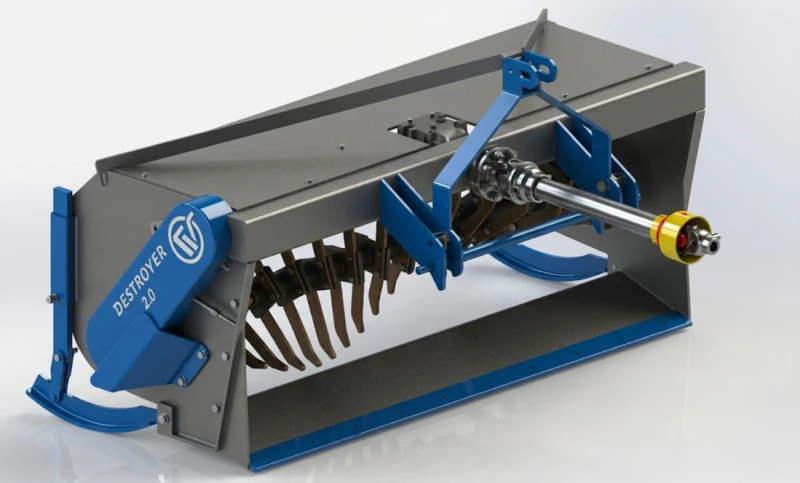
The DESTROYER achieves 80 cm depth at lower power and lower weight than many stirrers that only reach 30 to 50 cm. This is a design efficiency advantage — the DESTROYER’s rotor geometry and tine arrangement are optimized for deep penetration in soft composting material, where cutting force (not weight or power) determines effective depth. Heavier, more powerful competitors do not automatically go deeper; they are simply heavier and more expensive to operate.
How to Check If Your Current Stirrer Is Deep Enough
If you already operate a compost barn, you can test whether your current stirrer is reaching the full pack depth with a simple procedure:
|
Temperature Probe Test Insert a long compost thermometer to 20 cm, 40 cm, 60 cm, and 80 cm depth. Record temperatures at each level. If temperature drops sharply below 45 degrees Celsius at 40 to 50 cm, your stirrer is not reaching the deep zone. A fully stirred pack should maintain composting temperatures (above 40 degrees Celsius) at all depths down to the floor. |
|
Moisture Feel Test Push your arm (wearing a long glove) to 60 to 80 cm depth immediately after stirring. If the material at this depth feels significantly wetter, colder, and more compacted than the material at 20 to 30 cm, the deep zone is anaerobic and not being stirred effectively. |
|
Odor Test After stirring, stand at the end of the barn and inhale. A properly composting pack smells earthy and warm. If you detect ammonia, sulfur (rotten eggs), or a strong sour smell, anaerobic decomposition is occurring in unstirred zones. The deeper the source of the odor, the worse the anaerobic problem — and the more critical the need for deeper stirring. |
DESTROYER Models: 80 cm Depth in Two Widths
| Spec | DESTROYER 2.0 | DESTROYER 3.0 |
|---|---|---|
| Working Width | 2 m | 3 m (+50%) |
| Working Depth | 80 cm (both models — identical depth) | |
| Min. Power | 75 hp | 80 hp |
| Weight | 460 kg | 660 kg |
| Stirring time (100-cow barn) | 45-60 min | 30-45 min |
| Best For | Smaller barns, narrow doors | Larger barns, fastest coverage |
Frequently Asked Questions
|
Q1: My current stirrer reaches 40 cm and the surface looks fine. Is there really a problem? Possibly. The surface can appear dry and warm while the bottom 40 to 50 cm is anaerobic, cold, and wet. Use the temperature probe test to check. If temperature at 60 cm depth is below 40 degrees Celsius, you have a deep anaerobic zone that is compromising pathogen kill, generating odor, and wicking moisture upward toward the surface. The surface appearance is misleading. |
|
Q2: Can I just make my bedding shallower to match my stirrer depth? You could reduce bedding depth to match your stirrer, but shallow packs (under 50 cm) have less thermal mass, less moisture buffering capacity, and provide less cushion for the cows. The system works best with 60 to 80+ cm of bedding stirred to its full depth. Reducing bedding to match a shallow stirrer is a compromise that degrades every benefit of the compost barn system. |
|
Q3: Why does the DESTROYER reach 80 cm at only 75-80 hp when competitors need 100+ hp for less depth? The DESTROYER’s rotor and tine design are optimized for penetrating soft composting material — not hard soil. Compost bedding has low density and low resistance compared to agricultural soil. The DESTROYER uses geometry and tine arrangement rather than brute force to achieve depth, keeping power demand low and weight minimal. Heavier, higher-power competitors are often adapted from soil tillage equipment rather than purpose-designed for compost barn conditions. |
|
Q4: How quickly will I see improvement if I switch from a 40 cm stirrer to the DESTROYER? Pack temperature at depth will increase within the first week as the previously anaerobic zone is aerated for the first time. Surface moisture will improve within 2 to 3 weeks as the deep moisture reservoir is broken up. Odor reduction is usually noticeable within days. SCC improvement follows within 4 to 8 weeks as the pathogen reservoir in the deep zone is eliminated by sustained composting temperatures. |
|
Q5: Is 80 cm deep enough for packs deeper than 80 cm? In most compost barns, the pack is 60 to 100 cm deep. At 80 cm stirring depth, the DESTROYER reaches the bottom of packs up to 80 cm and the near-bottom of 100 cm packs. The lowest 10 to 20 cm of a very deep pack rests on the concrete floor and receives minimal organic input — it naturally has less composting activity. 80 cm stirring covers the full active zone in virtually all standard barn configurations. |
|
Q6: Will the DESTROYER damage my barn floor at 80 cm depth? No. The stirring depth is controlled by the tractor’s three-point hitch height setting. Set the depth so the tines stir the bedding without contacting the concrete floor. The operator adjusts this once and monitors periodically. On earth-floor barns, the DESTROYER stirs to the full 80 cm without floor contact issues. |
|
Q7: I am building a new compost barn. What stirrer should I buy? The DESTROYER 3.0 (3 m, 80 hp) for barns over 80 cows — fastest coverage per pass. The DESTROYER 2.0 (2 m, 75 hp) for smaller barns or narrow doorways. Both reach the full 80 cm depth. Design your barn doorways to accommodate the 3.0 (minimum 3.5 m width) — even if you start with the 2.0, the wider door preserves the option to upgrade later. |
|
Q8: How do I get a DESTROYER quote? Contact our team with your barn dimensions, herd size, current stirrer (if any), doorway width, and tractor power. We will recommend the right model and provide factory-direct pricing including shipping. |
.webp "The Result of 80 cm Stirring: Warm, Dry, Pathogen-Free Surface — Every Day")
30 cm Does Half the Job. 80 cm Does All of It.
Stirring depth is not a nice-to-have specification — it is the difference between a compost barn that works and one that pretends to. The DESTROYER series delivers 80 cm depth at 75-80 hp, 460-660 kg, and zero hydraulics — the deepest, lightest, simplest compost barn stirrer available. Factory-direct pricing, worldwide delivery.
|
DESTROYER Quote 2.0 or 3.0 pricing |
Depth Test Advice Is your current stirrer deep enough? |
Dealer Opportunities Compost barn equipment range |