Same Stony Field, Two Very Different Solutions
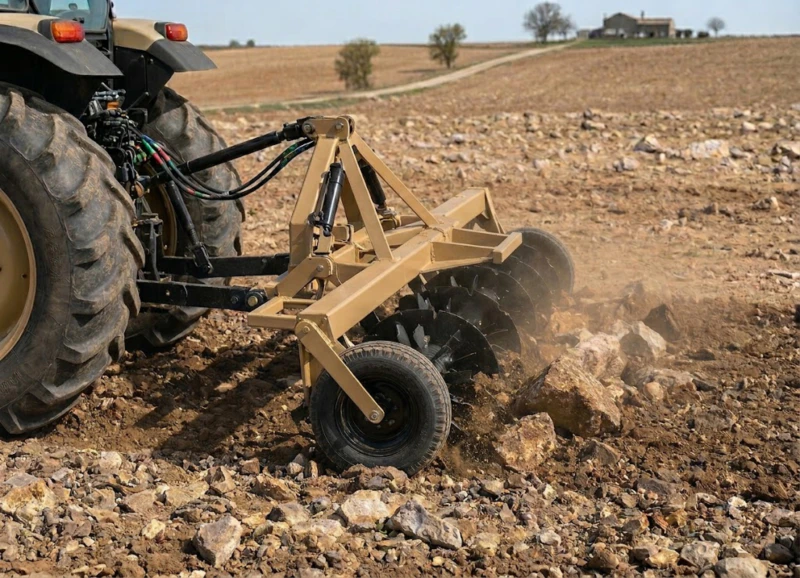
A stone-burying rotavator and a stone crusher both leave the field surface looking clean and ready for work. But what they have done to the stones underneath could not be more different. The rotavator hides the stones below the seedbed — intact, unchanged, and waiting. The crusher destroys them — permanently converting obstacles into beneficial soil particles that improve drainage and structure.
Neither machine is universally “better.” Each one is the correct choice under specific conditions of soil type, stone characteristics, crop plan, tillage system, and operational context. Choosing the wrong machine for your conditions wastes money. Choosing the right one solves the problem efficiently and economically.
This guide is the technical decision framework. It answers the practical question: given YOUR soil, YOUR stones, YOUR crops, and YOUR equipment — should you bury or crush?
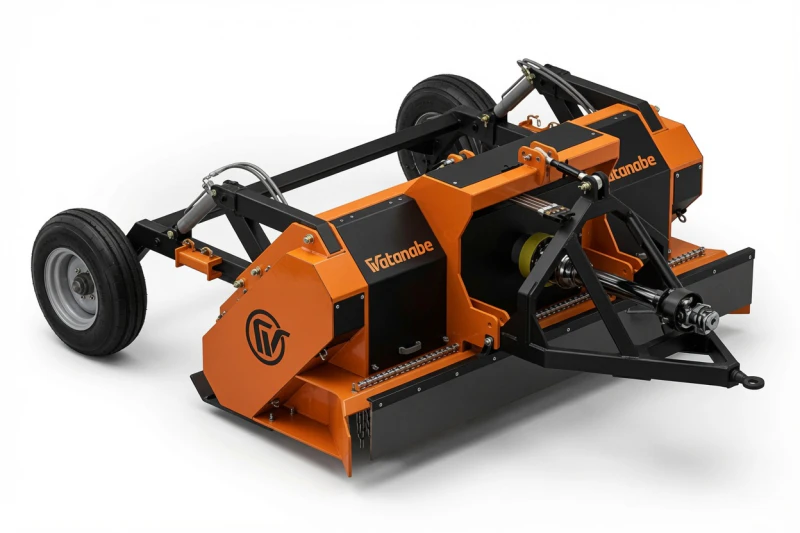
The Fundamental Technical Difference
| Factor | Stone-Burying Rotavator (PSW-3200) | Stone Crusher (THOR 2.4 / 3.0) |
|---|---|---|
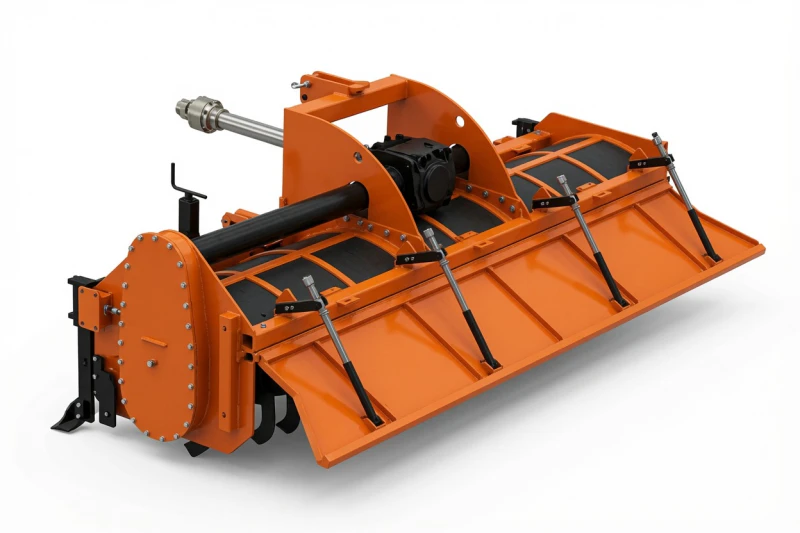
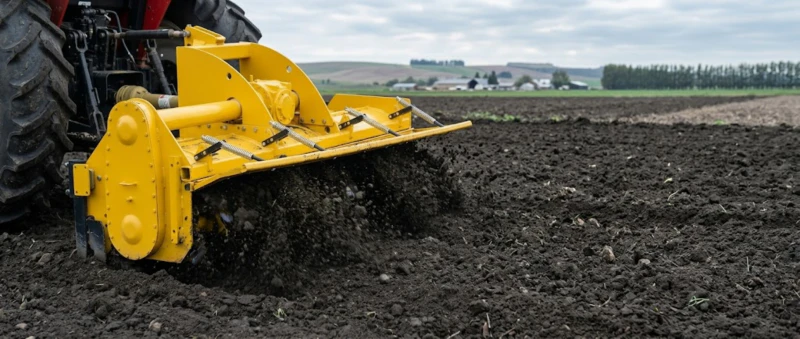
| Mechanism | PTO rotary blades till soil and push stones downward beneath cultivated layer | PTO hammer rotor pulverizes stones against hydraulic anvil into fragments under 50 mm |
| Stone Outcome | Intact, relocated 20-30 cm below surface | Destroyed, integrated into soil |
| Secondary Function | Creates finished seedbed simultaneously | Crushes stones; separate tillage pass needed for seedbed |
| Can Stones Return? | Yes — frost heave and deep ploughing | No — permanently eliminated |
Decision Factor 1: Your Soil Type
Soil type fundamentally affects how each machine performs and which one delivers the better result:
|
Heavy Clay Soils Recommendation: Crusher preferred. Clay soils compact severely and drain poorly. Crushed stone particles create permanent macropore channels that dramatically improve drainage — solving two problems simultaneously. A rotavator creates fine tilth on clay but the buried stones block water movement below, and clay’s tendency to waterlog accelerates frost heave that pushes buried stones back up. |
|
Sandy and Light Soils Recommendation: Either works well. Sandy soils drain naturally, so the drainage benefit of crushing is less critical. The rotavator produces an excellent seedbed in sandy conditions with minimal power demand. However, if stone density is high and you want a permanent solution, the crusher still provides the most definitive treatment. On sand, frost heave is reduced but ploughing still resurfaces buried stones. |
|
Loam and Mixed Soils Recommendation: Based on stone severity. Loam soils respond well to both treatments. For light-to-moderate stones, the rotavator is an efficient, dual-purpose choice (tillage + burying). For moderate-to-heavy stones, the crusher is the better investment because loam soils experience enough frost heave to resurface buried stones within 2 to 4 years. |
|
Peat and Organic Soils Recommendation: Rotavator preferred. Peat soils are soft and low-density. The rotavator buries stones effectively with minimal power because the soft matrix yields easily. Crushers work on peat but the soft surrounding material provides less resistance for the anvil, potentially reducing crushing efficiency. Stones in peat tend to be scattered and variable rather than densely packed. |
Decision Factor 2: Your Stone Characteristics
| Stone Characteristic | Rotavator | Crusher |
|---|---|---|
| Small (under 100 mm) | Excellent — buries easily | Effective but may be overkill |
| Medium (100-200 mm) | Good — at rotavator capacity limit | Excellent — comfortably within range |
| Large (200-400 mm) | Cannot bury — exceeds capacity | Designed for this — up to 400 mm |
| Low density (scattered) | Efficient — handles while tilling | Works but may under-utilize capacity |
| High density (packed) | Overwhelmed — too many stones | Designed for heavy conditions |
| Surface only | Good — pushes below surface | Good — processes at surface level |
| Surface + subsurface (deep layer) | Cannot reach deep stones | Plough first, then crush exposed stones |
Rule of Thumb: If your stones are mostly under 100 mm and scattered at low density, the rotavator handles them as part of normal tillage. Once stones exceed 150 mm or density exceeds “occasional,” the crusher becomes the technically superior choice.
Decision Factor 3: Your Crop Plan
|
Potatoes and Root Crops Best: Crusher, then rotavator for seedbed. Potatoes develop underground — any stone in the ridge zone causes tuber damage at harvest. The crusher eliminates stones permanently at every depth. A rotavator follow-up creates the fine seedbed. The rotavator alone buries stones below the current ridge, but deep ploughing in rotation years resurfaces them into the next potato crop’s ridge zone. |
|
Cereals and Grain Crops Either works well. Grain crops grow above ground and are less affected by subsurface stones. The rotavator creates a fine seedbed that promotes even grain emergence. Crushing is beneficial for reducing plough and drill damage but is less critical for crop quality than in root crops. On heavily stony grain land, the crusher’s permanent solution eliminates ongoing equipment damage costs. |
|
Vegetables (Carrots, Onions, Garlic) Best: Crusher. Like potatoes, vegetables develop underground and are directly damaged by stones during mechanical harvest. Carrots in particular are extremely sensitive — a single stone can cause forking or cracking that renders the root unmarketable. The crusher permanently eliminates this risk. The rotavator helps but buried stones resurface over time. |
|
Pasture and Grassland Either works. Pasture is not mechanically harvested, so subsurface stones do not cause crop damage. The rotavator creates a fine surface for grass seed establishment. The crusher improves long-term drainage, which benefits grass growth on waterlogged soils. For dairy farms, crushed pasture land dries faster in spring, extending the grazing season. |
|
Mixed Rotation (Potatoes + Cereals + Vegetables) Best: Crusher. In a mixed rotation, the land must serve multiple crops over multiple years. Stones that are acceptable for cereals cause problems for potatoes and vegetables. The only treatment that works for all crops in a rotation is permanent elimination through crushing. The rotavator must be repeated before every root crop year, adding recurring cost and complexity. |
Decision Factor 4: Your Tillage System
| Tillage System | Rotavator Outcome | Crusher Outcome |
|---|---|---|
| Conventional (deep plough every year) | Buried stones resurfaced annually by ploughing. Treatment effectively reset to zero each year. | Stones permanently gone. Ploughing depth is irrelevant — there are no stones to resurface at any depth. |
| Minimum tillage (shallow cultivation only) | Good performance. Buried stones stay buried because shallow tillage does not reach them. Treatment lasts multiple seasons. | Permanent. Even better long-term value, but the rotavator performs well in this system too. |
| No-till / Direct drill | Not applicable — rotavator use contradicts no-till philosophy. | One-time crush before transitioning to no-till. Then stones are eliminated permanently with no further soil disturbance. |
Key Insight: If you deep plough, the rotavator’s stone burying is undone every time you plough — making it a seasonal, not long-term, solution. The crusher is the only treatment that survives every tillage practice unchanged.
Decision Factor 5: Your Climate and Frost Regime
|
Cold Climates With Deep Frost (Northern Europe, Canada, Northern US, Russia) Crusher strongly preferred. Deep freeze-thaw cycles drive aggressive frost heave that pushes buried stones to the surface rapidly — often within 1 to 2 winters. The rotavator’s burying effect is short-lived in these climates. The crusher eliminates the stones permanently regardless of frost depth or freeze-thaw frequency. |
|
Temperate Climates With Moderate Frost (Western Europe, Mid-Atlantic US, Southern Australia) Either works; choice based on other factors. Moderate frost produces slower, less aggressive heave. Rotavator-buried stones may remain below the surface for 3 to 5 years before significant resurfacing. The crusher remains the permanent solution but the rotavator has a longer effective lifespan in this climate zone. |
|
Tropical and Subtropical (No Frost) Rotavator has longest effective life. Without frost heave, buried stones stay where the rotavator places them indefinitely — unless disturbed by deep ploughing. In tropical climates, the rotavator’s lower cost and dual tillage function make it an especially attractive option. The crusher remains valuable for permanent elimination if budget allows. |
The Optimal Combination: Crush Once, Rotavate Annually
The technically optimal workflow for high-value crop production on stony land uses both machines in sequence — each doing what it does best:
| Step | Machine | Purpose | Frequency |
| 1 | THOR Stone Crusher | Permanently destroy all stones, improve drainage | Once (permanent) |
| 2 | PSW-3200 Rotavator | Annual seedbed preparation on stone-free soil | Each planting season |
In this workflow, the crusher solves the stone problem permanently (done once), and the rotavator serves its intended purpose as an annual seedbed preparation tool on already-clean soil. Neither machine is asked to do the other’s job. The rotavator is no longer fighting stones — it is simply creating the finest possible tilth from stone-free soil, which it does exceptionally well.
Quick Decision Matrix
| Your Situation | Bury (Rotavator) | Crush (THOR) |
|---|---|---|
| Small stones under 100 mm, low density | Best choice | Effective but optional |
| Stones 150-400 mm | Cannot handle | Best choice |
| Heavy clay with drainage problems | Surface tilth only | Best — permanent drainage fix |
| Tractor under 180 hp | Only option available | Insufficient power |
| Potato or root crop rotation | Temporary relief | Best — permanent crop protection |
| Deep plough every year | Undone by ploughing | Unaffected by ploughing |
| Minimum-till or no-till system | Good — stones stay buried | Best — one-time before transition |
| Cold climate, deep frost | Heave resurfaces stones fast | Best — immune to frost heave |
| Tropical, no frost | Good — no heave to undo it | Best if budget allows |
| Want the absolute best result | Both: Crush once + Rotavate annually | |
Frequently Asked Questions
|
Q1: Can a rotavator crush stones like a stone crusher? No. A rotavator’s blades are designed to cut and mix soil, not to fracture rock. They push stones aside and downward but do not break them. A stone crusher uses tungsten carbide hammers at high speed specifically designed to shatter rock. The two machines have completely different mechanical actions. |
|
Q2: How deep does each machine work? The PSW-3200 rotavator tills and buries to approximately 20 to 30 cm depth. The THOR crusher processes stones at and just below the soil surface (top 15 to 20 cm). For deeper stones, plough first to bring them to the surface, then crush. Both machines can be depth-adjusted from the tractor. |
|
Q3: Will large stones damage the rotavator? Stones exceeding approximately 200 mm diameter can damage rotavator blades, bend flanges, or jam the rotor. The machine is designed for small-to-medium stones. For larger stones, a stone crusher or preliminary rock raking is essential before rotavating. |
|
Q4: Can the PSW-3200B rotavator apply fertilizer while burying stones? Yes. The PSW-3200B has an integrated 2,000 kg fertilizer bunker, making it a 3-in-1 machine: stone burying + seedbed preparation + base fertilizer application in a single pass. This multi-function capability is a unique advantage that the crusher does not offer. |
|
Q5: What if I start with a rotavator and upgrade to a crusher later? A perfectly sensible progression. Use the rotavator for seasonal stone management while building the budget or tractor fleet for a crusher. Once the crusher treats the land permanently, the rotavator transitions to its ideal role: annual seedbed preparation on stone-free soil. |
|
Q6: In a tropical climate without frost, does it matter which I choose? Without frost heave, the rotavator’s stone burying lasts much longer because there is no natural mechanism pushing buried stones upward. The rotavator becomes a more viable long-term solution in tropical climates. The crusher remains the permanent choice, but the rotavator’s effective lifespan is greatly extended in frost-free zones. |
|
Q7: I grow only cereals. Do I really need a crusher? For cereal-only operations, the rotavator is often sufficient — cereals are less affected by subsurface stones than root crops. The crusher becomes worthwhile if your equipment repair costs from stone damage are high or if you plan to introduce root crops into the rotation in future. |
|
Q8: How do I determine my stone size distribution? Dig 5 to 10 sample holes (30 cm deep) across the field. Collect and sort the stones into size classes (under 50 mm, 50 to 100 mm, 100 to 200 mm, over 200 mm). The distribution tells you whether the rotavator can handle them (mostly under 100 mm) or whether you need a crusher (significant proportion over 150 mm). |
|
Q9: Do you manufacture both machines? Yes. We produce the PSW-3200 Rotavator series (standard, extended A, fertilizer B) and the THOR Stone Crushers (2.4 m and 3.0 m). Our recommendation is always based on your actual conditions, not on which machine has a higher price tag. |
|
Q10: How do I get a tailored recommendation? Contact our team with your soil type, stone assessment (size and density), crop rotation, tillage system, climate zone, tractor power, and budget. We will tell you honestly whether to bury, crush, or combine — and provide pricing for whichever path fits. |
Not Sure Whether to Bury or Crush? Let Us Help.
We make both machines. We have no agenda other than helping you choose correctly. Tell us your conditions and we will give you the same honest, technically grounded advice presented in this article — tailored to your specific farm.
|
Rotavator Quote PSW-3200 series pricing |
Crusher Quote THOR 2.4 / 3.0 pricing |
Honest Recommendation Based on YOUR conditions |