You Spent the Entire Season Growing These Potatoes. Do Not Lose Them in the Last 48 Hours.
Harvest is where a potato crop is either captured or lost. The tubers are in the ground, fully grown, ready to sell — and the only thing between the field and the buyer is the harvest operation itself. Yet harvest is also the operation where the most value is destroyed: 8 to 20 percent of the standing crop can be lost through mechanical bruising, tubers left behind, greening, cuts, contamination, and handling damage. On a 40 t/ha crop across 100 hectares, the difference between 12 percent harvest loss and 3 percent harvest loss is 360 tonnes of saleable potatoes — revenue that was already produced and only needs to be captured.
Most harvest losses are caused by the same recurring mistakes — mistakes that are preventable with the right technique, timing, and equipment. This guide identifies the seven most common, most costly harvest errors, explains the mechanism behind each one, and shows how to eliminate them.
|
Mistake 1: Harvesting Before Skin Set Is Complete What happens: Immature potato skin has not formed the protective suberized layer that resists abrasion. Tubers harvested before skin set are vulnerable to “skinning” — patches of skin are rubbed off by every contact surface (sieve webs, rollers, drops, trailer walls). Skinned tubers lose moisture in storage, develop infection entry points, and are downgraded at intake as visually unacceptable for ware markets. Typical loss: 5 to 15 percent downgrade on early-harvested crops. How to avoid it: Allow 14 to 21 days after haulm destruction (chemical desiccation or mechanical flailing) before harvesting. During this period, skin suberization hardens the skin surface to resist abrasion. Test skin set by rubbing your thumb firmly across the tuber — if skin slips or peels, wait longer. Only harvest when the skin resists thumb pressure without movement. |
|
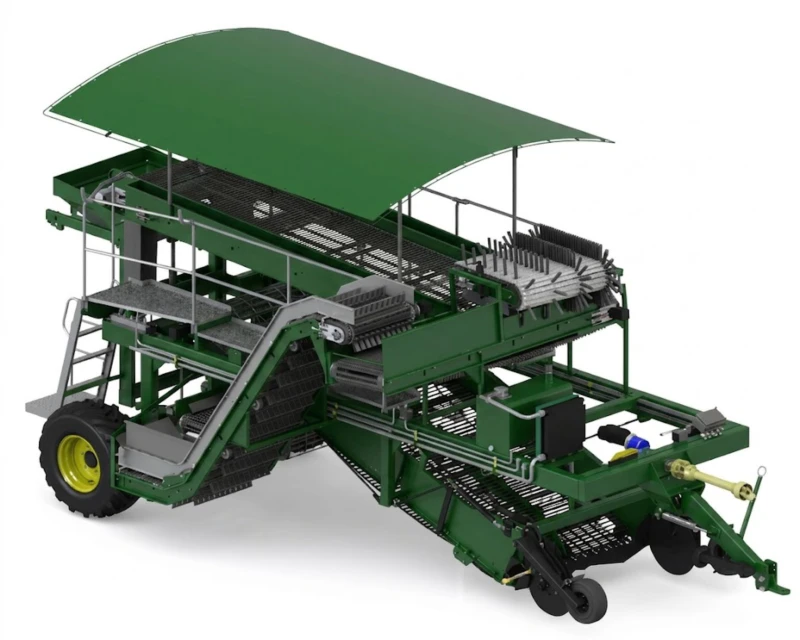
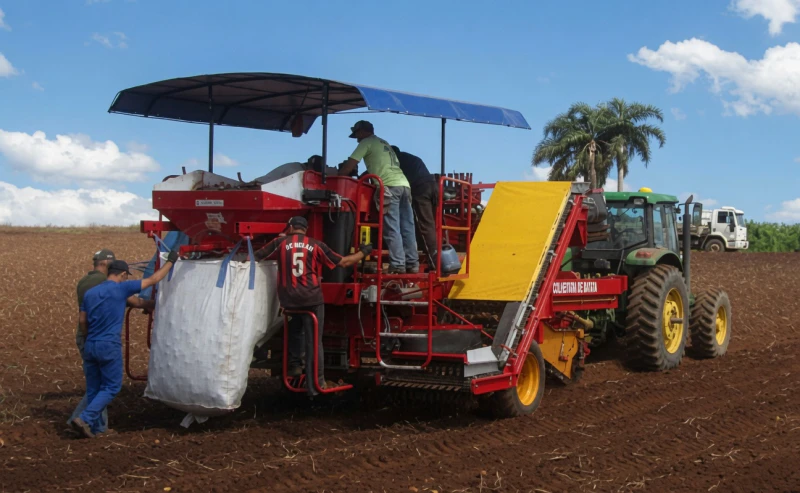
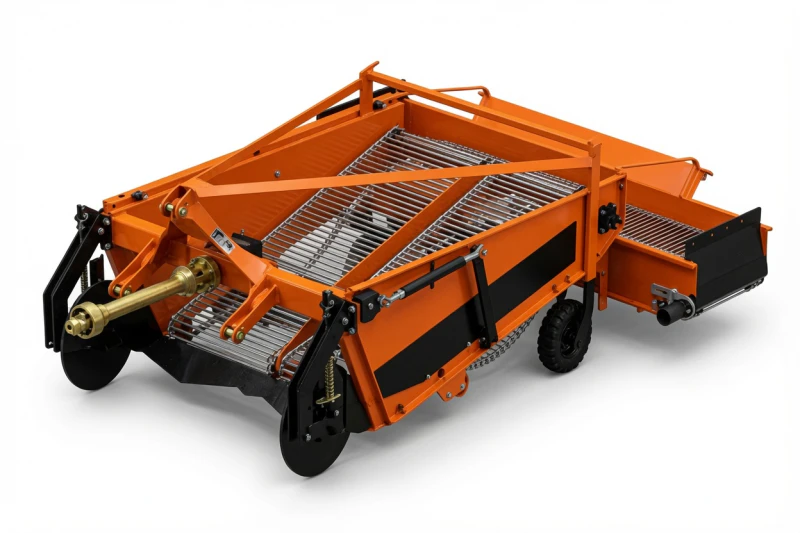
Mistake 2: Running the Harvester Too Fast What happens: Excessive forward speed overloads the sieve chain with soil and tubers simultaneously. The sieve cannot separate soil from tubers effectively — clods and tubers pass through together, increasing impact damage. Drop heights from sieve to cross conveyor to elevator increase with material volume, and tubers hit surfaces at higher velocity. On the CWB-2L harvester, the sieve chain has a designed throughput capacity — exceeding it by driving too fast reduces separation quality and increases mechanical damage. Typical loss: 3 to 8 percent increase in internal bruising at speeds 30+ percent above optimal. How to avoid it: Match forward speed to the harvester’s throughput capacity and soil conditions. On heavy clay, reduce speed by 20 to 30 percent versus sandy soil. Monitor the sieve chain load — if tubers are piling up at the rear of the primary sieve rather than flowing smoothly, you are going too fast. The correct speed is the fastest speed at which the sieve clears completely between each new ridge section. |
|
Mistake 3: Failing to Remove Stones Before Harvest What happens: Stones in the ridge travel through the harvester alongside tubers. They impact tubers on every surface — the digging share, the primary sieve, the cross conveyor, the elevator, and the trailer drop. Each impact creates internal bruising (black spot) invisible at intake but revealed when the tuber is cut — causing buyer rejection, processing penalties, and consumer complaints. Stones also accelerate wear on sieve webs, shares, and rubber surfaces. Typical loss: 5 to 15 percent downgrade from stone bruising on untreated stony ground. How to avoid it: Crush stones before the planting season with the THOR 2.4 or 3.0 stone crusher — a one-time treatment that permanently eliminates stones from the ridge zone. This is the only permanent solution; raking and picking must be repeated every season as new stones surface with tillage. See: The Hidden Cost of Stony Farmland. |
|
Mistake 4: Incorrect Digging Share Depth and Angle What happens: If the digging share runs too shallow, it slices through the bottom of the ridge and cuts tubers — creating physical cuts that become infection entry points in storage and are rejected at intake. If the share runs too deep, it lifts excessive subsoil onto the sieve chain, overloading the separation system and slowing throughput. If the share angle is too steep, tubers hit the share surface at a sharp angle, causing impact bruising before they even reach the sieve. Typical loss: 2 to 5 percent cut tubers (too shallow) or 20 to 30 percent throughput reduction (too deep). How to avoid it: Set the digging share to run 3 to 5 cm below the lowest tuber in the ridge. Check depth by stopping the harvester and inspecting the share position relative to visible tubers. Adjust share angle to lift the ridge gently — tubers should slide onto the sieve chain, not be thrown. The AWB digger and CWB-2L harvester both feature adjustable share depth and angle — recalibrate at the start of each field and when soil type changes. |
|
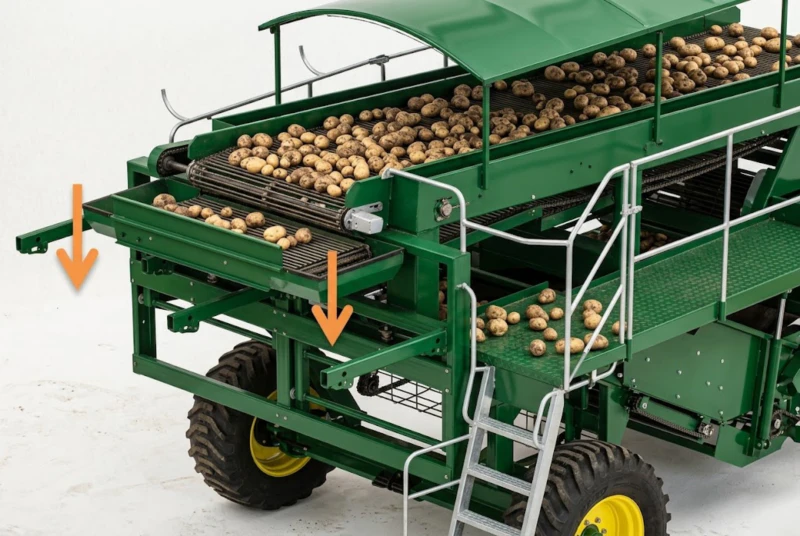
Mistake 5: Excessive Drop Heights Throughout the Chain What happens: Every time a potato falls — from sieve to cross conveyor, from elevator to trailer, from trailer to storage — it impacts the receiving surface. Drop height above 30 cm onto a hard surface causes measurable internal bruising. Drop height above 50 cm causes visible external damage. On a poorly configured harvest chain, a single tuber may experience 4 to 6 drops totalling 2+ metres of cumulative fall — enough to bruise even the most robust variety. Typical loss: 3 to 10 percent bruising from excessive drops (cumulative across the chain). How to avoid it: Audit every drop point in the chain: harvester sieve to cross conveyor, cross conveyor to elevator, elevator to trailer, trailer to storage. Maximum drop height at each point: 30 cm onto potatoes (soft landing) or 15 cm onto a hard surface. On the CWB-2L, the elevator discharge height is adjustable — raise it as the trailer fills to maintain a consistent 20 to 30 cm drop onto the potato heap rather than allowing the drop to increase as the heap grows. |
|
Mistake 6: Harvesting in Wrong Soil Conditions What happens: Harvesting in soil that is too wet causes clay to stick to tubers and clog sieve webs — reducing separation, slowing throughput, and burying tubers in mud that masks quality defects until the packhouse. Harvesting in soil that is too dry causes hard, angular clods that travel through the sieve like stones, bruising tubers at every contact point. Harvesting in soil that is too cold (below 7°C) increases tuber susceptibility to internal bruising by 50 to 100 percent — cold tubers bruise from impacts that warm tubers would survive. Typical loss: 5 to 15 percent from wrong-condition harvesting (bruising + contamination + throughput loss). How to avoid it: Monitor soil temperature daily during the harvest window — harvest when pulp temperature is above 8°C. Test soil moisture by squeezing a handful: it should crumble when released, not form a ball (too wet) or shatter into dust (too dry). If conditions are wrong, wait. One day of delay costs less than one season of downgraded product. Pre-season stone crushing with the THOR eliminates the hard-clod problem by destroying the rocks that form the clod nuclei. |
|
Mistake 7: Poor Ridge Formation That Causes Tuber Loss at Harvest What happens: Ridges formed too narrow, too shallow, or unevenly by the furrower at planting create problems months later at harvest. Shallow ridges leave tubers protruding from the sides — exposed to greening (solanine) and to the digger share cutting through tubers rather than under them. Uneven ridges cause inconsistent digging depth — the share runs correctly through one section and too shallow through the next, alternately cutting and missing tubers. Typical loss: 2 to 5 percent from greening + 1 to 3 percent from share-cut tubers on poorly formed ridges. How to avoid it: Ridge quality begins at seedbed preparation, not at harvest. The ERA Rotary Cultivator creates uniform, well-formed preliminary ridges during seedbed preparation. The R-380/R-580 Furrower builds final ridges to full height (18 to 25 cm) with consistent profile across the entire field. At 90 cm row spacing, larger ridges provide more soil cover and reduce greening risk further. See: Potato Row Spacing Guide: 60 vs 75 vs 90 cm. |
Summary: 7 Mistakes, 7 Solutions, Combined Impact
| Mistake | Loss | Solution | Equipment |
|---|---|---|---|
| 1. No skin set | 5-15% | Wait 14-21 days after desiccation | Timing discipline |
| 2. Too fast | 3-8% | Match speed to sieve capacity | CWB-2L / AWB |
| 3. Stones in ridge | 5-15% | Crush before planting season | THOR 2.4/3.0 |
| 4. Wrong share depth | 2-5% | Set 3-5 cm below lowest tuber | AWB / CWB-2L |
| 5. Excessive drop heights | 3-10% | Max 30 cm drop, adjust elevator | CWB-2L |
| 6. Wrong soil conditions | 5-15% | Temp >8°C, correct moisture | THOR (clod elimination) |
| 7. Poor ridge formation | 3-8% | Uniform ridges from planting | ERA + R-380 |
Combined potential: A farm making all 7 mistakes simultaneously loses 20+ percent of its crop. A farm that eliminates all 7 reduces losses to under 3 percent. On 100 hectares at 40 t/ha, the recovery is 680+ tonnes of saleable potatoes — the most valuable single improvement any potato operation can make.
Frequently Asked Questions
|
Q1: Which mistake causes the most damage? On stony ground: Mistake 3 (stones) dominates — it causes bruising, equipment wear, contamination, and speed reduction simultaneously. Eliminating stones with the THOR crusher addresses the largest single source of harvest loss. On stone-free ground: Mistake 1 (skin set timing) and Mistake 5 (drop heights) are typically the biggest losses because they affect every tuber in every load. |
|
Q2: How do I measure my current harvest loss? After the harvester passes, walk behind and count or weigh all tubers visible on the surface and accessible in the top 5 cm of soil across a measured area (e.g., 10 m × the harvested width). Express this as a percentage of the yield from the same area. Also sample 50 tubers from the trailer, cut them in half after 48 hours, and count the percentage showing internal bruising (brown or black discolouration under the skin). |
|
Q3: Should I use a digger or a harvester? The AWB digger lifts tubers onto the surface for manual or mechanical collection. The CWB-2L harvester lifts, separates, and loads directly into a trailer — zero crew needed. For operations over 30 to 50 hectares where labour is expensive or unavailable, the CWB-2L eliminates Mistakes 5 (drop heights are controlled within the machine) and 6 (faster harvest reduces exposure to deteriorating weather). See: Digger vs. Harvester: Which Is Right? |
|
Q4: Can ridge quality at planting really affect harvest losses months later? Absolutely. Harvest problems caused by Mistake 7 (poor ridges) are created 4 to 5 months earlier at planting. Shallow, uneven ridges cause greening, cut tubers, and inconsistent digging depth — all of which become visible only at harvest. Investing in good seedbed preparation with the ERA cultivator and precise ridging with the R-380 furrower prevents harvest losses that are impossible to fix once the crop is growing. |
|
Q5: Does variety choice affect susceptibility to harvest damage? Yes — significantly. Some potato varieties have genetically thicker skin, deeper periderm, and higher dry matter that resists bruising. Processing varieties (Russet Burbank, Innovator) are generally more bruise-resistant than fresh market varieties with thin, delicate skin. However, even the most robust variety will bruise if subjected to excessive drop heights, stone impacts, or premature harvest. Variety choice and correct harvest technique work together — neither alone is sufficient. |
|
Q6: What is the single most impactful change I can make this season? If you are on stony ground: crush stones (THOR 2.4/3.0) — this addresses Mistakes 3, partially 4, partially 5, and partially 6 in a single treatment. If you are on stone-free ground: enforce the skin set waiting period (Mistake 1) and audit every drop height in the chain (Mistake 5). These two changes alone can reduce harvest losses by 5 to 10 percentage points with zero equipment purchase — just discipline and measurement. |
|
Q7: How do I get harvest equipment configured for minimum damage? Contact our team with your hectarage, soil type, row spacing, and current harvest loss rate. We will recommend the right digger or harvester model and provide setup guidance calibrated for your specific conditions — ensuring every tuber reaches the trailer intact. |
Every Tuber That Reaches the Trailer Intact Is Revenue Earned. Every Tuber Lost Is Revenue Destroyed.
These seven mistakes are all preventable — with the right knowledge, the right timing, and the right equipment. Stone crushing before planting (THOR), proper seedbed and ridge formation (ERA + R-380), and correctly configured harvest equipment (AWB digger or CWB-2L harvester) address the equipment-related causes. Timing and operator technique address the rest. Factory-direct pricing, worldwide delivery.
|
Harvest Equipment Quote AWB digger or CWB-2L harvester |
Stone Crushing Eliminate stones before harvest |
Full Potato System Seedbed to harvest, matched |
Contact Us — Get Harvest Equipment That Protects Every Tuber