Building a Potato Operation? Start With the Right Equipment in the Right Order.
Starting a mechanized potato operation — or upgrading from manual production to full mechanization — requires a sequence of equipment investments that build on each other. Buy the harvester before the planter and you have nothing to harvest. Buy the planter before the seedbed equipment and your planting quality suffers. Buy everything at once and your capital is tied up before any revenue flows.
The most successful potato operations build their equipment fleet in a phased sequence where each investment generates revenue that funds the next, each machine solves the current bottleneck, and the complete fleet emerges over 2 to 5 seasons rather than in a single capital event. This guide presents the optimal sequence — from first machine to complete fleet — across three farm scales: smallholder (10 to 30 ha), mid-scale (30 to 100 ha), and large-scale (100 to 500+ ha).
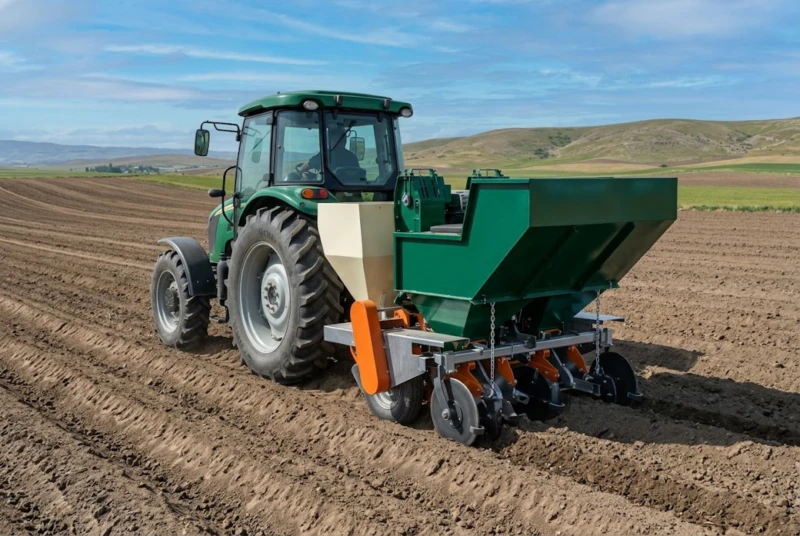
The Complete Potato Equipment Chain: 8 Operations, 8 Machines
| Step | Operation | Equipment | Min HP | When Needed |
|---|---|---|---|---|
| 0 | Stone management (if stony) | THOR 2.4/3.0 or hire | 180-250 | One-time, before first season |
| 1 | Primary tillage (deep) | PSW-3200 Rotavator or plough | 160 | Pre-season, October-February |
| 2 | Seedbed + fertilizer + ridging | ERA Rotary Cultivator (3-in-1) | 75 | 2-3 weeks before planting |
| 3 | Planting + starter fertilizer | PAI-2100 or PANTHER Planter | 75-125 | March-May (Northern Hemisphere) |
| 4 | Post-emergence hilling | R-380 / R-580 Furrower | 75 | 4-6 weeks after emergence |
| 5 | Crop protection (spray) | Sprayer (standard market) | — | Throughout growing season |
| 6 | Harvest (dig or harvest) | AWB Digger or CWB-2L Harvester | 75-100 | August-October (NH) |
| 7 | Transport to storage | Trailers (standard market) | — | Harvest period |
Steps 0, 2, 3, 4, and 6 use equipment from our range. Steps 1, 5, and 7 use standard market equipment (plough, sprayer, trailers) available from any agricultural dealer. The goal is a matched, integrated chain where every machine’s output feeds cleanly into the next machine’s input — same row spacing, same row count, same operating width.
Phase 1: The Starter Fleet — Minimum Viable Mechanization (10-30 ha)
|
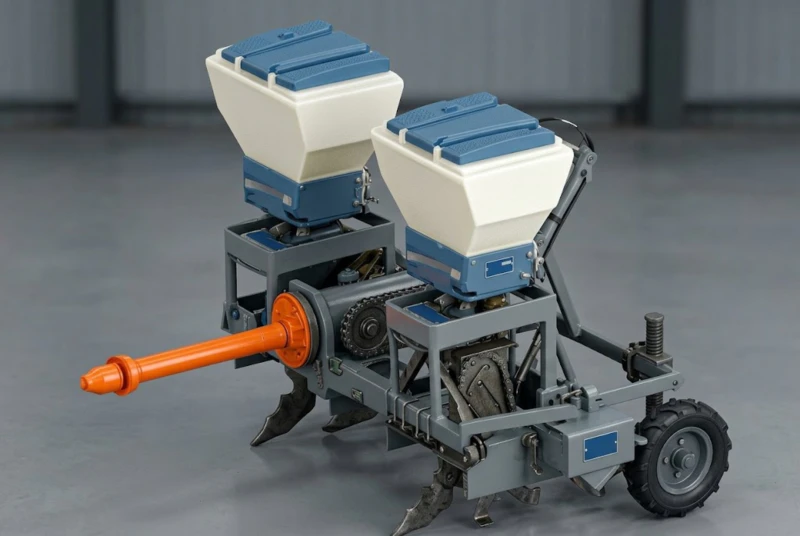
The 75 HP Starter Package Tractor: One 75 to 85 hp utility tractor with 540 RPM PTO, Cat II hitch, 4WD. This single tractor powers every implement in the starter package. Machine 1 — ERA-2100 Rotary Cultivator: Seedbed preparation, banded fertilizer, and ridge formation in one pass. Replaces three separate machines. Buy this first — it is the highest-efficiency machine in the starter fleet. Machine 2 — PAI-2100 Planter: 2-row planter with integrated fertilizer hopper. Precision cup-belt metering replaces manual planting — saving 70 to 90 percent of planting labour while improving seed spacing accuracy and yield consistency. Machine 3 — R-380 Furrower: 3-row furrower for pre-planting ridge formation and post-emergence hilling. Light, simple, inexpensive — essential for maintaining ridge quality throughout the season. Machine 4 — AWB-1600 Mounted Digger: 2-row digger that lifts tubers onto the surface. Manual picking or mechanical collection behind. Entry-level harvest mechanization that eliminates hand-digging — the most backbreaking operation in potato farming. |
Investment sequence: ERA first (seedbed efficiency), then PAI planter (planting quality + labour), then R-380 (ridge maintenance), then AWB digger (harvest). Each machine generates revenue improvement that funds the next. Total Phase 1 investment covers 4 machines on one 75 hp tractor — the minimum viable mechanized potato operation. See: Smallholder Potato Farming: Affordable Mechanization From 75 HP.
Phase 2: Scaling Up — Mid-Scale Efficiency (30-100 ha)
At 30 to 100 hectares, the starter fleet becomes a bottleneck: the 2-row planter cannot cover the area in the available planting window, the mounted digger is too slow for the harvest volume, and a second tractor becomes necessary for overlapping operations.
|
Upgrade 1: Planter → PANTHER 3-Row (100 hp) The PANTHER 3-row planter covers 50 percent more ground per pass than the 2-row PAI, with larger seed and fertilizer hoppers for longer runs between refills. Requires a 100+ hp tractor — the second tractor in the fleet. The PAI-2100 becomes the backup planter or is sold to fund the upgrade. |
|
Upgrade 2: Digger → AWB Trailed (higher speed) The AWB trailed digger (AAR/BAR/CAR) operates at 5 to 10 km/h versus 3 to 5 km/h for the mounted version — nearly doubling daily harvest area. The independent chassis provides consistent depth on uneven terrain. Essential for scaling harvest throughput to match 50+ hectares. |
|
Addition: Dedicated Fertilizer Applicator — ADB-380/480 At 50+ hectares, a dedicated ADB-380 or ADB-480 banding applicator enables the dual-band fertilizer strategy (deep base dressing + shallow starter at planting) that produces 5 to 15 percent yield increase over single-band application. The ERA continues handling seedbed prep; the ADB adds a second fertilizer pass at a different depth for maximum nutrition efficiency. |
|
Addition: Furrower upgrade — R-580 (5-row) The R-580 covers 5 rows per pass versus the R-380’s 3 rows — matching the larger planter’s throughput and reducing hilling time by 40 percent. Light, inexpensive upgrade with immediate time savings on every hilling pass. |
Phase 3: Full Fleet — Large-Scale Production (100-500+ ha)
At 100+ hectares, the fleet must deliver zero-crew harvest, maximum daily throughput, and the ability to complete each operation within its weather window without depending on hired labour:
|
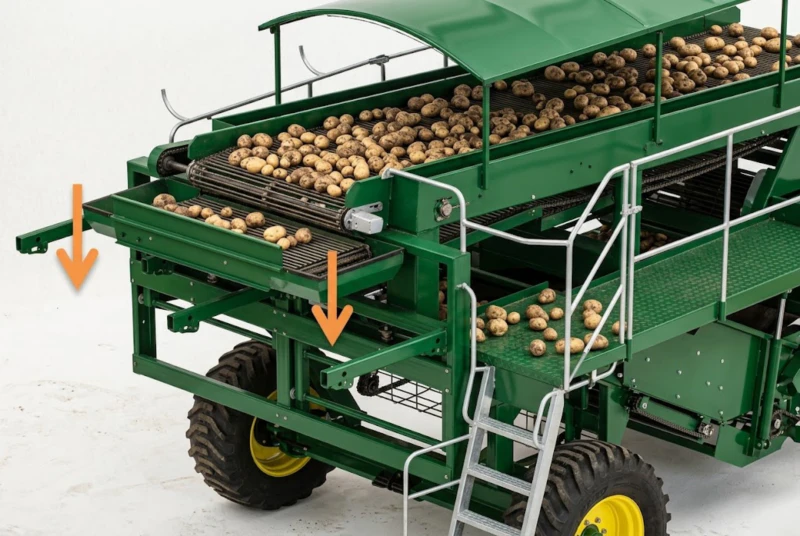
Upgrade: Digger → CWB-2L Elevator Harvester The CWB-2L eliminates the picking crew entirely — 2-row digging, sieving, and elevator loading directly into a trailer running alongside. One operator, zero crew, field to trailer. This is the single largest cost-reduction investment for any large-scale potato operation. See: Digger vs. Harvester: Which Is Right? |
|
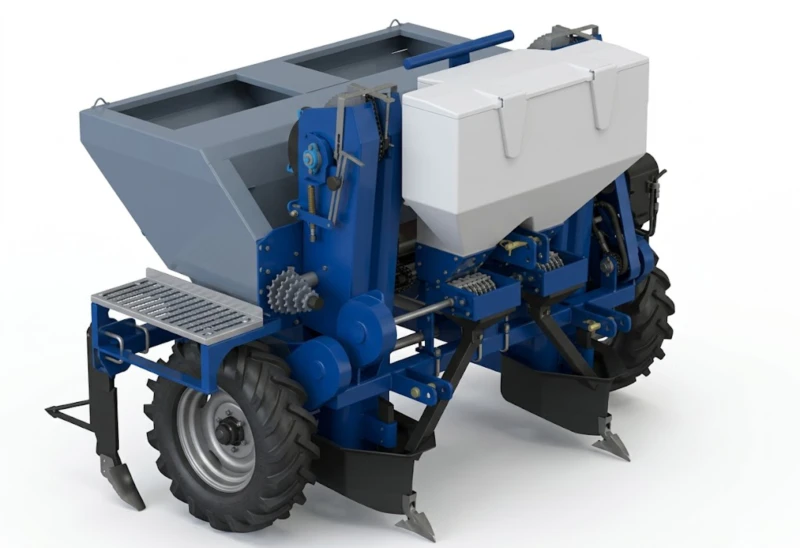
Upgrade: Planter → PANTHER 4-Row or PAI-480-AR The PANTHER 4-row (125 hp, mounted) or PAI-480-AR (140 hp, trailed, dual-band fertilizer + insecticide) cover 30 to 50 percent more area per day than the 3-row. The PAI-480-AR delivers dual-band fertilizer and in-furrow insecticide in the same planting pass — eliminating separate fertilizer and insecticide application passes entirely. |
|
Addition: Stone Crushing — THOR 2.4 or 3.0 (purchase) At 100+ hectares on stony ground, purchasing a THOR becomes more economical than hiring — especially if new fields are brought into potato production each year or the THOR is offered as a contractor service to neighbours. The THOR pays for itself through eliminated equipment damage, reduced harvest bruising, and higher-grade marketable yield. See: The Hidden Cost of Stony Farmland. |
|
Addition: Heavy Rotavator — PSW-3200 Series For operations that plough annually, the PSW-3200 rotavator (160 hp, 3.2 m working width) replaces multiple secondary tillage passes after ploughing — breaking clods, burying trash, and preparing a fine tilth in a single aggressive pass. On heavy clay or stony soil after ploughing, the PSW-3200 reduces seedbed preparation from 3 to 4 passes to 1 to 2 passes. |
Complete Fleet Summary by Phase
| Machine | Phase 1 (10-30 ha) |
Phase 2 (30-100 ha) |
Phase 3 (100-500+ ha) |
|---|---|---|---|
| Stone crusher | Hire THOR | Hire THOR | Own THOR 2.4/3.0 |
| Primary tillage | Plough (market) | Plough (market) | Plough + PSW-3200 |
| Seedbed + fertilizer | ERA-2100 | ERA-2100 + ADB | ERA + ADB-480 |
| Planter | PAI-2100 (2-row) | PANTHER 3-row | PANTHER 4-row / PAI-480-AR |
| Furrower / hiller | R-380 (3-row) | R-580 (5-row) | R-580 (5-row) |
| Harvest | AWB mounted digger | AWB trailed digger | CWB-2L harvester |
| Tractors needed | 1 × 75-85 hp | 1 × 75 hp + 1 × 100 hp | 75 hp + 140 hp + 180-250 hp |
5 Principles for Fleet Planning
|
1. Buy the bottleneck At any given time, one operation is your biggest constraint — the slowest, most expensive, or most labour-dependent step. Invest in the machine that removes that constraint first. On most startup farms, planting and harvest are the bottlenecks; seedbed and hilling are secondary. |
|
2. Match row count and spacing across the chain Every machine in the chain must operate at the same row spacing (60, 75, or 90 cm). Specify your spacing at order — we pre-configure every machine to match. A fleet with mismatched spacing wastes time realigning implements between operations. See: Potato Row Spacing Guide: 60 vs 75 vs 90 cm. |
|
3. Match tractor power to the heaviest implement The tractor must handle the most demanding implement in its assigned fleet — not just the lightest one. A 75 hp tractor that runs ERA, PAI, R-380, and AWB is correctly matched. A 75 hp tractor asked to also run a PANTHER 4-row or CWB-2L is underpowered. See: How to Calculate Tractor HP for Your Implement. |
|
4. Phase investments for cash flow Buy one or two machines per season and let each generate revenue before investing in the next. A staged 3-year equipment plan is more sustainable than a single large capital event. The first machine (planter or ERA) should generate measurable yield and labour savings in Season 1 that fund the second machine purchase. |
|
5. One manufacturer, one quality standard Sourcing the entire potato equipment chain from one manufacturer ensures dimensional compatibility (row spacing, hitch category, PTO speed), consistent build quality, unified spare parts supply, and single-point technical support. Every product in our range is designed to work together as a system — not as isolated implements from different factories with different standards. |
Frequently Asked Questions
|
Q1: What is the absolute minimum investment to start mechanized potatoes? One 75 hp tractor, one ERA-2100 cultivator, and one PAI-2100 planter. These two machines mechanize the two most impactful operations (seedbed + planting) and deliver the largest yield and labour improvement per dollar invested. Harvest can remain manual or use a basic digger in the first season while revenue builds for the next investment. |
|
Q2: Can I skip Phase 2 and go directly from Phase 1 to Phase 3? Yes — if the capital is available and the hectarage justifies it. A 100-hectare operation starting from scratch can purchase the Phase 3 fleet immediately. However, operator experience matters: starting with simpler 2-row equipment for one season builds operational skill before scaling to 4-row and harvester complexity. The learning cost of mistakes on a 2-row is lower than on a 4-row. |
|
Q3: Do you offer package pricing for complete fleets? Yes. Contact our team with your hectarage, tractor power, and budget. We provide fleet package pricing that reflects the multi-machine purchase — factory-direct, configured to your row spacing, and delivered as a matched system. Package pricing is lower than purchasing each machine individually. |
|
Q4: What about sprayers and trailers? We specialise in the potato-specific equipment chain: seedbed, fertilizer, planting, ridging, harvest, and stone management. Sprayers, trailers, grading lines, and storage equipment are standard market items available from local agricultural dealers. We recommend selecting these based on local availability and service support. |
|
Q5: How do I get a fleet recommendation for my specific situation? Contact our team with your total hectarage, soil type (stony or clean), available tractor(s) and HP, target market (seed/ware/processing), row spacing preference, and budget horizon (single purchase or phased). We will provide a phased fleet plan with factory-direct pricing for each phase — configured, matched, and ready to deploy. |
Build the Fleet That Builds Your Business
Every successful potato operation started with one machine and grew from there. The right sequence turns each investment into revenue that funds the next — building a complete, matched, high-efficiency fleet over 2 to 5 seasons without betting the farm on a single purchase. Contact us with your starting point and we will design the phased plan that takes you from where you are to where you want to be. Factory-direct pricing, worldwide delivery, fleet package discounts.
|
Fleet Plan Phased for your farm |
Package Quote Multi-machine pricing |
Dealer Opportunities Complete product range |