The Spreading Method Determines the Road Quality — Before the Stabilizer Even Starts
Soil stabilization is a two-machine process: first, a binder (lime or cement) is distributed across the road surface; second, a stabilizer mixes it into the soil. The mixing step gets the attention — it is the visible, dramatic transformation. But the spreading step is where road quality is won or lost. If the binder is unevenly distributed — thick in some places, thin in others, missing entirely in patches — no amount of mixing will produce a uniform road. The THOR ST Soil Stabilizer can only blend what was placed in front of it. If the input is inconsistent, the output is inconsistent.
Across the developing world — and even in developed markets where project budgets are tight — binder is still spread by hand. Workers slit open 25 or 50 kg bags and scatter the powder across the road surface by shovel, bucket, or simply shaking the bag. This method is perceived as “cheaper” because it avoids the cost of a mechanical spreader. In reality, it is more expensive in total, produces lower-quality roads, wastes binder, creates health hazards, and takes longer.
This article presents a transparent comparison of manual bag spreading versus mechanical distribution with the DCW 2.2 Binder Spreader — on cost, quality, speed, health, and long-term road performance.
Complete Head-to-Head Comparison
| Factor | Manual Bag Spreading | DCW 2.2 Mechanical Spreader |
|---|---|---|
| Distribution uniformity | Poor — visible piles, gaps, and streaks | Uniform — metered curtain across full width |
| Application rate accuracy | ±30-50% variation (estimated by eye) | ±5-10% variation (calibrated metering) |
| Binder waste | 10-25% (wind drift, spillage, over-dosing) | Under 3% (enclosed hopper, low-drop delivery) |
| Spreading speed (per km) | 3-6 hours (crew of 6-10) | 20-40 minutes (1 operator) |
| Labor required | 6-10 workers per km | 1 tractor operator |
| Dust exposure to workers | Extreme — workers breathe lime/cement dust | Minimal — enclosed hopper, operator in cab |
| Bag handling labor | Every bag opened, carried, scattered by hand | Bulk or bag-loaded into hopper once |
| Wind sensitivity | Cannot work in wind (powder blows away) | Low-drop delivery — operable in moderate wind |
| Resulting road quality | Variable — strong/weak zones, premature failure | Consistent — uniform strength across road width |
| Road lifespan | Shorter (weak zones fail first) | Longer (uniform strength, no weak points) |
The Uniformity Problem: Why Hand Spreading Produces Weak Roads
A soil stabilization project specifies a binder dosage rate — for example, 5 percent cement by dry weight of soil. This means every square meter of road surface must receive the same amount of binder, to the same depth, for the same strength result across the entire road. Deviations from this target produce:
|
Under-dosed zones (too little binder) Areas that receive less binder than specified develop lower CBR strength. Under traffic, these weak zones deform, rut, and crack before the correctly dosed areas show any wear. The road fails at its weakest point — not its average — so even a small percentage of under-dosed area determines the road’s effective lifespan. Manual spreading routinely produces under-dosed gaps where the worker did not reach or where wind carried the powder away. |
|
Over-dosed zones (too much binder) Areas that receive excess binder develop higher-than-necessary strength — wasting expensive binder material on performance that the road does not need. On cement-stabilized roads, over-dosed zones can become brittle and crack under traffic load. Manual spreading produces over-dosed piles wherever the worker emptied a bag — concentrated heaps that the stabilizer cannot fully homogenize. |
|
Zero-dosed strips (no binder at all) The most damaging outcome: strips between manual spreading passes where no binder reached the surface. The THOR ST mixes these strips into the soil like any other area, but with no binder present, the “stabilized” layer in these strips is just re-mixed raw soil with zero additional strength. These strips fail immediately under load — often within the first month of traffic. |
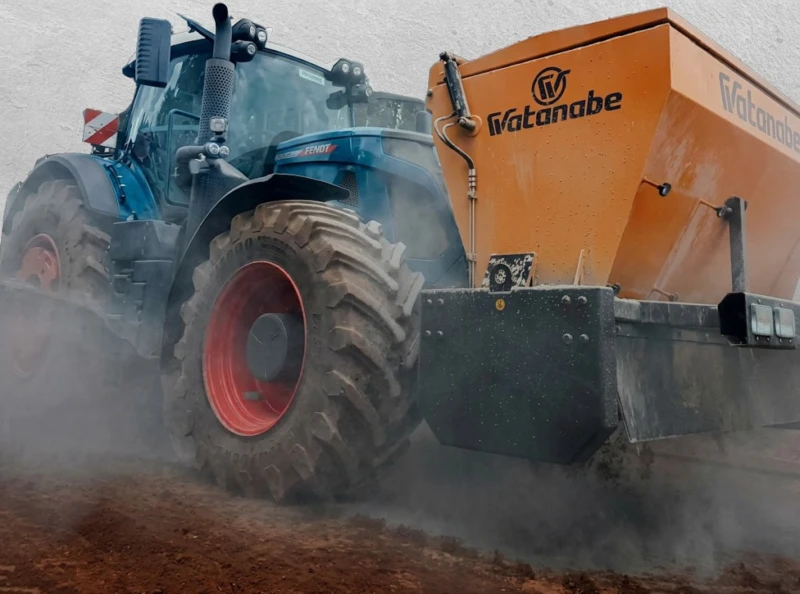
The DCW 2.2 eliminates all three problems. Its hydraulic metering chain delivers a continuous, calibrated curtain of binder at a constant rate per linear meter, across the full spreading width. There are no gaps, no piles, and no variation — every square meter of road receives exactly the target dosage.
Speed and Cost: The Numbers That Change the Calculation
| Metric (per km of 3 m wide road) | Manual (8-Person Crew) | DCW 2.2 (1 Operator) |
|---|---|---|
| Spreading time per km | 3-6 hours | 20-40 minutes |
| Person-hours per km | 24-48 person-hours | 0.3-0.7 person-hours |
| Binder wasted per km | 6-15 tonnes (10-25% of total) | Under 2 tonnes (under 3%) |
| Bags opened and handled | 1,200-2,800 bags (25 kg each) | Bulk loaded or bags tipped into hopper |
| Daily output (spreading only) | 1-2 km (limited by crew speed) | 5-10+ km (limited by refills) |
| THOR ST waiting time | Hours (stabilizer idles while crew spreads) | Minutes (spreader always ahead of stabilizer) |
The speed difference is decisive for project economics. On a manual-spread project, the THOR ST Soil Stabilizer sits idle for hours waiting for the crew to finish spreading the next section. The stabilizer — the most expensive piece of equipment on the project — is productive for only 30 to 50 percent of the working day. With the DCW 2.2, the spreader runs far ahead of the stabilizer, ensuring the THOR ST operates continuously at maximum productivity. Equipment utilization rises from 30-50 percent to 80-95 percent — the same project is completed in less than half the time.
The Health and Safety Factor
Lime and cement powder are strong alkaline irritants. Manual bag spreading exposes workers to extreme dust levels during bag opening, pouring, and scattering — often without adequate respiratory protection, eye protection, or skin covering. The health consequences are well-documented:
| Respiratory damage | Inhalation of lime or cement dust causes chemical burns to the throat and lungs, chronic bronchitis, and aggravated asthma. Workers spreading bags all day without masks inhale concentrations far above occupational exposure limits. |
| Skin burns | Lime (especially quicklime) and cement react with moisture on the skin, producing alkali burns. Workers handling bags with bare or inadequately protected hands develop chemical burns on hands, forearms, and faces. Sweat accelerates the reaction. |
| Eye injury | Powder entering the eyes causes severe chemical conjunctivitis and corneal burns. Manual spreading in any wind creates an unavoidable eye exposure risk for the entire crew. |
The DCW 2.2 eliminates virtually all worker exposure. The binder is loaded into the enclosed hopper (from bulk delivery or by tipping bags at the loading point). The operator sits in the tractor cab, upwind and above the spreading point. The low-drop delivery system minimizes airborne dust during application. One operator at minimal exposure replaces 6 to 10 workers at extreme exposure.
Why Manual Spreading Still Happens — and Why It Shouldn’t
|
“We cannot afford a mechanical spreader” The DCW 2.2 costs a fraction of the THOR ST stabilizer — the machine already on the project. Binder waste from manual spreading (10-25 percent) on a single 10 km project often exceeds the purchase price of the DCW 2.2. The spreader pays for itself on the first project through binder savings alone — before counting the labor savings, speed improvement, and quality gains. |
|
“Labor is cheap in our region” Even where daily wages are low, the crew’s slow speed means the expensive THOR ST sits idle for hours per day — that idle time represents lost productive capacity worth far more than the crew’s wages. The DCW 2.2 does not just replace the crew; it unlocks the full productivity of the stabilizer by eliminating the spreading bottleneck. Total project cost drops even with cheap labor. |
|
“Manual spreading is good enough” It is not. The variability (±30-50 percent) produces a road with alternating strong and weak zones. The road fails at the weak zones — typically within 1 to 3 years instead of 5 to 10+ years. The cost of premature failure (re-treatment, lost access, vehicle damage) exceeds the cost of the DCW 2.2 many times over. Professional road quality requires professional binder distribution. |
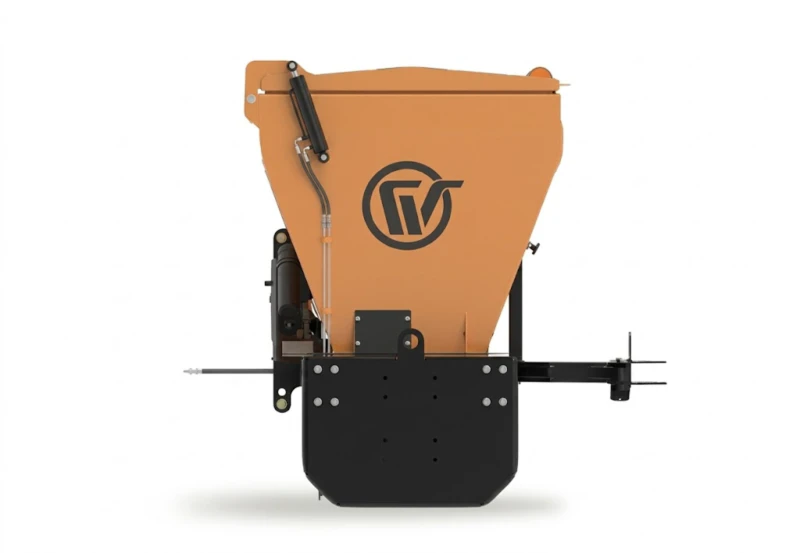
DCW 2.2 Binder Spreader: Specifications
| Hopper capacity | 2,200 kg |
| Spreading width | Adjustable — covers standard rural road widths (2 to 3+ m) |
| Metering system | Hydraulic chain drive with adjustable gate — calibrated for target kg/m² |
| Compatible binders | Quicklime, hydrated lime, Portland cement, calcium chloride flake/pellet |
| Mounting | Tractor-mounted, hydraulic drive |
| Coverage per fill | 200 to 400 linear meters (3 m wide road at 3-6% dosage) |
| Alternative use | Agricultural lime spreading for field pH correction |
Frequently Asked Questions
|
Q1: How quickly does the DCW 2.2 pay for itself? On most projects: within the first 5 to 10 km of road stabilized. Binder savings (10-25 percent less waste), labor savings (1 operator vs 6-10 workers), and increased THOR ST productivity (doubling daily output) combine to recover the DCW 2.2’s purchase price rapidly. For contractors doing multiple projects, payback is measured in weeks, not months. |
|
Q2: Can the DCW 2.2 handle bulk binder delivery (not just bags)? Yes. The 2,200 kg hopper can be loaded from bulk delivery trucks via conveyor or front-loader, or from bags tipped at the loading point. Bulk loading eliminates bag handling entirely — the fastest, cleanest, most economical option on large projects where bulk delivery is available. |
|
Q3: Does the DCW 2.2 work for agricultural liming as well? Yes — the DCW 2.2 spreads agricultural lime for field pH correction using the same hopper and metering system. This dual-purpose capability means the machine earns revenue outside of road stabilization projects, improving its overall return on investment for farm operations. |
|
Q4: Is there any situation where manual spreading is acceptable? For very small, one-time repairs (under 100 m) where mobilizing the DCW 2.2 is impractical, careful manual spreading can produce adequate results. For any project over 100 m — and especially for entire road sections or networks — mechanical spreading is the professional standard. The quality, speed, and cost advantages are too large to ignore. |
|
Q5: What tractor does the DCW 2.2 need? The DCW 2.2 requires a tractor with hydraulic remotes (one set of double-acting hydraulics). Power requirement is modest — the spreading function uses hydraulic flow, not PTO power. Most tractors from 75 hp upward have adequate hydraulic capacity. The same tractor can operate the DCW 2.2 for spreading, then hitch the THOR ST for mixing. |
|
Q6: Can I rent a DCW 2.2 for a single project? In some regions, rental or contractor service is available. For single short projects (under 5 km), rental may be practical. For recurring road maintenance, multiple projects, or dual-use (road stabilization + agricultural liming), purchasing delivers better long-term economics. Contact us for both purchase and availability guidance. |
|
Q7: Do you supply both the spreader and the stabilizer? Yes. The DCW 2.2 Binder Spreader and THOR ST Soil Stabilizer are designed as a matched system. One manufacturer, one quality standard, factory-direct pricing on both machines — and the package price for the pair reflects their intended use as a combined stabilization system. |
|
Q8: How do I get a quote? Contact our team with your project scope (road km, soil type, binder type) and tractor specifications. We will quote the DCW 2.2 individually or as a package with the THOR ST, and provide factory-direct pricing including delivery to your location. |
Professional Roads Start With Professional Spreading
The DCW 2.2 costs less than the binder it saves on a single project. It spreads faster than any crew, produces roads that last years longer, and protects worker health in the process. If you own or hire a THOR ST, the DCW 2.2 is the investment that unlocks its full potential. Factory-direct pricing, worldwide delivery.
|
DCW 2.2 Quote Standalone or paired with THOR ST |
System Package DCW 2.2 + THOR ST combined |
Contractor Fleet Stabilization service equipment |