Rocky Land Is Not Unproductive Land — It Is Untreated Land
Around the world, millions of hectares of agricultural land sit underperforming or entirely abandoned because of one problem: rocks. Surface boulders that break plough blades. Subsurface stones that jam planters and damage harvesting equipment. Fields so stony that farmers avoid them entirely, leaving potentially fertile soil locked beneath an impenetrable layer of rock and rubble.
For decades, the only options were to pick stones off the surface year after year (a Sisyphean task, since frost heave pushes new ones up every winter) or to abandon the land and farm only the easier fields. Neither option makes economic sense in an era of rising land costs and growing food demand.
Then stone crushers changed the equation entirely. A modern agricultural stone crusher does not collect, relocate, or bury stones. It destroys them. Rocks up to 400 mm in diameter are pulverized into particles smaller than 50 mm in a single pass, permanently converting obstacles into a beneficial soil component that improves drainage, aeration, and structural stability. The stones are gone — not moved to the field edge, not buried to resurface later — but genuinely, physically eliminated from the soil profile forever.
This article explains exactly how stone crushers achieve this transformation, what happens to the soil after crushing, how the economics work across different farming systems, and why stone crushing has become the fastest-growing category of land improvement equipment in global agriculture.
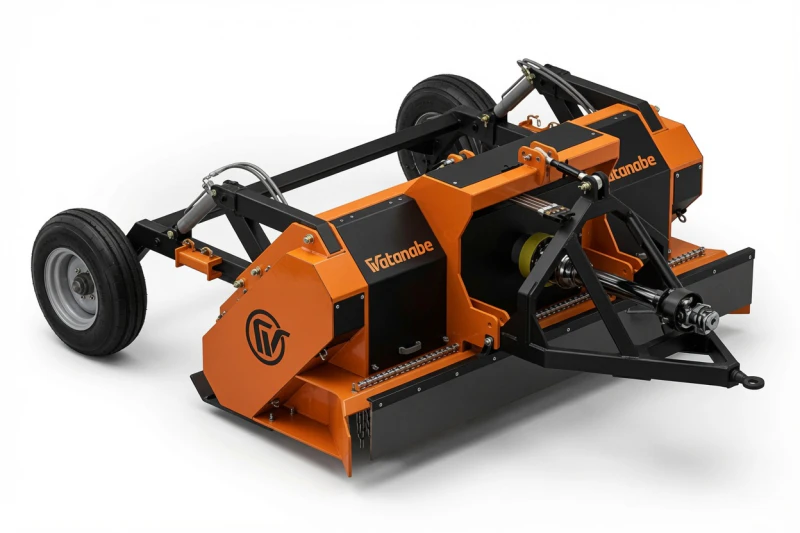
The Science: How a Stone Crusher Pulverizes Rock
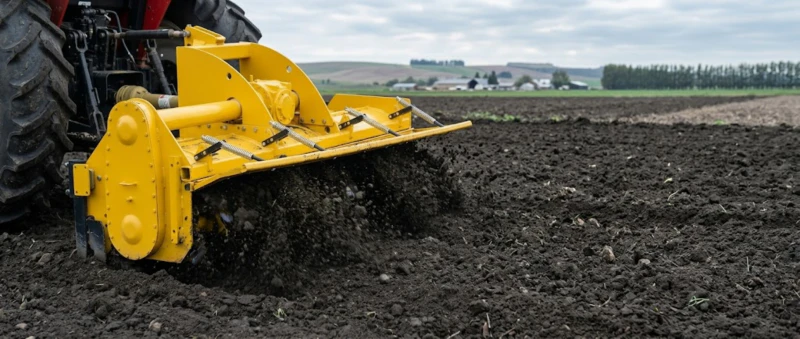
A tractor-mounted stone crusher uses a simple but devastatingly effective mechanical principle: high-speed impact fragmentation. A heavy rotor drum spinning at PTO-driven speed carries rows of tungsten carbide-tipped hammers. As the tractor advances slowly (typically 3 km/h), the hammers strike surface and subsurface stones with enormous kinetic energy, shattering them against a rear anvil or counter-comb. The resulting fragments are progressively reduced until they are small enough to pass through the controlled gap between the rotor and anvil.
The process handles virtually all common rock types encountered in agriculture:
| Limestone & Chalk | Relatively soft (Mohs 3-4). Crushes easily. Produces calcium-rich fragments that can raise soil pH over time — an agronomic bonus on acidic soils. |
| Sandstone & Shale | Medium hardness (Mohs 4-6). Crushes efficiently. Produces angular fragments with excellent drainage properties. |
| Granite & Basalt | Hard (Mohs 6-7). Requires more energy but crushes effectively with tungsten carbide hammers. Produces very durable angular particles that create permanent drainage channels within the soil structure. |
| Mixed Glacial Deposits | The most common agricultural stone type worldwide — a random mix of rock types deposited by glacial action. Stone crushers handle this variability without issue, processing whatever the glacier left behind. |
The output particle size is adjustable from the tractor cab via a hydraulic anvil. Close the gap for fine output (under 30 mm, ideal for seedbed preparation). Open it for coarser output (under 100 mm, maximum throughput for road subgrade). This real-time adjustability lets the operator optimize for different field conditions within a single pass.
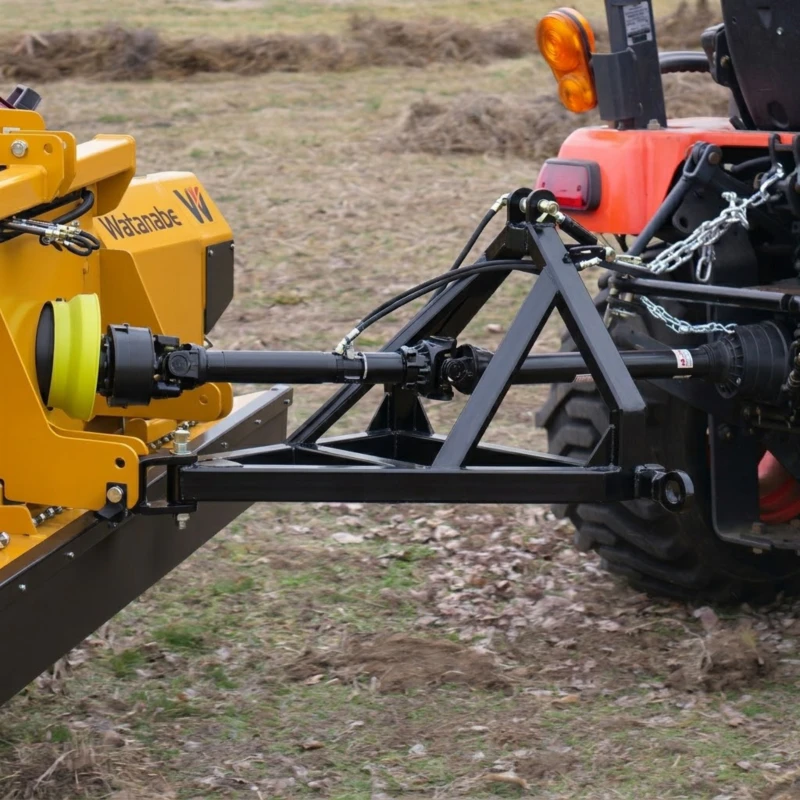
The Transformation: What Happens to the Soil After Crushing
Stone crushing does not merely remove an obstacle — it actively improves the soil. The crushed rock fragments become a permanent, beneficial component of the soil profile. Understanding these improvements is key to appreciating why crushing delivers returns far beyond simple stone removal.
|
Drainage Improvement Crushed stone particles are angular and irregularly shaped. When mixed into soil, they create permanent macropore spaces between the fragments that water drains through rapidly. Heavy clay soils that previously waterlogged after rain become free-draining within a single season after crushing. Farmers on clay-heavy land consistently report this as the single most valuable benefit — fields that were unworkable for weeks in wet periods become trafficable within days. |
Soil Structure Enhancement The angular crushed particles act as a permanent skeleton within the soil matrix, resisting compaction and maintaining an open, aerated structure even under heavy traffic. Root crops (potatoes, carrots, beets) develop more freely in this open structure. The improvement is permanent because the stone particles do not decompose, shrink, or dissolve — they maintain the structural benefit for the lifetime of the farm. |
|
Earlier Spring Access Improved drainage means crushed fields dry out faster after winter and spring rainfall. Tractors can access the land earlier in the season, planting can begin sooner, and the crop gets a longer growing season. In northern climates where the planting window is narrow, gaining even one extra week of access can translate into measurably higher yields — more growing degree days, better canopy development, higher tuber count. |
Reduced Erosion Large surface stones create turbulent water flow during rainfall, channeling runoff and accelerating erosion of fine topsoil. Crushed particles, being small and embedded in the soil matrix, eliminate this turbulence. Water infiltrates rather than running off. Topsoil stays on the field. On sloping land, this erosion reduction can be as valuable as the drainage improvement — preserving the very soil that grows the crop. |
|
Mineral Release (Limestone and Chalk Soils) When limestone or chalk stones are crushed, the dramatically increased surface area of the resulting particles accelerates the release of calcium carbonate into the soil solution. This gradually raises soil pH — a natural, slow-release liming effect that reduces or eliminates the need for separate lime application on acidic soils. Over 5 to 10 years, this mineral release can save significant liming costs while continuously maintaining optimal root-zone pH. |
|
Why the Solution Is Permanent — the Physics of Frost Heave
Every farmer who has picked stones knows the frustration: you clear the field this year, and next year the stones are back. This happens because of frost heave — the physical process by which freeze-thaw cycles push buried stones upward through the soil profile toward the surface. The mechanism works because stones conduct heat differently from soil: the bottom of a stone freezes first, and the expanding ice lens beneath it pushes the stone upward. Over multiple freeze-thaw cycles, even deeply buried stones migrate to the surface.
Stone crushing breaks this cycle permanently. Crushed particles (under 50 mm) are too small and too well-integrated into the soil matrix to be affected by frost heave. They do not have the mass, shape, or thermal contrast with the surrounding soil to generate the upward migration force. Once crushed, the stone particles stay where they are — mixed into the soil, improving its properties, forever. This is the fundamental physical reason why crushing is permanent and picking is not.
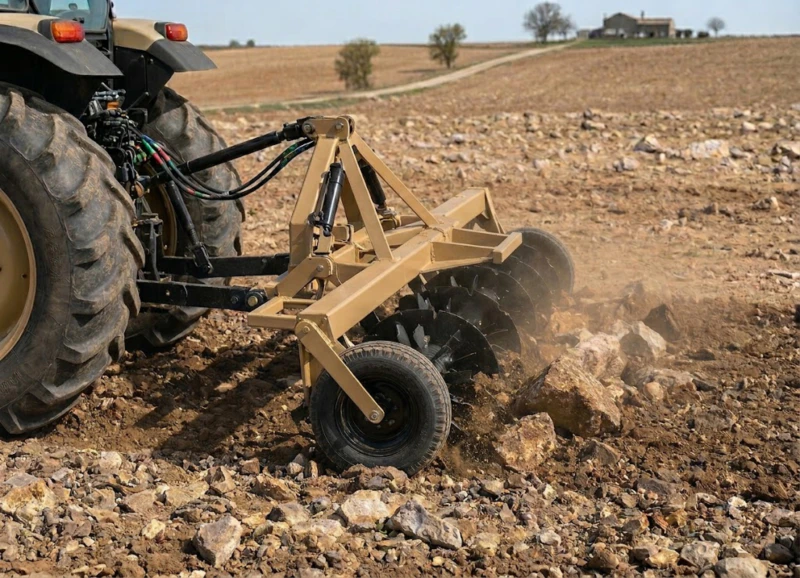
The Economics: How Stone Crushing Pays for Itself
Stone crushing is the highest initial investment among stone management methods. But when analyzed over a 5 to 10-year horizon, it is almost always the lowest total cost option — and frequently delivers a positive return on investment within the first 2 to 4 seasons. Here is how the numbers work:
Revenue Gains (Annual, Per Hectare)
| Benefit Source | Estimated Annual Value |
| Yield increase from improved soil structure and drainage (5 to 15 percent) | Significant |
| Reduced harvest damage and grading losses (potatoes: 10 to 20 percent fewer damaged tubers) | Significant |
| Earlier spring access (1 to 2 extra weeks of growing season) | Moderate |
Cost Savings (Annual, Per Hectare)
| Saving Source | Estimated Annual Value |
| Eliminated annual stone-picking cost (labor, fuel, machine hours, haulage) | Significant |
| Reduced equipment repair and replacement (plough points, planter parts, harvester components) | Moderate to Significant |
| Reduced liming cost (on limestone/chalk soils — natural mineral release) | Variable |
| Reduced drainage maintenance (less waterlogging, less damage to drainage systems) | Moderate |
When you combine annual yield gains with eliminated recurring costs, the cumulative financial benefit over 10 years substantially exceeds the one-time crushing investment on most commercial farms. Importantly, these benefits begin in the first season after crushing and continue indefinitely — every year the field produces at its improved potential without any additional stone management expenditure.
Beyond Farming: Other Applications for Stone Crushers
While agricultural land improvement is the primary use, stone crushers serve a growing range of additional applications:
|
Road and Highway Construction Crushing rocky subgrade into compactable aggregate for road foundations. Particularly valuable in rural areas where importing gravel is expensive. The crushed-in-place material forms an excellent road base with natural drainage. Our THOR ST Soil Stabilizer complements the crusher by mixing the crushed material with binder for maximum road strength. |
|
Pipeline and Utility Corridors Processing excavated rock spoil from pipeline trenches into fine bedding material, eliminating the need to import sand or gravel for pipe bedding. On long-distance projects, this saves enormous trucking costs and reduces environmental impact. |
|
Mine Rehabilitation and Land Reclamation Converting rock waste from mining operations into a medium capable of supporting vegetation. Crushing raw rock into plantable soil accelerates rehabilitation timelines and helps operators meet regulatory requirements for post-mining land restoration. |
|
Sports Turf and Landscaping Creating stone-free surfaces for golf courses, sports pitches, parks, and residential developments. The fine crushed output creates an excellent base for turf establishment, with built-in drainage from the angular particle structure. |
|
Forestry Access and Firebreaks Crushing rocky terrain to create forest access tracks and firebreaks. The stone crusher processes the ground in place without importing material, minimizing environmental disturbance in forest ecosystems. |
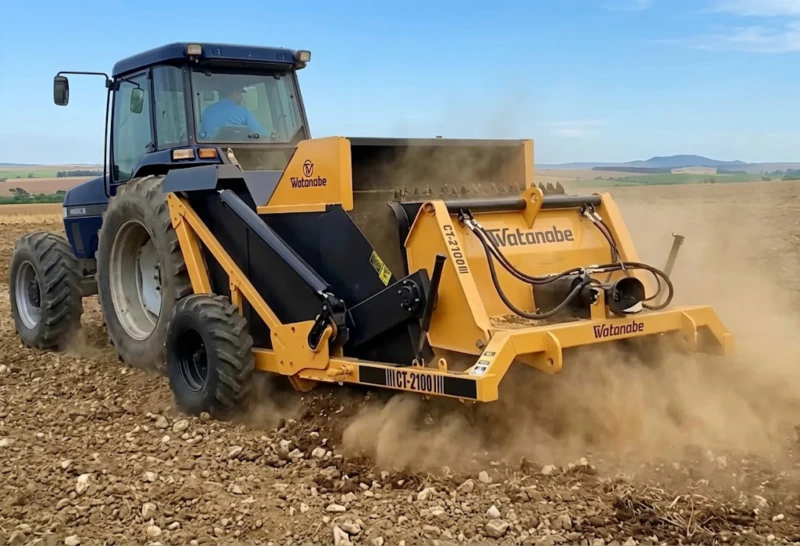
Our Stone Crushers: THOR 2.4 and THOR 3.0
We manufacture two models to cover different farm scales and tractor power classes:
| Specification | THOR 2.4 | THOR 3.0 |
|---|---|---|
| Working Width | 2.4 m | 3.0 m |
| Min. Tractor Power | 180 hp | 230 hp |
| Hourly Coverage | ~0.72 ha/h | ~0.90 ha/h |
| Max. Stone Input | ~400 mm | |
| Output Particle Size | Under 50 mm (adjustable from cab) | |
| Hammer Material | Tungsten carbide-tipped | |
| Best For | Medium farms, contractors | Large-scale, max throughput |
Both models feature cab-controlled hydraulic anvil adjustment for real-time output size control, tungsten carbide-tipped hammers for maximum service life on all rock types, and oversized flywheel systems that store kinetic energy for consistent crushing through the hardest impacts. We supply replacement hammer sets at competitive prices worldwide.
Frequently Asked Questions
|
Q1: What types of rock can a stone crusher handle? Virtually all common agricultural rock types: limestone, chalk, sandstone, shale, slate, granite, basalt, and mixed glacial deposits. The tungsten carbide hammers handle even the hardest igneous rocks. Hammer wear rate varies with rock hardness — we recommend specific configurations based on your rock type. |
|
Q2: How deep does the crusher work? The crusher processes stones at and just below the soil surface — typically the top 15 to 20 cm where the rotor engages. For deeper stones, plough the field first to bring subsurface stones to the surface, then crush. On heavily stony land, two passes (plough and crush) reach stones down to plough depth (25 to 30 cm). |
|
Q3: How long do the tungsten carbide hammers last? Typical hammer life is 50 to 200 operating hours depending on rock type and density. Each hammer has multiple cutting faces — rotate to a fresh edge before full replacement, effectively doubling service life. We supply replacement sets globally at prices significantly lower than competing brands. |
|
Q4: Will crushed stone damage my drainage tiles? No. Crushed particles (under 50 mm) are too small to block or damage subsurface drainage tiles. In fact, the improved surface drainage from crushed stone reduces the hydraulic load on tile systems, potentially extending their effective life. Ensure the crusher does not operate directly over shallow tile lines (mark them before crushing). |
|
Q5: Can I hire a stone crusher instead of buying? Yes. Many agricultural contractors offer stone crushing as a per-hectare service. This is an excellent option for a one-time land improvement project. For ongoing new-land development or contracting businesses, purchasing provides better long-term economics. |
|
Q6: Should I rake or pick stones before crushing? On heavily stony fields, a preliminary rock rake pass to concentrate scattered stones into windrows can significantly improve crusher efficiency. The crusher then processes only the concentrated windrows rather than the entire field. On moderately stony fields, direct crushing without pre-raking is usually more time-efficient. |
|
Q7: What is the best time of year to crush? Any time when soil conditions are reasonably dry and the field is accessible. Autumn crushing is ideal because it allows winter weathering to incorporate the crushed particles into the soil before spring planting. Summer fallow periods are also excellent for new-land development projects. |
|
Q8: How does stone crushing compare to FAE brand crushers? FAE produces excellent stone crushers and is the industry benchmark. Our THOR series delivers comparable crushing performance using the same tungsten carbide hammer technology, with a significantly lower purchase price and substantially lower hammer replacement costs — the largest ongoing expense in stone crushing operations. |
|
Q9: Can a stone crusher prepare land for potato planting? Stone crushing is the first and most important step in preparing stony land for potatoes. After crushing, follow with a rotavator for seedbed preparation, fertilizer application, and ridge formation. See our complete guide: Preparing Stony Land for Potato Planting. |
|
Q10: How do I get a quote for a THOR stone crusher? Contact our team with your tractor power, rock type, total hectares to process, and shipping destination. We will recommend the right model and provide factory-direct pricing including freight to your location. |
Ready to Transform Your Rocky Land?
Every hectare of rocky land on your farm is an underperforming asset. A single pass with the right trituradora de piedra converts it permanently into productive farmland — improving soil structure, drainage, and crop potential for the lifetime of the farm. Contact us for a free assessment and factory-direct pricing.
|
Free Land Assessment Send photos and soil details |
THOR 2.4 vs 3.0 Advice Which model fits your farm? |
Become a Dealer Crusher distribution rights |