The Hidden Cost of Stony Farmland
Stones in agricultural land are not just an inconvenience. They are a persistent, compounding financial drain that affects every operation on the farm, every season, year after year. Surface and subsurface rocks damage tillage equipment, break planter components, dull harvester blades, cause uneven seedbeds, reduce plant populations, obstruct drainage systems, and add hours of unplanned maintenance to every field operation.
Research from agricultural universities across Europe and North America consistently shows that stony soils reduce crop yields by 5 to 25 percent compared to stone-free land of equivalent fertility, and increase machinery repair costs by 15 to 40 percent annually. For potato growers the impact is even more severe: stones in the ridge cause tuber damage at harvest, increase grading losses, and reduce the marketable yield of every hectare.
The good news is that effective stone management solutions exist. The question is not whether to address the stones, but which method to use. This guide compares the four primary approaches to clearing stones from agricultural land — rock raking, rock picking, stone burying (rotavator), and stone crushing — across cost, permanence, speed, power requirements, and suitability for different farm situations, so you can make an informed investment decision.
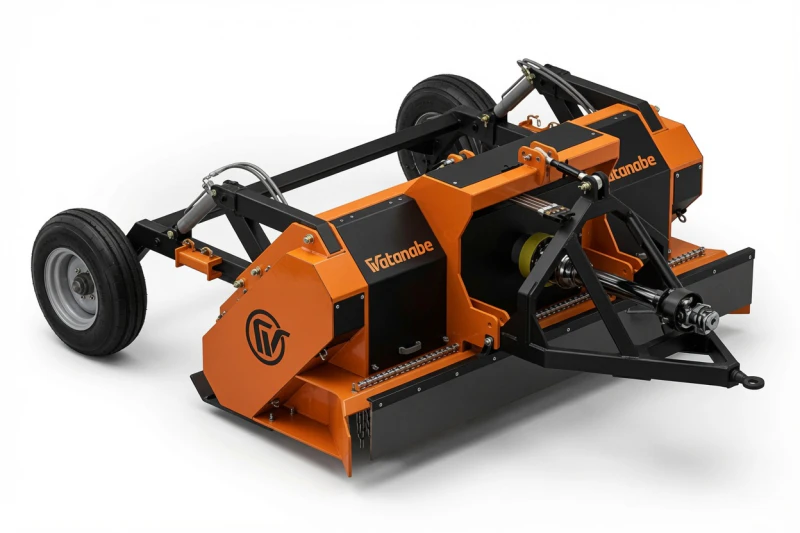
Method 1: Rock Raking — Windrow and Remove Surface Stones
A rock rake (also called a stone windrower or landscape rake) is a tractor-mounted implement with heavy-duty tines that comb through the top 15 to 25 cm of soil, gathering surface and shallow-subsurface stones into windrows for later collection. The rake does not crush or bury the stones — it simply concentrates scattered rocks into organized rows that can be picked up by hand, front-loader, or a rock-picking machine.
Rock raking is typically the first step in a multi-pass stone management program. By concentrating scattered stones into windrows, it dramatically reduces the time and effort needed for the subsequent removal step. It is also used as a standalone method on lightly stony land where the stone volume is manageable and manual collection after raking is feasible.
| Best For | Light to moderate surface stone density. Pre-concentration before picking. New land clearing. Sports turf and landscaping preparation. |
| Limitations | Stones remain on the field (in windrows) until collected. Does not address subsurface stones below tine depth. Requires a second operation to remove the windrows. Stones are not destroyed and must be hauled off the field. |
| Tractor Power | From 75 to 100 hp depending on working width (2.4 to 3.6 m typical) |
| Permanence | Temporary. Frost heave and tillage will bring new stones to the surface in subsequent seasons. Raking must be repeated periodically. |
Our Solution: The EW-4000 Rock Rake (3.6 m hydraulic, 100 hp) and the EW-4000T (3.6 m mechanical PTO, 75 hp) are designed for efficient stone windrowing on farms, estates, and construction sites.
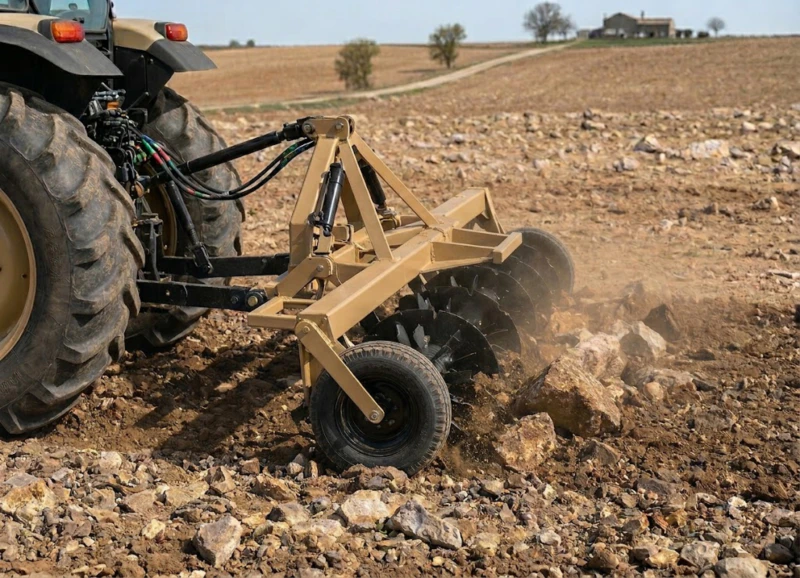
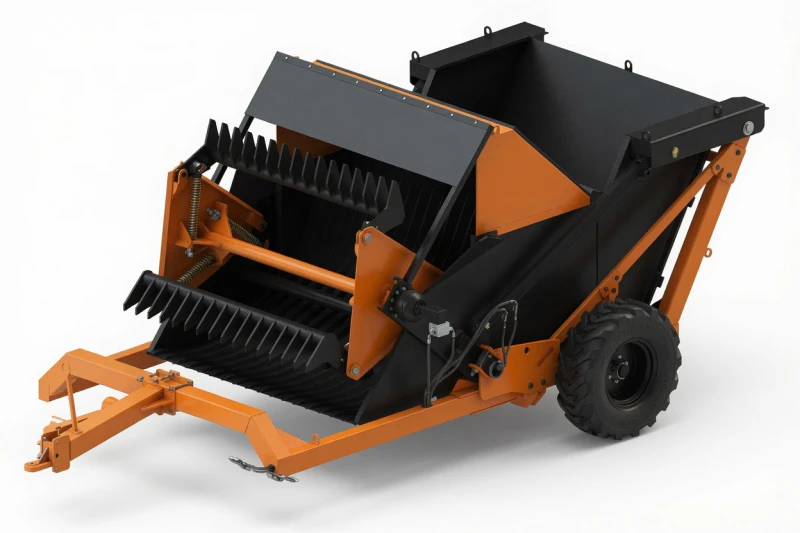
Method 2: Rock Picking — Mechanical Collection and Removal
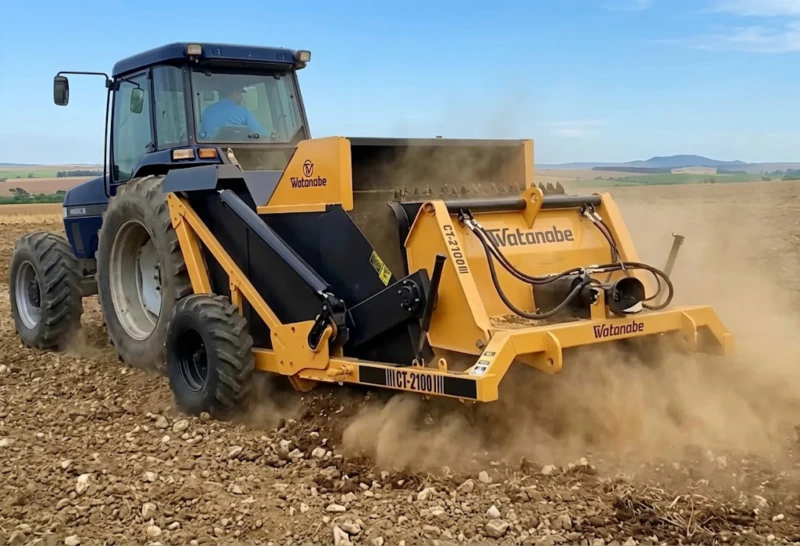
A rock picker (also called a stone picker or stone collector) is a PTO-driven machine that lifts stones from the soil surface, separates them from fine soil on vibrating screens, and collects them into an onboard bunker. When the bunker is full, the operator dumps the stones at the field edge or into a trailer. Unlike a rock rake, a picker physically removes the stones from the field entirely.
Rock picking is the most common stone clearance method worldwide. It has been used for decades, is well understood, and is effective for removing surface and shallow-subsurface stones from ploughed or cultivated land. However, picking has an inherent limitation: it only removes stones that are currently at or near the surface. Deeper stones that are brought up by future ploughing or frost heave must be picked again, season after season.
| Best For | Moderate to heavy surface stone density. Farms with an established annual stone-picking program. Fields where stones must be physically removed (not just relocated or buried). |
| Limitations | Does not address subsurface stones. New stones surface every season through frost heave and ploughing, requiring annual re-picking. Collected stones must be hauled off-field and disposed of. The picking operation itself is relatively slow (3-5 km/h). |
| Tractor Power | From 100 to 130 hp depending on model and soil conditions |
| Permanence | Semi-permanent. Surface is clear after picking, but new stones surface annually. Most farms pick every 1 to 3 years as an ongoing maintenance operation. |
Our Solution: The CT-2100 Rock Picker (2.5 m3 bunker, 110 hp) provides efficient mechanical stone collection with a high-capacity bunker for extended field runs.
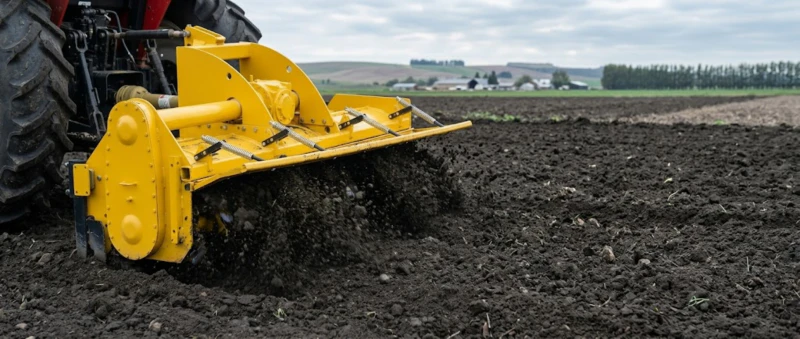
Method 3: Stone Burying — Rotavator (Stone Burier)
A stone-burying rotavator (also called a stone burier, rotary stone burier, or burying tiller) is a heavy-duty PTO-driven rotary cultivator that tills the topsoil while pushing stones and debris downward beneath the cultivated layer. The machine creates a fine, stone-free seedbed on the surface while depositing the stones at the bottom of the tilled profile, typically 20 to 30 cm below the surface.
Stone burying is a popular choice for potato growers because it simultaneously creates a fine tilth seedbed for planting and moves stones out of the root and tuber development zone. The result is a clean planting surface with stones buried below the depth that harvesting equipment reaches. However, the stones are still present in the soil — they are relocated, not removed.
| Best For | Potato and root crop production (clears the ridge zone). Creating fine seedbeds on stony land. Fields where surface appearance matters. Operations that also need tillage. |
| Limitations | Stones are buried, not removed — they remain in the soil. Deep ploughing in future seasons brings buried stones back to the surface. Not a permanent solution. Does not address large boulders that are too big for the rotavator to bury. Higher power requirement than raking or picking. |
| Tractor Power | From 120 to 180 hp depending on working width and soil conditions |
| Permanence | Temporary to semi-permanent. Effective for the current season’s crop, but deep ploughing or natural frost heave may re-expose buried stones in future years. |
Our Solution: The PSW-3200 Rotavator series (3.2 m working width, 140 hp) is specifically designed for stone burying with deep tillage, available in three configurations (standard, extended-frame A, and fertilizer-equipped B).
Method 4: Stone Crushing — Permanent Elimination
A كسارة الحجارة (also called a rock crusher, soil crusher, or stone pulverizer) is the only method that permanently eliminates stones from agricultural land. Instead of raking, picking, or burying the rocks, a stone crusher pulverizes them in place into fine particles (typically less than 50 mm) using a high-speed hammer or pick rotor. The crushed stone fragments are mixed back into the soil, where they improve drainage, aeration, and structural stability. The stones literally cease to exist as obstacles — permanently.
Stone crushing is the most definitive solution to stony land. There is no frost heave recurrence (because the stones are too small to migrate upward), no annual re-picking, no buried stones resurfacing after ploughing, and no stone stockpiles to haul and dispose of. Every stone processed by the crusher is permanently converted into a beneficial soil component.
| Best For | Permanent stone elimination. Land reclamation. Road subgrade preparation. Fields with recurring stone problems despite years of picking. High-value crop land where stone-free conditions are critical (potatoes, vegetables, sports turf). |
| Limitations | Higher tractor power requirement (180-230+ hp). Tungsten carbide hammers are a wear item requiring periodic replacement. Not suitable if stones must be physically removed from the field (e.g., for sale as aggregate). Slowest working speed of the four methods (3 km/h). |
| Tractor Power | From 180 hp (2.4 m width) to 230+ hp (3.0 m width) |
| Permanence | PERMANENT. Crushed stones cannot resurface, cannot heave, cannot damage equipment. One-time treatment lasts the lifetime of the farm. |
Our Solution: The THOR 2.4 Stone Crusher (2.4 m, 180 hp) and THOR 3.0 Stone Crusher (3.0 m, 230 hp) pulverize stones up to 400 mm into particles below 50 mm with tungsten carbide hammer rotors and hydraulic cab-controlled output size adjustment.
Head-to-Head Comparison: All 4 Methods
| Criteria | Rock Raking | Rock Picking | Stone Burying | Stone Crushing |
|---|---|---|---|---|
| Permanence | Temporary | Semi-permanent | Temporary | Permanent |
| Stone Disposal | Required | Required | None (buried) | None (crushed) |
| Annual Repeat? | Yes | Every 1-3 years | Seasonal | No — once only |
| Min. Tractor Power | 75 hp | 110 hp | 140 hp | 180-230 hp |
| Working Speed | 5-10 km/h | 3-5 km/h | 2-4 km/h | 3 km/h |
| Soil Improvement | None | None | Fine seedbed | Drainage + structure |
| Haulage Cost | High | High | None | None |
| Lifetime Cost | High (recurring) | High (recurring) | Medium (recurring) | Lowest (one-time) |
Which Method Should You Choose?
The right choice depends on your specific situation. Here is a practical decision framework:
|
Choose Rock Raking if… You have light surface stone density, need to prepare land quickly for the current season, plan to follow with a rock picker for removal, or are clearing landscaping and construction sites. Budget-friendly first step. Best combined with picking as a two-step system. |
|
Choose Rock Picking if… You need stones physically removed from the field (not just buried or crushed). You have an established annual or biennial picking program. You want to sell the collected stone as aggregate or use it for farm tracks. Moderate stone density where annual maintenance is acceptable. |
|
Choose Stone Burying if… You grow potatoes or root crops and need a clean, fine seedbed above the stone zone. You want to combine stone management with tillage in one operation. Moderate stone density. You do not plough deeper than the burying depth in subsequent seasons. |
|
Choose Stone Crushing if… You want a permanent, one-time solution. You are tired of the annual picking cycle. You have 180+ hp available. You want to improve soil drainage and structure. You farm high-value crops where stone damage is costly. You are reclaiming new land, improving road subgrade, or rehabilitating mine sites. The long-term cost savings justify the higher initial investment. |
Combining Methods for Maximum Efficiency
In practice, many farms use two or more methods together in a planned workflow:
| Rake + Pick | First pass with a rock rake to windrow scattered stones, then a rock picker to collect the concentrated windrows. The raking step dramatically speeds up the picking operation by eliminating the need for the picker to search for scattered stones. |
| Rake + Crush | First pass with a rock rake to windrow surface stones, then a stone crusher to process the concentrated windrows. This maximizes the crusher’s throughput by concentrating material, reducing the total area the crusher must cover. |
| Crush + Rotavator | First pass with a stone crusher to eliminate large surface and subsurface stones, then a rotavator to create a perfectly fine seedbed from the crushed material. This produces the highest-quality potato planting surface achievable. |
| Pick + Crush (progressive) | Use a rock picker annually for immediate surface clearance, then invest in a stone crusher for a one-time permanent treatment when the farm budget allows. The crusher eliminates the ongoing need for picking entirely. |
Frequently Asked Questions
|
Q1: Which method is cheapest per hectare? Rock raking has the lowest single-pass cost. However, when you factor in the repeated annual cost over 10 to 20 years, stone crushing has the lowest lifetime cost because it is a one-time permanent treatment with no recurring expense. |
|
Q2: Can I crush stones on rented land? Yes, and it often makes economic sense even on rented land if the lease is long enough (5+ years) for the crush-once savings to exceed the annual picking costs you would otherwise incur. The improved soil condition also supports higher crop yields for the remaining lease term. |
|
Q3: Do crushed stones damage drainage? No. Crushed stone particles actually improve soil drainage. The angular fragments create pore spaces that enhance water infiltration and reduce waterlogging. Many farmers report improved drainage after crushing, particularly on heavy clay soils where the added stone fraction breaks up the clay structure. |
|
Q4: How deep do the stones need to be to stop causing problems? For general arable farming, stones below 25 to 30 cm rarely cause equipment damage. For potato production, stones below 20 cm (below the typical ridge depth) are usually not harvested. For sports turf and landscaping, the top 10 to 15 cm must be completely stone-free. Only stone crushing eliminates stones at all depths permanently. |
|
Q5: What size stones can each method handle? Rock rakes handle surface stones of virtually any size. Rock pickers typically handle stones from 50 mm to 500 mm. Stone burying rotavators work with stones up to about 200 mm. Stone crushers process stones from surface level up to approximately 400 mm diameter in a single pass. |
|
Q6: Can I hire (rent) stone clearance equipment instead of buying? In many regions, agricultural contractors offer stone raking, picking, and crushing as a per-hectare service. This is a practical option for one-time land clearance projects. For ongoing annual stone management, purchasing is usually more economical over 3+ years. |
|
Q7: What happens to stones picked and collected? Collected stones are typically dumped at the field edge, used for farm track construction, sold as aggregate or landscaping material, or disposed of in designated areas. This creates an ongoing haulage and disposal cost that stone crushing eliminates entirely. |
|
Q8: Is stone crushing noisy? Stone crushers generate significant noise (comparable to other heavy PTO implements). Operators should wear hearing protection. The noise is comparable to a large rotary mower or forestry mulcher. It is an outdoor operation and typically does not create a disturbance beyond the immediate field area. |
|
Q9: How do I know which method my farm needs? Contact our technical team with details of your stone density, soil type, crop type, tractor power, and farm area. We will recommend the most cost-effective approach — whether a single method or a combined workflow — based on your specific situation. |
|
Q10: Do you supply all four types of stone clearance equipment? Yes. We manufacture and export the complete range: rock rakes (EW-4000), rock pickers (CT-2100), stone burying rotavators (PSW-3200), and stone crushers (THOR 2.4 and 3.0). All are available with factory-direct pricing and worldwide delivery. |
Not Sure Which Stone Clearance Method Is Right for Your Farm?
Every farm’s stone problem is different. Send us details of your situation — stone size, density, soil type, crop plan, tractor power, and total area — and our engineering team will recommend the most effective, cost-efficient solution for your specific operation. No obligation, no charge for the consultation.
|
Free Assessment Send photos, get recommendations |
Compare Pricing All 4 equipment types quoted |
Become a Dealer Full stone management range |