Protection That Starts Before the Sprout Reaches the Surface
The most dangerous period for a potato plant is the first 4 to 6 weeks after planting — when the seed tuber is sprouting underground, the young roots are developing, and the emerging shoot is pushing toward the surface. During this vulnerable window, soil-dwelling pests — wireworm, Colorado beetle larvae, cutworms, aphids colonizing the base of the stem — can destroy the sprout, sever roots, or transmit virus before the plant ever breaks the surface. By the time the damage is visible above ground, the yield loss is already locked in.
Traditional crop protection waits until after emergence to react: scout the field, identify the pest, decide on a product, schedule a spray pass, and apply. By then, 2 to 6 weeks of unprotected growth have passed — the exact window when the plant is most vulnerable. In-furrow insecticide application eliminates this gap entirely by placing a protective barrier around the seed tuber at the moment of planting. The plant is protected from day one, underground, before any pest can establish.
This article analyzes the full economics of in-furrow application: what it costs, what it saves, what it replaces, and under what conditions it delivers the strongest return on investment.
How In-Furrow Application Works
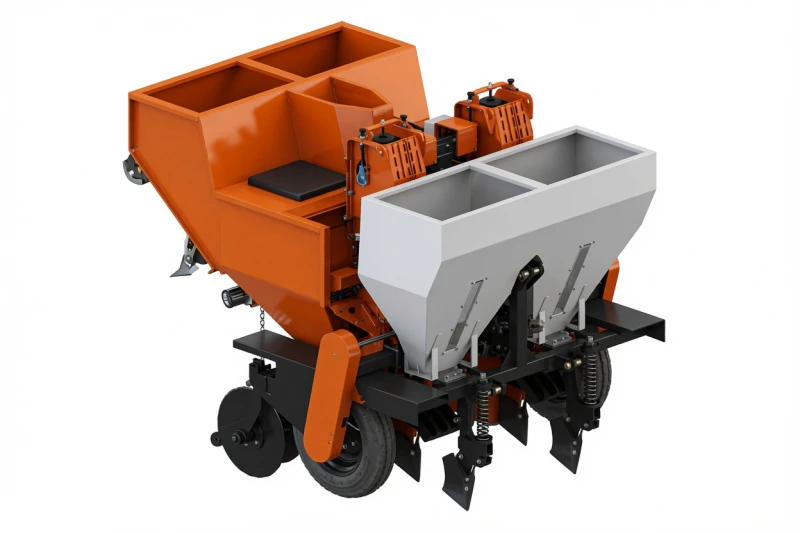
Modern potato planters — including all models in our PANTHER and PAI range — carry onboard liquid tanks (200 to 600 L capacity) connected to precision nozzles positioned at the furrow opener. As each seed tuber is placed in the furrow, the nozzles simultaneously spray a measured dose of liquid insecticide directly onto and around the tuber before the closing discs cover it with soil.
The result is a concentrated zone of active ingredient surrounding each seed tuber in the soil, providing a chemical barrier that soil-dwelling pests must pass through to reach the sprouting plant. The insecticide is not on the soil surface where it would be exposed to UV degradation and rainfall wash-off — it is in the root zone, exactly where the pests feed, protected from the elements, and active for the full critical establishment period.
| Application point | Directly in the planting furrow, at seed tuber depth (5-10 cm below ridge surface) |
| Timing | Simultaneous with seed placement — zero delay between planting and protection |
| Coverage | Concentrated around each individual tuber — not broadcast across the entire field surface |
| Duration | Typically 4 to 8 weeks depending on product and soil conditions — covering the full critical establishment window |
| Separate field pass? | No — happens during the planting pass with zero additional time, fuel, or labor |
Target Pests: What In-Furrow Application Protects Against
|
Wireworm (Agriotes spp.) The single most damaging soil pest for potatoes worldwide. Wireworm larvae live in the soil for 3 to 5 years, feeding on tubers by boring entry holes that cause cosmetic damage (downgrading ware to processing), enable secondary rot, and reduce marketable yield by 5 to 25 percent on infested fields. In-furrow treatment creates a lethal zone that wireworm must pass through to reach the tuber — the most effective placement for this soil-dwelling pest. |
|
Colorado Potato Beetle (Leptinotarsa decemlineata) Adults overwinter in the soil and emerge in spring to colonize new potato growth. Larvae defoliate the canopy, reducing photosynthetic capacity and yield. Systemic in-furrow insecticides are taken up by the plant roots and distributed through the foliage, providing systemic protection against both larvae and adults for the first 4 to 6 weeks — the critical window before foliar sprays are typically applied. |
|
Aphids (Myzus persicae, Macrosiphum euphorbiae) Aphids transmit Potato Virus Y (PVY) and Potato Leafroll Virus (PLRV) — the two most economically damaging potato viruses. Systemic in-furrow products protect emerging plants against early-season aphid colonization, reducing virus transmission during the critical first 4 to 6 weeks when infection causes the greatest yield loss. This is especially valuable for seed potato production where virus-free status determines the entire crop’s value. |
|
Cutworms and Soil Grubs Cutworm larvae sever young potato stems at or below the soil surface, killing individual plants and creating gaps in the stand. In-furrow treatment protects the stem base during the vulnerable establishment period. Stand losses from cutworm can reach 5 to 15 percent on unprotected fields in high-risk regions. |
The Economics: In-Furrow vs. Foliar Spray Programs
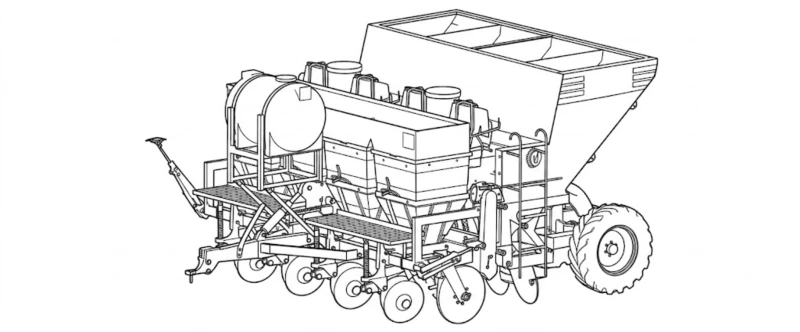
The financial case for in-furrow application rests on four economic pillars: reduced spray passes, lower total product volume, prevented yield loss, and eliminated application labor.
| Cost Factor | In-Furrow at Planting | Foliar Spray Program |
|---|---|---|
| Timing of first protection | Day 0 (at planting) | Week 3-6 (post-emergence) |
| Additional field passes | Zero (part of planting pass) | 1-3 dedicated spray passes |
| Fuel for application | Zero additional | Sprayer fuel × 1-3 passes |
| Application labor | Zero (planter operator does it) | Spray operator × 1-3 passes |
| Treated area | Furrow zone only (~30% of surface) | 100% of field surface |
| Product volume per hectare | Lower (concentrated placement) | Higher (full-surface coverage) |
| UV/rain degradation | None (buried in soil) | Yes (surface exposed) |
| Soil compaction from application | Zero additional | 1-3 extra tractor passes on crop rows |
| Unprotected window (yield risk) | Zero days | 21-42 days |
The Yield Protection Value: What Unprotected Weeks Cost You
The 3 to 6 weeks between planting and the first foliar spray represent an unprotected window during which soil pests feed freely on the developing plant. The economic impact of this window depends on pest pressure:
| Pest Pressure Level | Without In-Furrow | With In-Furrow |
|---|---|---|
| Low (occasional pests) | 0-3% yield loss | Protected — near zero loss |
| Moderate (regular presence) | 5-10% yield loss | Protected — under 2% loss |
| High (infested fields) | 10-25% yield loss | Protected — under 5% loss |
| Seed potato (virus vector risk) | Virus infection → crop declassified | Early aphid suppression → crop protected |
For seed potato growers: In-furrow insecticide is not optional — it is essential. Early-season aphid-transmitted virus infection can declassify an entire seed crop from certified seed to ware or feed grade, destroying the premium value that makes seed production profitable. The cost of in-furrow treatment is negligible compared to the value at risk from a single virus infection event.
When In-Furrow Application Delivers the Strongest ROI
|
Fields with wireworm history If you have ever seen wireworm holes in harvested tubers, the field has an established wireworm population that will persist for years. In-furrow treatment is the highest-ROI intervention — far more effective than surface sprays against a pest that lives and feeds exclusively in the soil. |
|
Fields following grassland or pasture Wireworm populations build up under long-term grassland. Fields converted from pasture to potatoes carry extremely high wireworm risk for the first 3 to 5 years. In-furrow treatment is strongly recommended for all potato crops following grass in the rotation. |
|
Seed potato production Seed crops demand zero virus infection. Early aphid suppression via systemic in-furrow treatment is the most cost-effective insurance against virus-related crop declassification. The treatment cost is a fraction of a percent of the seed crop’s total value. |
|
Regions with Colorado beetle pressure Systemic in-furrow products provide 4 to 6 weeks of beetle larval suppression before the first foliar spray is needed. This delays or eliminates the first 1-2 foliar spray passes, reducing spray cost and slowing the development of beetle resistance to foliar products. |
|
Large farms where spray logistics are complex On farms over 100 hectares, scheduling and completing early-season spray passes across the entire area within the narrow post-emergence window is logistically challenging. In-furrow application eliminates this scheduling pressure by pre-treating every hectare during planting — the one operation that must cover the entire farm regardless. |

Equipment: In-Furrow Capability Across Our Planter Range
| Planter | Rows | Insecticide Tank | Ha per Fill (est.) | Best For |
|---|---|---|---|---|
| PAI-2100 | 2 | 200 or 300 L | 4-6 ha | Smallholder, 10-40 ha |
| PANTHER 2-Row | 2 | 200 or 300 L | 4-6 ha | 20-80 ha |
| PANTHER 3-Row | 3 | 300 L | 5-8 ha | 40-150 ha |
| PANTHER 4-Row | 4 | 300 L | 5-8 ha | 100-300 ha |
| PAI-480-AR | 4 | 300 or 600 L | 8-15 ha | 150-500+ ha |
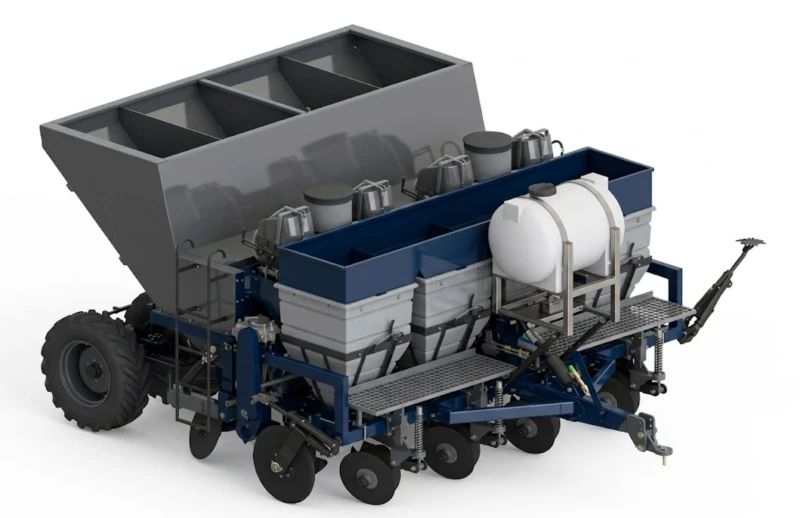
The PAI-480-AR’s optional 600 L tank provides the longest field autonomy — up to 15 hectares per fill — minimizing refilling stops on large operations. All models use the same precision nozzle system for consistent dosing regardless of tank size.
Decision Matrix: When to Use and When to Skip In-Furrow
| Your Situation | Recommendation |
|---|---|
| Field with known wireworm history | Always use in-furrow |
| First potatoes after grassland | Always use in-furrow |
| Seed potato production | Always use in-furrow (virus insurance) |
| Colorado beetle endemic region | Strongly recommended |
| Large farm (100+ ha), tight spray scheduling | Strongly recommended |
| Low pest-pressure field, continuous arable rotation | Optional — consider as insurance |
| Organic production (no synthetic insecticides permitted) | Not applicable (biological alternatives may be used) |
Frequently Asked Questions
|
Q1: Does in-furrow application replace ALL foliar sprays? No. In-furrow treatment covers the first 4 to 8 weeks. Depending on pest pressure, the growing season may require additional foliar spray applications later in the season. However, the first 1 to 2 early-season sprays are typically eliminated or delayed, reducing total spray passes and costs. |
|
Q2: What insecticide products work in-furrow? Common in-furrow products include neonicotinoid-based solutions (where legally permitted), diamide-based alternatives, and biological options. Product availability varies by country. Consult your local agronomist or crop protection advisor for registered products in your region. Our planters work with any liquid formulation. |
|
Q3: Does in-furrow treatment slow down planting? No. The insecticide system operates simultaneously with seed placement — it adds zero time per hectare. The only additional time is occasional tank refilling, which coincides with seed hopper refilling in practice. The planting speed is identical whether the insecticide system is active or not. |
|
Q4: Is in-furrow environmentally better than surface spraying? Yes. In-furrow application places a small, concentrated dose in the soil at root depth — below the surface, protected from drift, wash-off, and UV degradation. Surface foliar sprays apply product across the entire field surface, increasing exposure to non-target organisms, run-off into waterways, and atmospheric drift. In-furrow is the most targeted, lowest-impact delivery method for soil pest control. |
|
Q5: What is the typical cost per hectare for in-furrow treatment? Product cost varies by country and active ingredient. However, because the treated zone is only the furrow (approximately 30 percent of the field surface) rather than the full surface, product volume per hectare is typically 40 to 60 percent lower than a full-surface spray at equivalent pest control. The application cost is zero — it is a free addition to the planting pass. |
|
Q6: Can I use the insecticide tank for other liquids? Some growers use the tank system for liquid starter fertilizer, biological inoculants, or anti-fungal treatments instead of or in addition to insecticide. The plumbing and nozzle system handles any compatible liquid product. Consult our technical team for specific product compatibility confirmation. |
|
Q7: Do all your planters come with the insecticide system? Yes. All five models — PAI-2100, PANTHER 2/3/4-Row, and PAI-480-AR — include in-furrow insecticide application capability as standard. Tank sizes vary by model (200 to 600 L). The system can be left empty and inactive on fields where in-furrow treatment is not needed. |
|
Q8: How do I get a planter with in-furrow capability? Contact our team with your hectarage, tractor power, and pest situation. We will recommend the right planter model and tank configuration, and provide factory-direct pricing for the complete planting system. |
Protect Your Crop From Day One — At Zero Additional Cost Per Pass
In-furrow insecticide application costs nothing to apply — it happens during the planting pass you are already making. The only cost is the product itself, at volumes 40 to 60 percent lower than surface spraying. The yield protection it provides is worth many times the product cost on any field with soil pest pressure. Every planter in our range includes the system as standard, at factory-direct pricing.
|
Planter Quote All models with in-furrow |
Pest Assessment Advice Which fields need treatment |
Dealer Inquiries Full planter range |