The Harvest Decides Your Profit — and the Machine Decides the Harvest
Every investment you make throughout the potato season — seedbed preparation, stone management, fertilizer, planting, crop protection — culminates in a single operation: the harvest. How you harvest determines how much of your yield reaches market in sellable condition, how much is lost to mechanical damage, and how much labor you need to get potatoes from the ground into storage.
The choice between a potato digger and a potato harvester is not simply a question of budget. It is a decision about labor model, daily throughput, tuber quality, and operational autonomy. A digger is simpler and cheaper, but it leaves potatoes on the ground for manual collection — requiring a picking crew, additional time, and accepting weather exposure. A harvester loads potatoes directly into a trailer — one tractor, one operator, zero manual picking.
This guide compares every aspect of both machine types, including the often-overlooked trailed digger as the middle option, so you can select the harvest machine that matches your farm’s scale, workforce, and profitability goals.
Three Levels of Harvest Mechanization
|
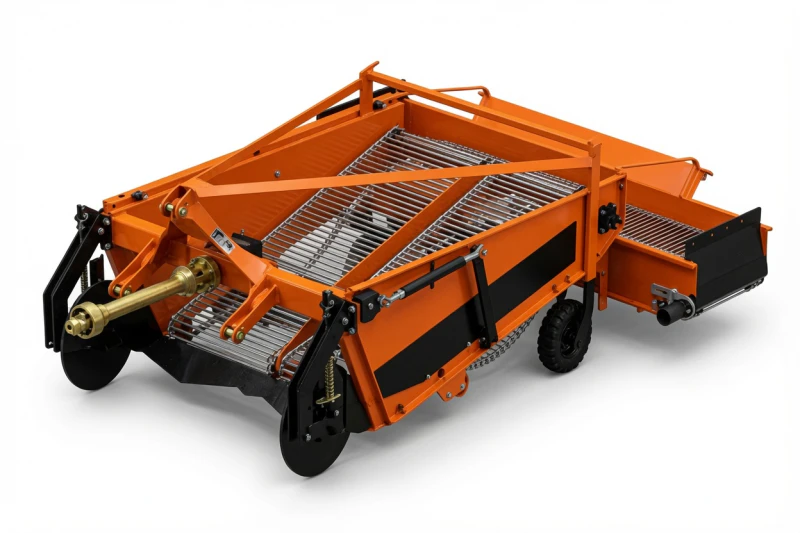
Level 1: Mounted Potato Digger (AWB Series Mounted) What it does: Digs 2 rows, lifts the soil-tuber mass onto a vibrating sieve web, separates soil and debris, and deposits clean potatoes in a windrow on the ground surface behind the machine. The potatoes remain on the field until a separate operation collects them — either by hand, mechanical pickup belt, or front-loader. Key characteristic: The machine does half the job (dig and sieve). You and your crew do the other half (pick up and load). |
|
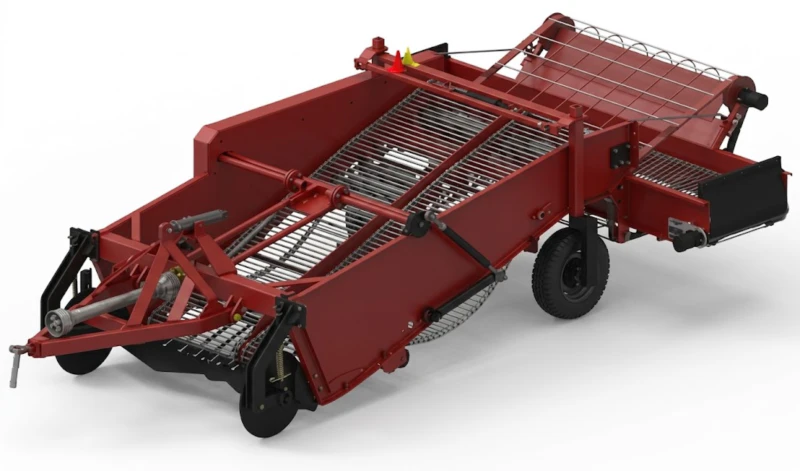
Level 2: Trailed Potato Digger (AWB Series Trailed) What it does: Same dig-sieve-windrow function as the mounted digger, but on its own trailed chassis with independent wheels. The trailed design allows higher working speeds (5-10 km/h versus 3-5 km/h for mounted), better stability in uneven ground, and zero rear-axle loading on the tractor. Key characteristic: Faster and more stable than a mounted digger, but potatoes still land on the ground for manual collection. |
|
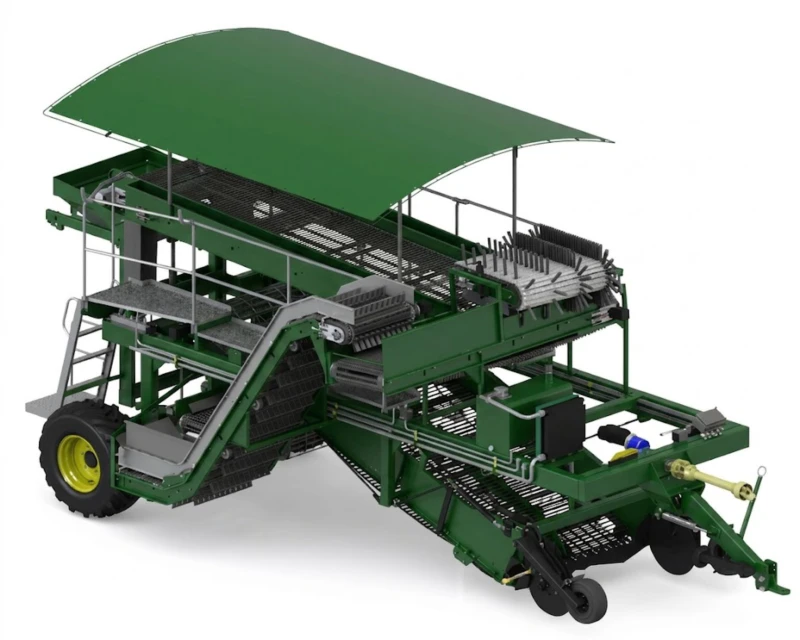
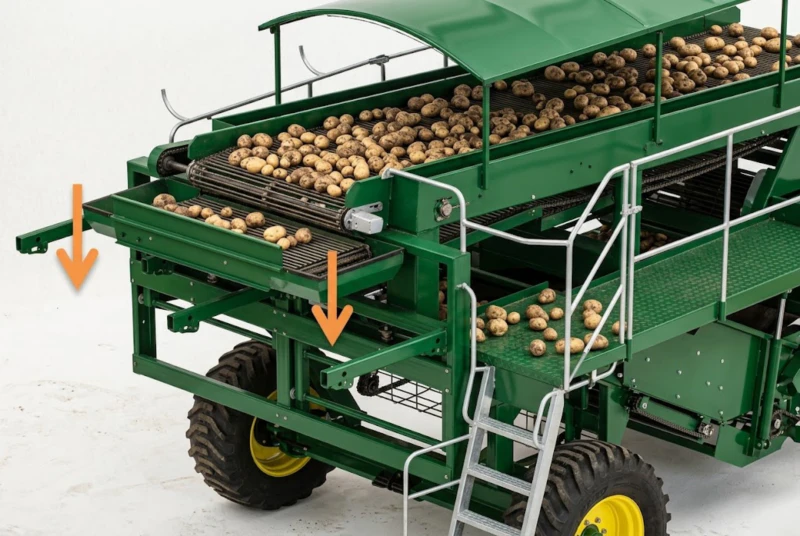
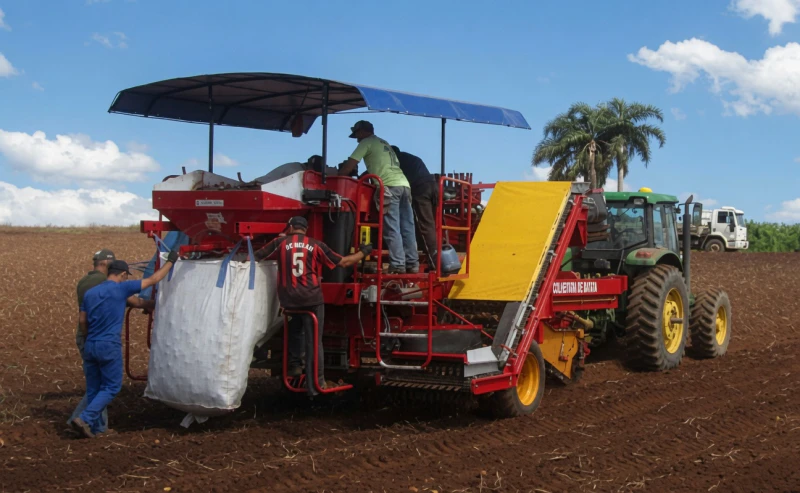
Level 3: Elevator Potato Harvester (CWB-2L) What it does: Digs 2 rows, separates through multiple sieve stages, removes haulm debris, and loads clean potatoes directly into a trailer via a 3.9 m high-reach elevator. No potatoes touch the ground. No manual picking. One tractor, one operator, field-to-trailer in a single pass. Key characteristic: The machine does the entire job. No crew needed. No potatoes on the ground. No weather exposure after digging. |
Complete Head-to-Head Comparison
| Factor | Mounted Digger | Trailed Digger | Elevator Harvester |
|---|---|---|---|
| Output | Windrow on ground | Windrow on ground | Direct to trailer |
| Manual picking needed? | Yes — full crew | Yes — full crew | No — zero crew |
| Working speed | 3-5 km/h | 5-10 km/h | 4-6 km/h |
| Digging capacity (ha/day) | 4-6 | 8-12 | 4-5 |
| HARVESTED ha/day (field to trailer) | Depends on crew speed | Depends on crew speed | 4-5 ha/day (complete) |
| Min. tractor power | 75-95 hp | 95 hp | 100 hp |
| Machine weight | 800-1,350 kg | 1,200-1,650 kg | 3,150 kg |
| Weather exposure risk | High — potatoes on ground | High — potatoes on ground | None — direct to trailer |
| Greening risk (light exposure) | Yes — windrow on surface | Yes — windrow on surface | Minimal — covered in trailer |
| Sieve stages | 1 (basic separation) | 1 (basic separation) | Multiple (thorough cleaning) |
| Elevator (trailer loading) | No | No | Yes — 3.9 m reach |
| Upfront cost | Lowest | Medium | Highest |
| Total harvest cost (machine + labor) | High (cheap machine + expensive crew) | Medium | Lowest on farms over 50+ ha |
The Labor Question: The Hidden Cost That Changes Everything
On paper, a mounted digger is dramatically cheaper than an elevator harvester. But that comparison ignores the single largest harvest cost on most potato farms: the picking crew.
A digger deposits potatoes in a windrow on the ground surface. Someone — or many someones — must pick them up, sort them, and load them into bins or trailers. This requires:
| Picking crew size | 8 to 20+ people per digger depending on yield and speed. Heavy-yielding fields (40+ t/ha) at high digging speed need more pickers to keep up. |
| Crew duration | Full harvest season — typically 3 to 6 weeks depending on acreage and weather. Crew must be available daily, rain or shine, at the field at dawn. |
| Crew reliability | The number-one operational complaint from digger users worldwide. Seasonal labor is increasingly difficult to find, unreliable in attendance, and expensive to manage. A single day with an incomplete crew delays the entire harvest schedule. |
| Crew cost | Wages, transport, supervision, insurance, meals. On farms in regions with high minimum wages, crew costs can exceed the annual depreciation of a harvester within a single season. |
The CWB-2L elevator harvester eliminates the entire picking crew. One tractor, one operator. Potatoes go from ground to trailer without touching a human hand. No crew to recruit, manage, pay, transport, or depend on. The machine is available every day, starts when you start, and never calls in sick.
The Real Comparison: Do not compare machine price vs. machine price. Compare digger price + 5 years of crew costs vs. harvester price + zero crew costs. On most farms over 50 hectares, the harvester is cheaper within 2 to 4 seasons.
Our Complete Harvest Equipment Lineup
Mounted Diggers — AWB-1600 Series (4 Models)
| Model | Weight | HP | Hyd. Valves | Speed | Best For |
|---|---|---|---|---|---|
| AWB-1600 | 800 kg | 75 | 0 | 3-5 km/h | Entry level, 10-30 ha |
| AWB-1600A | 900 kg | 80 | 1 | 3-5 km/h | Standard, 20-50 ha |
| AWB-1600B | 1,100 kg | 85 | 1 | 3-5 km/h | Enhanced, 30-60 ha |
| AWB-1600C | 1,350 kg | 95 | 2 | 3-5 km/h | Professional mounted, 40-80 ha |
Trailed Diggers — AWB-1600 Trailed Series (3 Models)
| Model | Weight | HP | Speed | Best For |
|---|---|---|---|---|
| AWB-1600 AAR | 1,200 kg | 95 | 5-10 km/h | Standard trailed, 50-100 ha |
| AWB-1600 BAR | 1,400 kg | 95 | 5-10 km/h | Enhanced trailed, 60-120 ha |
| AWB-1600 CAR | 1,650 kg | 95 | 5-10 km/h | Professional trailed, 80-150 ha |
Elevator Harvester — CWB-2L
| Model | Weight | HP | Speed | Elevator | Best For |
|---|---|---|---|---|---|
| CWB-2L | 3,150 kg | 100 | 4-6 km/h | 3.9 m reach | 50+ ha, zero crew |
When to Choose Each Machine Level
|
Choose a Mounted Digger (AWB-1600) if: You have under 50 hectares and a reliable picking crew. Your tractor is 75 to 95 hp. Budget is limited and you want the lowest equipment cost. You grow for a local market where tuber appearance is less critical. You are starting out and want to mechanize the hardest part (digging) while labor handles collection. |
|
Choose a Trailed Digger (AWB Trailed) if: You have 50 to 150 hectares and need to cover more ground per day than a mounted digger allows. Your fields are long and benefit from higher speed (5-10 km/h). You want better stability on uneven ground. You still have access to a picking crew but need faster digging to keep the crew continuously supplied. |
|
Choose an Elevator Harvester (CWB-2L) if: You have 50+ hectares and want to eliminate the picking crew entirely. Labor is expensive, unreliable, or unavailable in your region. You want the highest tuber quality (no ground contact, no greening, no weather exposure). You value operational independence — one tractor, one operator, predictable daily output regardless of crew availability. |
5 Signs You Have Outgrown Your Digger
|
Sign 1: You cannot finish harvest before weather deteriorates If your digger-and-crew system consistently fails to complete harvest before autumn rains arrive, you are losing yield and quality to weather. A harvester maintains output regardless of crew issues and eliminates the weather-exposure risk for dug potatoes. |
|
Sign 2: Your crew costs exceed the harvester’s annual depreciation Calculate your total crew cost for one harvest season (wages, transport, meals, supervision, insurance). If this exceeds 20 to 25 percent of a CWB-2L’s purchase price, the harvester pays for itself within 4 to 5 seasons — and every subsequent season is pure savings. |
|
Sign 3: You are losing tubers to greening and damage on the ground Potatoes in a windrow are exposed to sunlight (causing greening), rain (causing disease), and repeated handling (causing bruising). A harvester eliminates all three — potatoes go from soil to dark, covered trailer in seconds. |
|
Sign 4: Crew availability is becoming unreliable Seasonal agricultural labor is declining globally. If you are spending more time recruiting, managing, and replacing pickers than actually harvesting, the problem will only get worse. The harvester makes you independent of the labor market permanently. |
|
Sign 5: You are expanding your potato acreage If acreage is growing, crew requirements grow proportionally — but the harvester handles the additional area without additional labor. The harvester’s cost per hectare decreases as acreage increases, while the crew’s cost per hectare stays constant or increases. |
Why Stone Management Matters Even More at Harvest
Both diggers and harvesters perform dramatically better on stone-free ground. Stones in the ridge zone cause digging share damage, jam sieve webs, bruise tubers during separation, and slow working speed as the operator reduces pace to minimize damage. The THOR stone crusher permanently eliminates these harvest-stage problems, and the CWB-2L’s multiple sieve stages handle a cleaner crop with less wear and higher throughput on crushed land.
Frequently Asked Questions
|
Q1: What exactly is the difference between a digger and a harvester? A digger lifts, sieves, and deposits potatoes in a windrow on the ground — you must then pick them up separately. A harvester lifts, sieves through multiple stages, removes debris, and loads clean potatoes directly into a trailer via an elevator. The harvester replaces the digger plus the entire picking crew plus the loading operation. |
|
Q2: At what farm size does the harvester become more economical? Typically 50 to 80 hectares, depending on local labor costs. At this acreage, the seasonal crew cost approaches or exceeds the harvester’s annual depreciation. Above 80 hectares, the harvester is almost always the more economical choice. Below 30 hectares, a mounted digger with a small crew is usually cheaper. |
|
Q3: Can I start with a digger and upgrade to a harvester later? Yes, and this is the most common growth path. Start with a mounted digger (AWB-1600), progress to a trailed digger (AWB-AAR/BAR/CAR) as acreage grows, then upgrade to the CWB-2L harvester when crew costs or availability justify the investment. Each machine retains resale value. |
|
Q4: Does the CWB-2L harvester damage tubers more than hand picking? On properly prepared, stone-free ground: no. The CWB-2L’s multiple sieve stages handle tubers gently with rubber-cushioned transitions. In fact, tuber quality is often better because there is no ground contact (no mud, no greening from sunlight, no re-handling). On stony ground, both diggers and harvesters produce more damage — which is why stone management is essential regardless of harvest method. |
|
Q5: Why do trailed diggers work faster than mounted diggers? The trailed chassis carries its own weight on independent wheels — the tractor’s rear axle is not overloaded. This allows higher working speeds (5-10 km/h versus 3-5 km/h) without sacrificing digging depth consistency. The trailed design also provides better ground following on uneven terrain. |
|
Q6: What planter matches each harvest level? AWB mounted digger (2-row) pairs with PAI-2100 or PANTHER 2-Row planter. AWB trailed digger pairs with PANTHER 3-Row. CWB-2L harvester pairs with PANTHER 4-Row or PAI-480-AR planter — matching high-throughput planting with high-throughput harvesting. |
|
Q7: How does the 3.9 m elevator work? The CWB-2L’s elevator is a rubber-cushioned conveyor belt that lifts cleaned potatoes from the sieve discharge to a height of 3.9 m, then gently deposits them into a trailer or bulk bin travelling alongside or behind the harvester. The height is sufficient to fill standard agricultural trailers and high-side bins without tipping or compacting the load. |
|
Q8: Can I hire a harvester instead of buying? In some regions, contractors offer CWB-2L harvesting as a per-hectare service. This is an excellent option for farms in the 50 to 80 hectare range where purchasing is not yet justified. Above 80 hectares, owning is typically more economical and guarantees harvest timing independent of contractor availability. |
|
Q9: Do you supply all three harvest levels? Yes. We manufacture the complete range: AWB mounted diggers (4 models, 75-95 hp), AWB trailed diggers (3 models, 95 hp), and the CWB-2L elevator harvester (100 hp). One manufacturer, one support team, factory-direct pricing. |
|
Q10: How do I get a recommendation? Contact our team with your potato hectarage, current crew situation, tractor fleet, and stone conditions. We will recommend the right harvest level and provide factory-direct pricing — including matched planter and seedbed equipment if you want a complete system quote. |
Choose the Harvest Machine That Matches Your Operation — Not Just Your Budget
The cheapest digger and the most expensive harvester both dig potatoes. The difference is what happens next — and what it costs you in crew, time, quality, and stress every harvest season for years to come. We supply all three levels and will recommend the one that delivers the best total harvest economics for your specific situation. Factory-direct pricing on every model.
|
Harvest Equipment Quote Digger or harvester pricing |
Complete System Package Planter + harvester matched |
Dealer Inquiries Full harvest range distribution |