The Yield Gap Between Hand Planting and Machine Planting Is Not a Small Difference
Across potato-growing regions worldwide — from Europe and North America to Sub-Saharan Africa, South Asia, and Latin America — a consistent pattern emerges from field trials, university research, and commercial yield data: farms that switch from manual or semi-manual planting to fully mechanized planting see yield increases of 15 to 30 percent in the very first season, with identical varieties, identical fertilizer programs, and identical soil conditions.
This is not a marketing claim. It is an agronomic reality rooted in physics, biology, and the precision limits of the human hand versus a calibrated machine. A human planter, no matter how skilled, cannot place 40,000 to 60,000 seed tubers per hectare at exactly the same depth, the same spacing, the same orientation, and the same time of day across an entire field. A machine can — and does, every hectare, every season.
This article explains the six specific agronomic mechanisms through which mechanized planting increases yield, quantifies each one, and identifies the equipment that delivers these gains on your farm.
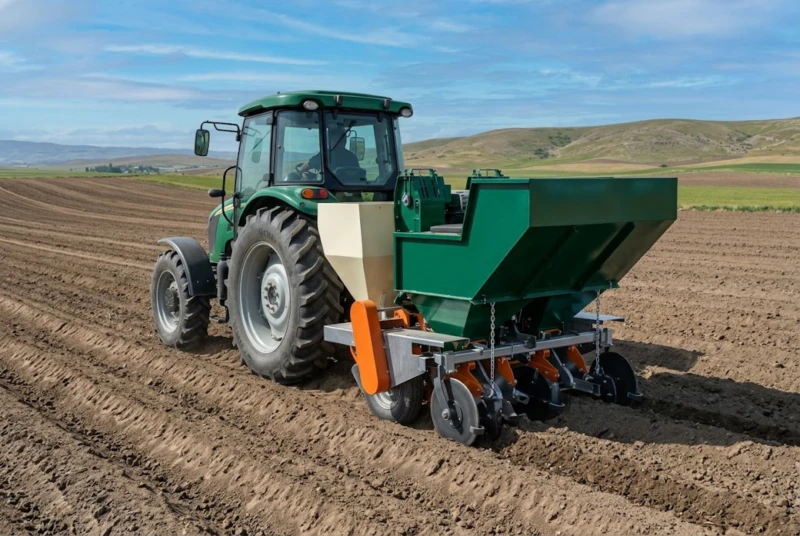
Mechanism 1: Uniform Spacing → Uniform Canopy → Maximum Light Capture
Potato yield is fundamentally driven by light interception. The more sunlight the canopy captures over the growing season, the more photosynthetic energy is available for tuber production. Maximum light interception requires maximum ground cover — and maximum ground cover requires uniform plant spacing.
| Manual planting | Spacing varies from 15 to 45 cm even when targeting 30 cm. Some gaps have no tuber (skips). Some have two (doubles). The canopy has holes (missed plants) and clusters (overcrowded plants). Holes waste sunlight that hits bare soil. Clusters produce undersized tubers from mutual competition. Typical spacing accuracy: 60 to 75 percent within target range. |
| Machine planting | The cup-belt metering mechanism places one tuber per cup at the calibrated spacing — typically 25 to 35 cm depending on variety and market. Skips and doubles are minimized to under 5 percent. The canopy develops uniformly, closes earlier, and intercepts more total sunlight over the season. Typical spacing accuracy: 92 to 98 percent within target range. |
Yield impact: Research consistently shows that uniform spacing alone accounts for 5 to 10 percent of the total yield increase from mechanization. Earlier canopy closure adds 3 to 7 additional growing days of full light interception, translating directly to higher total tuber weight at harvest.
Mechanism 2: Consistent Planting Depth → Uniform Emergence → Synchronized Maturity
Planting depth determines how long it takes each sprout to reach the soil surface. Deeper planting delays emergence; shallower planting accelerates it. When planting depth varies — as it inevitably does with hand planting — emergence is staggered: some plants emerge in 14 days, others in 21 days. This creates a mixed-age canopy where early plants shade late plants, reducing their growth potential.
| Manual planting | Depth varies from 3 to 15 cm depending on operator fatigue, soil condition changes, and visual estimation error. Emergence spreads over 7 to 14 days. Late-emerging plants are shaded, stunted, and produce fewer, smaller tubers. At harvest, the crop is a mix of mature and immature tubers — forcing a compromise harvest date that over-matures early plants and under-matures late ones. |
| Machine planting | Depth is controlled mechanically by the planter’s depth-adjustment system — typically 5 to 10 cm below the ridge crest, consistent within 1 to 2 cm across the entire field. Emergence is concentrated within a 3 to 5-day window. All plants start growing at virtually the same time, develop at the same rate, and reach maturity synchronously. Harvest timing is optimal for every plant. |
Yield impact: Uniform emergence and synchronized maturity contribute an estimated 3 to 8 percent yield improvement. The harvest-timing benefit alone — being able to harvest at the exact optimal moment for the entire crop rather than a compromise — can add 2 to 5 percent to marketable yield.
Mechanism 3: Planting Speed → Entire Farm in the Optimal Window
Potatoes have a narrow optimal planting window — typically 2 to 4 weeks in spring when soil temperature, moisture, and workability align. Every day of delay beyond this window shortens the growing season, reduces total growing degree days, and lowers yield potential.
| Manual planting | A crew of 10 to 15 people can plant approximately 0.5 to 1.0 hectare per day. A 50-hectare farm takes 50 to 100 working days — far exceeding the 2 to 4-week planting window. Fields planted last receive 3 to 6 fewer weeks of growing season than fields planted first. Late-planted fields yield 10 to 25 percent less than early-planted fields of the same variety. |
| Machine planting | A 3-row PANTHER planter covers 6 to 8 hectares per day. The same 50 hectares is planted in 7 to 9 days — well within the optimal window. Every hectare receives the full growing season. No field suffers the yield penalty of late planting. The 4-row PAI-480-AR covers 12 to 15+ hectares per day, completing the same farm in under 4 days. |
Yield impact: On farms where manual planting extends beyond the optimal window, the speed advantage of mechanization contributes 5 to 15 percent of the total yield increase — the largest single factor on large farms with narrow planting windows.
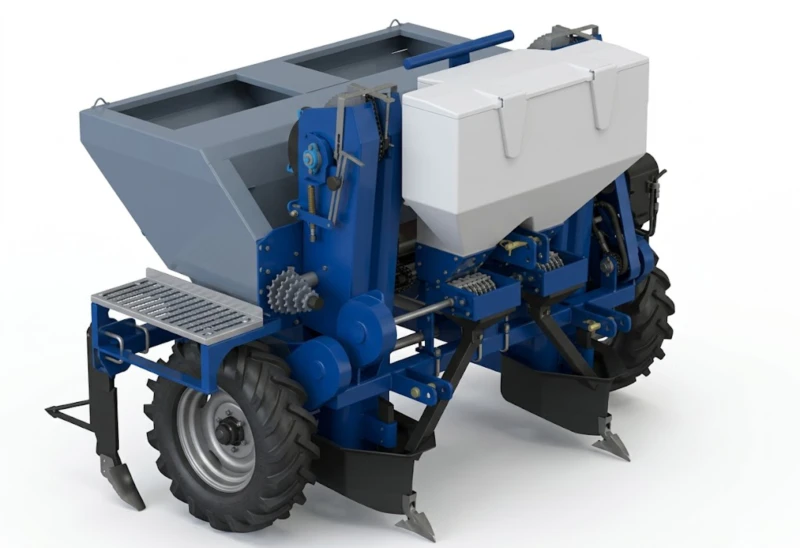
Mechanism 4: Integrated Fertilizer Placement → Immediate Nutrient Access
Modern potato planters carry onboard fertilizer hoppers that place granular NPK in a concentrated band directly alongside or below the seed tuber at planting depth. This puts high-concentration nutrients exactly where the first roots will develop — not scattered across the field surface where only a fraction reaches the root zone.
| Manual planting + broadcast fertilizer | Fertilizer is broadcast on the surface before or after planting. Young roots must search through diluted, unevenly distributed nutrients. Early growth is slow. Canopy closure is delayed. 40 to 50 percent of broadcast fertilizer lands between rows where no roots exist. |
| Machine planting + banded fertilizer | The PANTHER and PAI planters place fertilizer in a band 5 to 8 cm from the seed tuber. First roots contact high-concentration nutrients within days of emergence. Early growth is accelerated. Canopy closure is 5 to 10 days earlier. 20 to 40 percent less total fertilizer is needed for equal or better nutrition. |
Yield impact: Faster early growth from precision-placed fertilizer contributes an estimated 2 to 5 percent yield improvement. Combined with the 20 to 40 percent fertilizer saving, this mechanism delivers both higher yield and lower input cost simultaneously.
Mechanism 5: In-Furrow Insecticide → Early-Season Pest Protection
All PANTHER and PAI planters carry liquid insecticide tanks for in-furrow application at planting. This places a protective barrier around the seed tuber from the moment it enters the ground — before soil-dwelling pests like wireworm, Colorado beetle larvae, and aphids can attack the emerging sprout.
Manual planting systems typically rely on post-emergence foliar sprays, which protect the plant only after damage has already begun. In-furrow application provides pre-emptive, soil-level protection that is more effective and longer-lasting than surface sprays against soil-dwelling pests.
Yield impact: On farms with significant wireworm or soil pest pressure, in-furrow treatment can prevent 3 to 10 percent yield loss from early-season stand reduction and plant damage. On farms with low pest pressure, the impact is minimal but the insurance value remains.
Mechanism 6: Optimal Plant Population → Maximum Yield Potential
Every potato variety has an optimal plant population — the number of stems per hectare that maximizes total tuber yield for a given market (ware, seed, processing). Too few plants waste field space. Too many create excessive competition that produces small, unmarketable tubers.
| Manual planting | Plant population is difficult to control. Skips (missing plants) reduce population below target. Doubles (two tubers in one position) waste seed and create overcrowded positions. Typical achieved population: 70 to 85 percent of target. The 15 to 30 percent shortfall directly reduces yield potential — every missing plant is a missing contribution to total field output. |
| Machine planting | The cup-belt mechanism delivers one tuber per position with under 5 percent skip rate. Achieved population: 95 to 98 percent of target. Every planting position contributes to yield. Seed waste from doubles is minimized. The field produces at or near its biological maximum for the chosen variety and spacing. |
Yield impact: Achieving target plant population adds an estimated 3 to 8 percent to harvestable yield compared to the under-populated stands typical of manual planting.
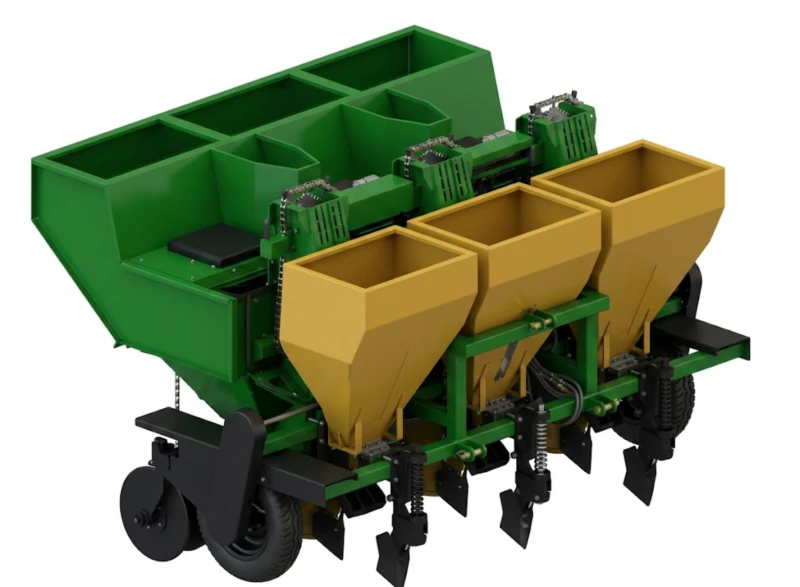
The Cumulative Impact: How 15-30% Adds Up
| Mechanism | Estimated Yield Impact |
|---|---|
| 1. Uniform spacing → full light capture | +5 to 10% |
| 2. Consistent depth → synchronized maturity | +3 to 8% |
| 3. Planting speed → entire farm in optimal window | +5 to 15% |
| 4. Banded fertilizer → immediate nutrient access | +2 to 5% |
| 5. In-furrow insecticide → early pest protection | +0 to 10% |
| 6. Optimal plant population → full field output | +3 to 8% |
| Combined range (not additive — mechanisms interact) | +15 to 30% |
The individual mechanisms are not simply additive — they interact and amplify each other. Uniform spacing enables uniform canopy which enables maximum light capture which enables higher tuber count per plant. Consistent depth enables synchronized emergence which enables optimal harvest timing which reduces storage losses. The total effect is a compounding improvement that consistently delivers 15 to 30 percent more marketable yield.
The Foundation: Seedbed Quality Amplifies Every Mechanism
Every precision advantage of a mechanized planter depends on the seedbed it plants into. The most accurate planter in the world cannot achieve consistent depth if the ridge surface is lumpy and uneven. It cannot maintain target spacing if stones jam the cup-belt. It cannot deliver banded fertilizer if the root zone is compacted.
The full yield benefit of mechanized planting is realized when the planter operates on a properly prepared seedbed:
| Stone-free ground | THOR stone crusher eliminates stones permanently. Zero cup-belt jams. Zero depth inconsistencies from stone deflection. Zero harvest damage from stones in the ridge. |
| Fine, uniform tilth | ERA Rotary Cultivator or PSW-3200 Rotavator creates the 5 to 20 mm aggregate seedbed that enables consistent planting depth and optimal soil-to-seed contact. |
| Well-formed ridges | R-380 / R-580 Furrower or ERA (3-in-1) creates uniform, correctly sized ridges that the planter follows precisely row after row. |
| Pre-applied base fertilizer | ADB-380/480 Applicator or ERA cultivator places base nutrients in the root zone before planting, complementing the planter’s starter dressing for dual-band nutrition. |
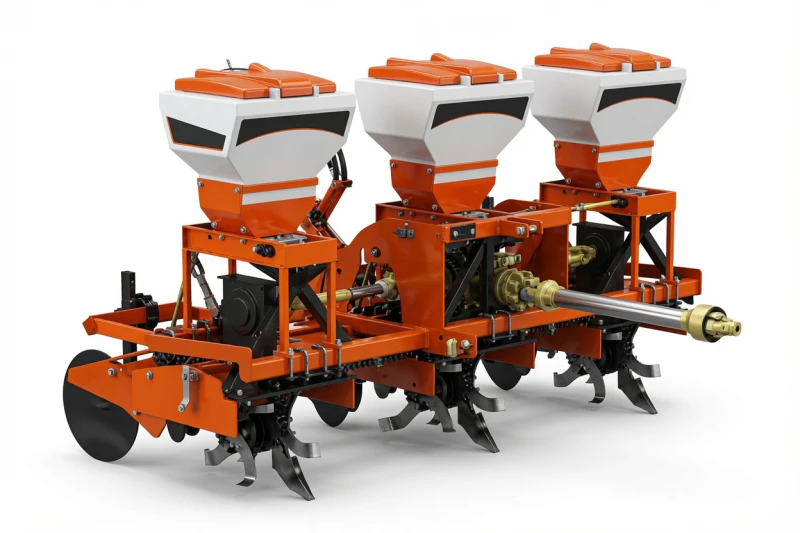
Equipment That Delivers the 15-30% Yield Gain
| Planter | Rows | HP | Ha/day | Fertilizer | Insecticide | Best For |
|---|---|---|---|---|---|---|
| PAI-2100 | 2 | 75 | 3-5 | 200 kg | 200/300 L | Smallholder entry |
| PANTHER 2-Row | 2 | 85 | 4-5 | 680 kg | 200/300 L | 20-80 ha |
| PANTHER 3-Row | 3 | 100 | 6-8 | 600 kg | 300 L | 40-150 ha |
| PANTHER 4-Row | 4 | 125 | 8-10 | — | 300 L | 100-300 ha |
| PAI-480-AR | 4 | 140 | 12-15+ | 2,500 kg | 300/600 L | 150-500+ ha |
Frequently Asked Questions
|
Q1: Is the 15-30% increase realistic for every farm? The magnitude depends on how inaccurate your current manual planting is. Farms with skilled hand planters on small areas may see 15 percent improvement. Farms with large areas where manual planting extends weeks beyond the optimal window typically see 25 to 30 percent. The improvement is largest where the current method is slowest and least precise. |
|
Q2: What is the most affordable entry into mechanized planting? The PAI-2100 (2-row, 75 hp, 350 kg seed, 200 kg fertilizer, 200/300 L insecticide). It delivers all six yield mechanisms at the lowest equipment investment. A 75 hp tractor — which most smallholder farms already own — powers it without an upgrade. |
|
Q3: Does the yield increase pay for the planter? On virtually every farm: yes, within 1 to 3 seasons. A 20 percent yield increase on a 30 t/ha baseline is 6 additional tonnes per hectare. At typical potato prices, the per-hectare revenue gain across even a small acreage exceeds the planter’s annual depreciation within the first season. |
|
Q4: Can I achieve these gains without stone management? Partially. Mechanisms 1, 2, 3, and 6 (spacing, depth, speed, population) work on any ground. But stones reduce the planter’s accuracy by causing cup-belt jams and depth deflections, and they damage tubers at harvest regardless of how well they were planted. For the full 15 to 30 percent gain including harvest quality, stone management is essential. |
|
Q5: How does seedbed quality affect the yield gain? A perfect planter on a poor seedbed achieves perhaps half its potential accuracy. A perfect planter on a perfect seedbed (fine tilth, uniform ridges, stone-free) achieves its full design accuracy. Investing in seedbed preparation — ERA cultivator, PSW-3200 rotavator, R-380 furrower — amplifies every percent of the planter’s yield advantage. |
|
Q6: What seed size works best with mechanized planters? Well-graded seed in the 35 to 55 mm range produces the best cup-belt performance (fewest skips and doubles). Oversized or irregularly shaped tubers increase double-planting rate. Undersized tubers increase skip rate. Investing in properly graded seed complements the planter’s precision for maximum yield benefit. |
|
Q7: Do you supply the complete seedbed-to-planting chain? Yes. Stone crushers, rotavators, ERA cultivators, fertilizer applicators, furrowers, and all five planter models. One manufacturer, one quality standard, factory-direct pricing. The planter’s yield advantage is maximized when every preceding machine in the chain is optimized. |
|
Q8: How do I get started? Contact our team with your current planting method, hectarage, tractor power, and yield targets. We will recommend the planter model that delivers the fastest payback and the highest yield gain for your specific operation. |
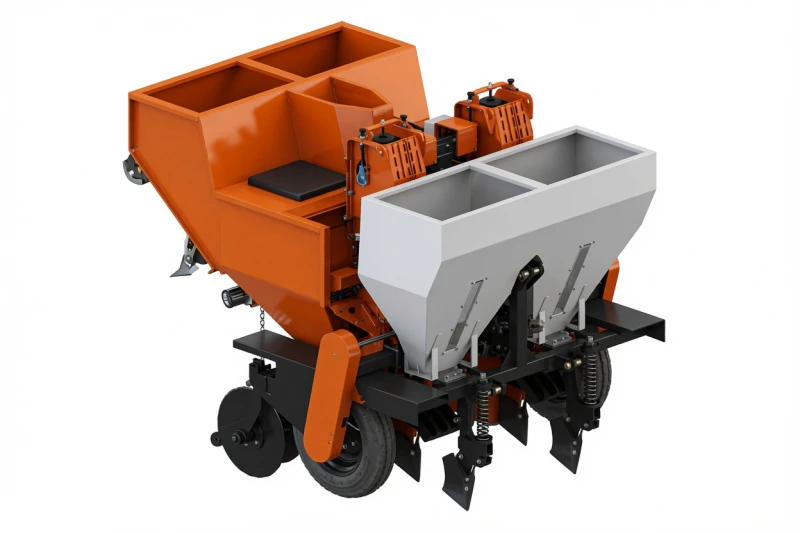
Your Land Can Produce 15-30% More. The Only Missing Piece Is the Planter.
The yield gap between manual and mechanized planting is real, measurable, and available to every potato grower. The investment pays for itself within 1 to 3 seasons through the additional tonnage alone — before counting labor savings, seed efficiency, and fertilizer reduction. We supply planters from 75 hp entry-level to 140 hp industrial-scale, all at factory-direct pricing.
|
Calculate Your Yield Gain Send your current yield data |
Planter Recommendation Matched to your hectares and HP |
Dealer Inquiries Planter product line |