You Are Feeding the Entire Field. Your Potatoes Only Occupy the Rows.
Potatoes grow in rows — typically 75 cm apart. The root system of each plant extends roughly 15 to 25 cm on either side of the stem. Yet broadcast fertilizer spreading distributes nutrients uniformly across the entire field surface — including the 40 to 50 cm of bare inter-row space where no potato roots exist, no nutrient uptake occurs, and every granule of fertilizer lands on soil that contributes nothing to your crop.
That inter-row fertilizer is not just wasted — it is actively counterproductive. It feeds weeds between the rows, leaches into groundwater during rain (creating environmental liability), and represents cash that left your account and entered the soil in a place where it cannot generate return. On a 100-hectare potato farm applying 1,200 kg/ha of NPK by broadcast, roughly 40 to 50 percent of the total fertilizer — hundreds of tonnes per season — lands between the rows where the crop cannot use it.
Banded application changes this equation entirely. Instead of spreading fertilizer everywhere, a banding machine places it only in the root zone — directly where the plant can access it. The result is the same or better crop nutrition with 20 to 40 percent less total fertilizer. This article provides the full technical and financial comparison so you can calculate exactly what banding would save on your farm.
How Each Method Works — The Fundamental Difference
|
Broadcast Spreading A disc or pendulum spreader throws fertilizer granules across the entire field surface in a uniform blanket. Every square meter receives the same amount — row zone, inter-row space, headlands, and tramlines alike. The fertilizer sits on the surface until it is washed or tilled into the soil, at which point it is distributed through the full plough depth. Roots in the row zone must find the nutrients among a diluted, field-wide distribution. Analogy: Watering an entire garden with a sprinkler to feed one row of vegetables. Most of the water goes where nothing is growing. |
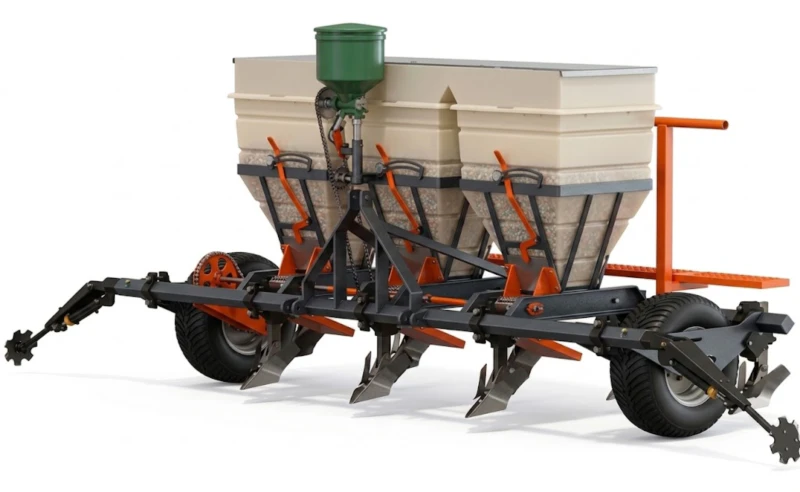
Banded Application A row-unit applicator deposits fertilizer in a concentrated band directly in or beside the potato row — typically 5 to 15 cm below the surface, exactly where the root system will develop. No fertilizer is placed between the rows. The nutrient concentration in the root zone is high, promoting rapid uptake. No nutrients are wasted on bare inter-row soil. Analogy: Using a drip hose that delivers water only to the base of each plant. Every drop reaches a root. |
The Numbers: How Much Does Banding Actually Save?
The savings from banding come from two sources: reduced total fertilizer volume (you apply less because none is wasted between rows) and improved nutrient uptake efficiency (a higher percentage of applied fertilizer is actually absorbed by the crop). Research from potato agronomic institutes consistently reports:
| Metric | Broadcast | Banded | Difference |
|---|---|---|---|
| Fertilizer placed in root zone | 50-60% | 95-100% | +40-50 percentage points |
| Fertilizer volume needed for equal yield | 100% (baseline) | 60-80% | 20-40% less fertilizer |
| Nutrient uptake efficiency (NUE) | 40-55% | 65-80% | +15-25 percentage points |
| Leaching and run-off losses | Higher (surface-applied) | Lower (subsurface placed) | Significant reduction |
| Inter-row weed fertilization | Yes — feeds weeds | No — starves inter-row weeds | Reduced weed pressure |
Practical Example: A farm broadcasting 1,200 kg/ha NPK on 100 hectares uses 120 tonnes of fertilizer per season. Switching to banded application at 20 to 40 percent reduction saves 24 to 48 tonnes of fertilizer annually — at current NPK prices, a substantial financial saving that recurs every season for the life of the equipment.
Beyond Cost Savings: Agronomic Advantages of Banding
The financial savings alone justify the switch, but banding delivers additional agronomic advantages that improve crop performance independently of cost:
|
Faster Early Growth Banded fertilizer is concentrated directly around the seed tuber and emerging roots. Young plants access high-concentration nutrients immediately rather than searching through diluted, broadcast-applied soil. This accelerates early canopy development — critical for yield potential, because the earlier the canopy closes, the more light energy is captured over the season. |
|
Reduced Salt Injury Risk Broadcast application concentrates fertilizer salts unevenly — puddles and low spots accumulate higher concentrations that can damage young roots. Banding places the fertilizer in a defined band slightly offset from the seed, where roots grow toward it gradually rather than being immersed in it. This reduces salt burn risk, especially with high application rates. |
|
Reduced Weed Competition Broadcasting feeds every weed seed in the field alongside the crop. Banding starves inter-row weeds of nutrients, reducing their vigor and competitive ability. Some growers report measurably lower weed populations and reduced herbicide requirements after switching to banded application — a secondary cost saving on top of the fertilizer reduction. |
|
Environmental Compliance Regulations on nutrient run-off, nitrate leaching, and phosphorus loading are tightening globally. Banded application demonstrably reduces the environmental footprint of fertilizer use — placing nutrients subsurface where they are taken up by roots rather than sitting on the surface where they are vulnerable to run-off. For farms in nitrate-sensitive zones or near waterways, banding may be essential for regulatory compliance. |
Equipment for Banded Application: Four Pathways
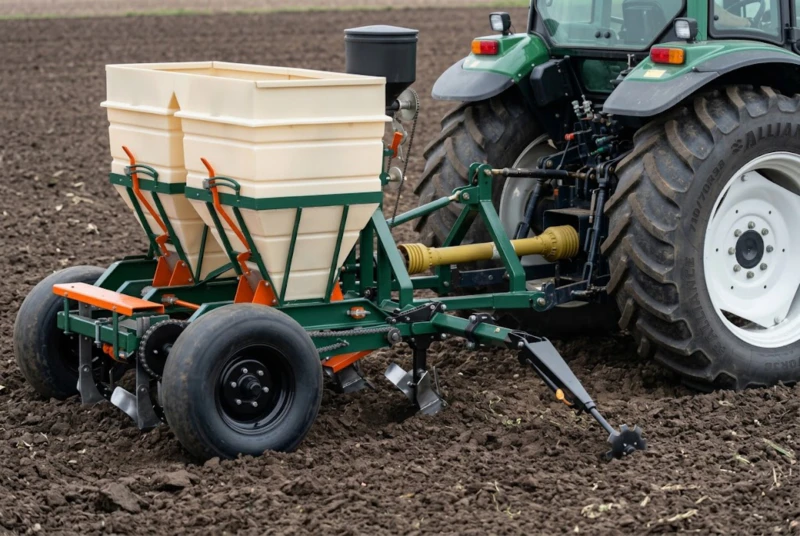
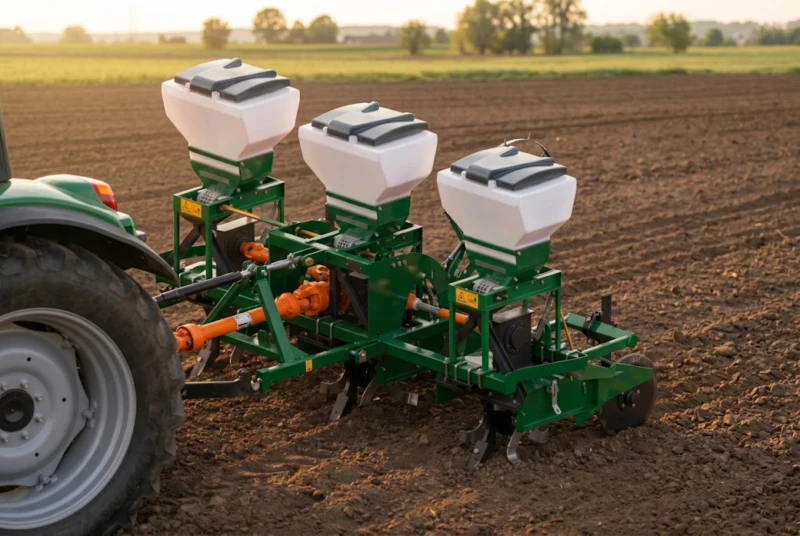
Banded fertilizer application for potatoes can be delivered by four different equipment configurations, each suited to a different workflow and farm scale:
| Equipment | Rows | Capacity | HP | When Applied |
|---|---|---|---|---|
| ADB-380 Applicator | 3 | 1,050 kg (3 x 350 kg) | 75 | Dedicated pre-plant pass |
| ADB-480 Applicator | 4 | 1,400 kg (4 x 350 kg) | 85 | Dedicated pre-plant pass |
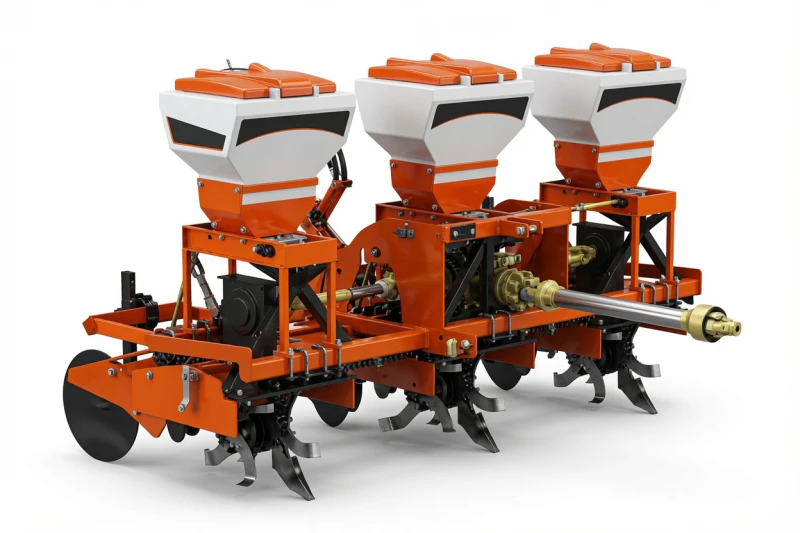
| ERA Rotary Cultivator | 2/3/5 | 125 kg per row | 75-100 | During seedbed prep (3-in-1) |
| PSW-3200B Rotavator | Full width | 2,000 kg | 140 | During seedbed prep |
| PANTHER / PAI Planters | 2-4 | 200-2,500 kg | 75-140 | During planting (starter dose) |
Optimal dual-band strategy: Apply the base dressing (60 to 70 percent of total fertilizer) banded during seedbed preparation with the ERA or ADB applicator. Then apply the starter dressing (remaining 30 to 40 percent) banded alongside the seed tuber at planting with the PANTHER or PAI planter. This dual-band approach places nutrients at two depths in the root zone — below and beside the seed — providing both immediate and sustained feeding throughout tuber development.
Complete Head-to-Head Comparison
| Factor | Broadcast | Banded |
|---|---|---|
| Fertilizer volume per hectare | 100% (baseline) | 60-80% (20-40% saving) |
| Placement precision | Entire surface (wasteful) | Root zone only (precise) |
| Nutrient uptake efficiency | 40-55% | 65-80% |
| Early crop vigor | Standard | Enhanced (concentrated near seed) |
| Weed fertilization | Yes — entire field fed | No — inter-row starved |
| Leaching / run-off risk | Higher (surface-applied) | Lower (subsurface) |
| Application speed | Fast (12+ km/h, wide spread) | Moderate (4-8 km/h, row-by-row) |
| Equipment cost | Lower (basic spreader) | Higher (precision applicator) |
| Total annual cost (equipment + fertilizer) | Higher (cheap machine + expensive fertilizer waste) | Lower (precision machine + 20-40% less fertilizer) |
When Broadcast Spreading Still Makes Sense
To be fair, broadcast spreading retains legitimate uses in specific situations:
|
Liming and pH correction Agricultural lime, gypsum, and soil conditioners need to treat the entire soil volume, not just the row zone. Broadcasting is the correct method for these amendments. For precision lime application on potato land, the DCW 2.2 Binder Spreader provides metered distribution. |
|
Organic manure and compost Bulk organic materials (FYM, slurry, compost) are impractical to band due to volume and particle size. These are broadcast and incorporated by ploughing. Their slow-release nature means broadcast losses are less critical than with soluble chemical fertilizers. |
|
Pre-planting potassium and phosphorus loading On severely deficient soils requiring very high initial P and K loading, a broadcast application followed by plough incorporation can be combined with subsequent banded maintenance applications. This is a transitional strategy for the first 1 to 2 seasons on newly developed land. |
Decision Matrix: Which Method for Which Nutrient?
| Application | Best Method | Reason |
|---|---|---|
| NPK compound (base dressing) | Band | Soluble, valuable, wasted between rows if broadcast |
| NPK starter (at planting) | Band | Must be near seed tuber for immediate uptake |
| Nitrogen side-dress | Band | Mobile nutrient — high leaching risk if broadcast |
| Agricultural lime | Broadcast | Needs to treat entire soil volume for pH correction |
| Organic manure / compost | Broadcast | Bulk material, slow release, impractical to band |
Frequently Asked Questions
|
Q1: Will my potatoes yield less with 20-40% less fertilizer? No. Research consistently shows that banded application at 60 to 80 percent of the broadcast rate produces equal or slightly higher yields because the nutrient uptake efficiency is so much greater. The crop receives the same or more actual nutrition per plant — it is the inter-row waste that is eliminated, not the crop feeding. |
|
Q2: Can I switch from broadcast to banded without changing my total fertilizer program? You can start by banding the same rate you were broadcasting and immediately see improved crop vigor from the higher concentration in the root zone. Then in subsequent seasons, reduce the rate by 10 to 20 percent at a time until you find the optimal rate for your soil and variety — typically landing at 60 to 80 percent of your original broadcast rate. |
|
Q3: Is banding slower than broadcasting? As a standalone operation, yes — a broadcast spreader covers ground faster. But when banding is integrated into the ERA cultivator (combined with tillage and ridging) or the PANTHER planter (combined with planting), the fertilizer application adds zero additional time — it happens simultaneously with operations you are doing anyway. |
|
Q4: What about dual-application — banding base and starter separately? This is the optimal approach for high-yield potato production. Apply 60 to 70 percent of total fertilizer as a base band during seedbed preparation (ERA or ADB applicator). Apply the remaining 30 to 40 percent as a starter band alongside the seed tuber at planting (PANTHER or PAI planter). Two bands at two depths provide both immediate and sustained feeding. |
|
Q5: What is the ADB-380 vs ADB-480 difference? The ADB-380 is a 3-row machine (1,050 kg total capacity, 75 hp). The ADB-480 is a 4-row machine (1,400 kg total capacity, 85 hp). Both have independent row control and identical per-row hopper size (350 kg). Choose 3-row if your planter is 3-row (matched passes), 4-row if your planter is 4-row. |
|
Q6: Can the ERA cultivator apply the same fertilizer volume as the ADB? The ERA’s per-row hoppers hold 125 kg each (vs 350 kg on the ADB). For standard base dressings of 600 to 900 kg/ha, the ERA requires more frequent refilling. For very high base rates or large uninterrupted fields, the ADB-380/480 with its larger hoppers may be more efficient as a dedicated applicator. Many farms use the ERA for base dressing and top up with the planter’s fertilizer system. |
|
Q7: Does banding work with all fertilizer types? Banding works with any free-flowing granular fertilizer: NPK compounds, DAP, MAP, SOP, urea, and blended products. Ensure the granule size is compatible with your applicator’s metering system (typically 2 to 5 mm). Dusty or sticky products may require metering adjustment. Liquid fertilizers require a different delivery system not covered by these applicators. |
|
Q8: What is the payback period for a banding machine? At 20 to 40 percent fertilizer savings on a 100-hectare potato farm, the annual saving is substantial — often enough to pay for the banding equipment within 1 to 3 seasons depending on the machine chosen and current NPK prices. The ERA cultivator pays back even faster because it replaces three machines, not just the broadcast spreader. |
|
Q9: Do you supply all the banding equipment options? Yes. We manufacture the ADB-380 and ADB-480 dedicated banding applicators, the ERA Rotary Cultivator with integrated banding, the PSW-3200B Rotavator with fertilizer bunker, and the PANTHER and PAI planters with planting-time banding. Every pathway to precision fertilizer is available from one manufacturer. |
|
Q10: How do I calculate my specific savings? Contact our agronomic team with your current broadcast rate, fertilizer product, hectarage, and NPK price. We will calculate the estimated banding rate, annual tonnage saving, financial saving, and equipment payback period for your specific operation. |
Stop Wasting Fertilizer Between the Rows
Every season you broadcast is a season you overpay for fertilizer. Banded application equipment pays for itself through the savings it generates — often within the first 1 to 3 seasons. We supply every banding solution from dedicated applicators to integrated 3-in-1 cultivators, all at factory-direct pricing.
|
Calculate Your Savings Send your current rates |
Equipment Recommendation ADB / ERA / planter options |
Factory-Direct Pricing All banding equipment models |